

With over 257,900 active members and 530,100 future candidates globally, the acca qualification remains the definitive gold standard for strategic financial leadership in 2026. You likely recognize the immense career potential this designation offers, yet the prospect of balancing 13 rigorous exams with a full-time career often feels daunting. It's common to feel stuck when comparing different accounting bodies or worrying if the high difficulty of papers like Advanced Audit and Assurance, which recently saw pass rates of 38%, is truly manageable within your current schedule.
This guide eliminates that uncertainty by providing a stable, professional roadmap for your career development. You'll discover the precise exam structures, the updated 2026 fee schedules including the £140 annual student subscription, and the tangible ROI of becoming a member. We provide a clear, logical plan to help you manage the transition from Applied Knowledge to the Strategic Professional level. This ensures your path toward a global finance leadership role is both structured and predictable, giving you the professional safety net you need to succeed in a complex regulatory environment.
Key Takeaways
- Master the 13-paper roadmap of the qualification, progressing through Applied Knowledge, Applied Skills, and Strategic Professional levels to achieve chartered status.
- Identify the significant return on investment provided by the acca designation, including global mobility and access to senior leadership roles across 180 countries.
- Understand the 2026 regulatory landscape, including critical IFRS amendments and updated ethics standards that will influence your examination syllabus.
- Follow a structured four-step plan to initiate your journey, from verifying your eligibility for exemptions to meeting the specific registration deadlines for 2026.
Understanding ACCA: The Global Gold Standard for Accountancy
The Association of Chartered Certified Accountants (ACCA) is a globally recognized professional body that sets the definitive standard for excellence in the financial sector. As of late 2025, the organization supports more than 257,900 active members and 530,100 future members across 180 countries. This massive network provides a professional safety net for those seeking a career that transcends national borders. By 2026, the qualification has evolved to prioritize digital finance, data analytics, and sustainability reporting. This evolution ensures graduates are prepared for a volatile economic environment. Effectively, the acca qualification serves as a bridge between technical accounting and global business strategy.
Chartered Certified Accountant vs. Traditional CPA
The "Chartered" designation carries significant prestige in the UK, Commonwealth, and European markets. It signifies a level of rigorous training that goes beyond standard certifications. While a CPA often focuses on specific national jurisdictions, the acca framework is built for global mobility. This allows professionals to transition between international markets without the need for extensive re-qualification. It's a strategic choice for those aiming for a borderless career. Professionals holding this status are recognized as elite experts who can manage complex cross-border tax and reporting requirements with precision.
The Role of ACCA in the Modern Finance Landscape
Modern finance roles demand more than mere bookkeeping; they require strategic foresight and risk management. ACCA prepares candidates for executive roles like CFO or CEO by integrating ethics and professional judgment into every level of the syllabus. With the adoption of the IESBA Handbook 2025 and new Part 5 standards effective December 15, 2026, the qualification remains at the forefront of global ethics. This focus on integrity provides the professional protection businesses need. You can explore our acca courses to see how this strategic training is structured to meet current requirements. The curriculum now incorporates amendments to IFRS 9 and IFRS 7, which became effective on January 1, 2026, ensuring that students work with the most current regulatory data available.
The ACCA Qualification Structure: A Roadmap to Success
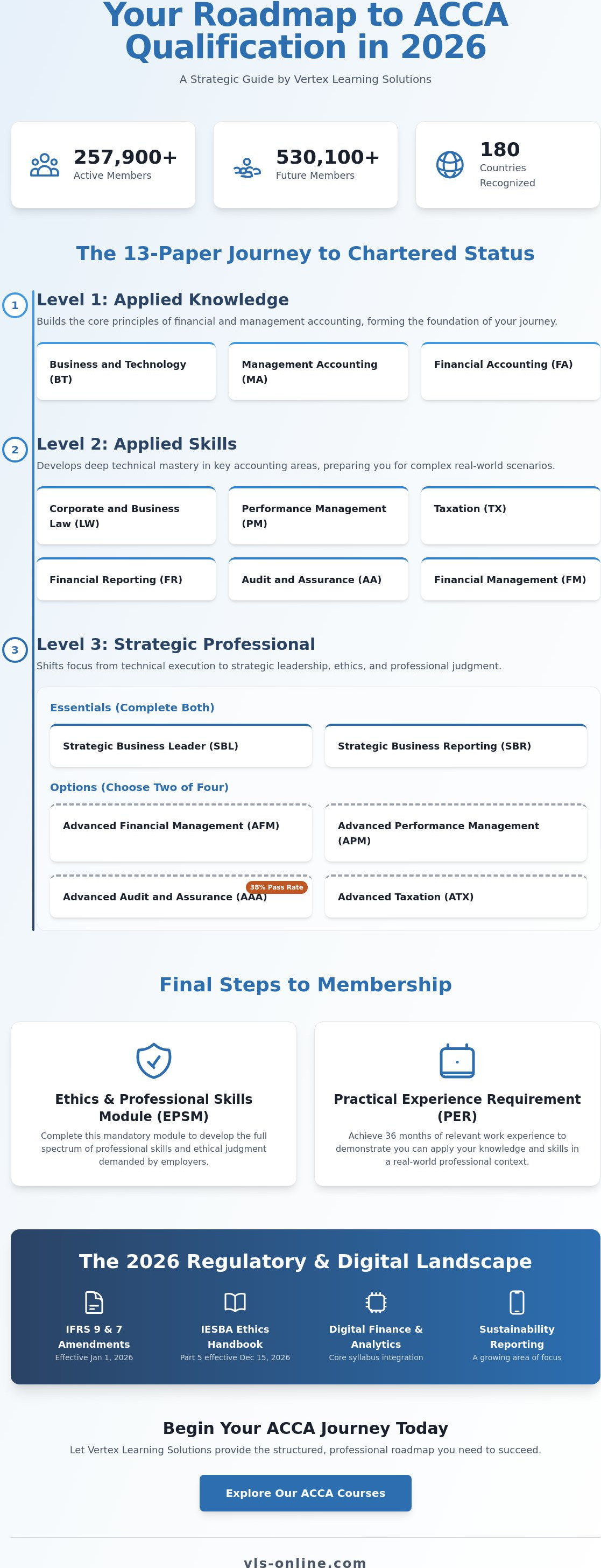
The path to becoming a qualified professional involves a rigorous, three-tier examination process designed to build expertise incrementally. You'll complete a total of 13 papers, though your previous academic background might qualify you for specific exemptions. This structured approach ensures that technical foundations are solidified before you move into complex strategic decision-making. For the most current registration details and official guidance, you should consult the ACCA Global portal.
Applied Knowledge and Applied Skills Levels
The journey begins with the Applied Knowledge level, focusing on the core principles of financial and management accounting. Transitioning into the Applied Skills level requires a deeper technical mastery of subjects like taxation and audit. If you're just starting, we suggest reading our ACCA Applied Knowledge: The Ultimate Guide. Once you've mastered the basics, you can explore the ACCA Applied Skills guide for the next step in your progression.
Strategic Professional: Becoming a Leader
At the final tier, the focus shifts from technical execution to strategic leadership. You'll master Strategic Business Leader (SBL) and Strategic Business Reporting (SBR) while choosing two elective options based on your professional interests. These options include:
- Advanced Audit and Assurance (AAA)
- Advanced Financial Management (AFM)
- Advanced Performance Management (APM)
- Advanced Taxation (ATX)
This level is where you define your specialization. For a deeper dive into these complex papers, reference our guide on Mastering the ACCA Strategic Professional Level.
To finalize your membership, you must also complete the Ethics and Professional Skills Module (EPSM) and fulfill the Practical Experience Requirement (PER). The PER involves 36 months of relevant work experience, ensuring you can apply your theoretical knowledge in real-world scenarios. This combination of exams and practice creates a stable professional foundation. You can find comprehensive support for every stage of this journey through our tailored acca courses.
Why Pursue ACCA? Career Opportunities and ROI in 2026
The return on investment for the acca qualification is measured not just in immediate salary increases, but in long-term strategic security. Professionals who achieve this status often see a significant uplift in earning potential compared to non-chartered peers. This financial gain is supported by the qualification's immense versatility. You aren't restricted to public practice; instead, you can pivot between corporate finance, government roles, or international NGOs. The rigorous nature of the exams, where papers like Advanced Audit and Assurance recently saw pass rates of 38%, acts as a filter for excellence. Employers recognize that an individual who clears these hurdles possesses the resilience and professional judgment required for high-stakes leadership.
ACCA and the Digital Shift
The finance function isn't just about manual entry. By 2026, the syllabus has integrated advanced concepts like Big Data analytics, AI-driven auditing, and Fintech applications. This ensures your skills remain relevant as automation replaces basic bookkeeping tasks. You'll learn to interpret complex data sets rather than just recording them. This proactive approach to technology transforms the accountant into a strategic advisor who can navigate the digital economy with confidence.
Networking and Global Community
Becoming a member grants you entry into an elite global community of over 257,900 professionals. This network provides a massive professional safety net, offering mentorship and career opportunities across 180 countries. Continuous Professional Development (CPD) resources ensure your knowledge of global standards, such as the IFRS 9 amendments effective January 1, 2026, stays current. This commitment to lifelong learning maintains your market value throughout your career.
If you're ready to secure your professional future, you can explore our comprehensive acca training programs to begin your specialization today.
How to Start Your ACCA Journey with Vertex Learning Solutions
Starting your journey toward becoming a chartered professional requires a methodical approach to ensure long-term success. Your first priority is to verify your eligibility and apply for any potential exemptions through the official portal. This step is crucial because it allows you to bypass redundant coursework and focus on the higher-level skills you need. Once confirmed, you'll register as an acca student, which grants you access to the official exam planner and resources. This registration involves a one-off fee of £89 and a £140 annual subscription for the 2026 calendar year.
Selecting a structured learning environment is the next logical phase. By choosing Vertex Learning Solutions, you gain access to a professional protective net that simplifies complex regulations. You'll then need to develop a disciplined routine. We recommend consulting our guide on accounting exam study tips to build a schedule that aligns with the March, June, September, or December 2026 exam sessions.
Why Online Tuition is the Preferred Choice in 2026
Online education has evolved into the standard for busy professionals who require both flexibility and high-level academic rigor. You don't have to sacrifice your current employment to progress. Our model combines recorded lectures with the discipline of live interactive sessions. The "Vertex Advantage" provides direct WhatsApp tutor support and a library of practice questions that mirror the actual exam environment. You can explore our ACCA Courses or secure Full Access to our entire curriculum to begin your studies immediately.
Preparing for Your First Exam: Business and Technology (BT)
For many, the Business and Technology (BT) paper serves as the ideal entry point into the acca qualification. It introduces you to the organizational environment and the essential roles of accounting in a modern business. The BT exam acts as the foundational pillar of professional business acumen, establishing the ethical and operational standards you'll carry throughout your career. Clearing this first hurdle with a score above the 50% pass mark builds the confidence needed for the more technical Applied Skills level.
Securing Your Future in Global Finance
Achieving the acca qualification is a strategic investment that provides a lifelong professional safety net. You've seen how the 13-paper structure builds a bridge between technical accounting and executive leadership, preparing you for the digital demands of the 2026 economy. By completing the Ethics and Professional Skills Module and fulfilling the 36-month Practical Experience Requirement, you join an elite network of 257,900 members recognized in 180 countries. This designation isn't just a certificate; it's a testament to your resilience and professional judgment.
Success requires more than just individual effort; it demands a structured, supported environment. Our programs offer active tutor support via WhatsApp and weekly live classroom simulations that replicate real-world scenarios. We provide exam-focused study notes and interactive questions to ensure your preparation is precise and effective. These tools are designed to simplify the complexity of global standards and provide the intellectual security you need during your studies.
Start your ACCA journey today with expert-led courses at Vertex Learning Solutions. Your path to becoming a global finance leader is clear, and we're here to ensure you navigate it with confidence and professional integrity.
Frequently Asked Questions
How long does it take to complete the ACCA qualification?
Completion of the qualification typically requires three to four years of disciplined study and practical application. Candidates must clear 13 examinations and document 36 months of relevant work experience to achieve full membership. This timeframe ensures a stable transition from technical learning to professional mastery in the workplace. While the pace depends on your individual circumstances, the quarterly exam cycles in March, June, September, and December 2026 provide a predictable structure for your progression.
What are the entry requirements for ACCA in 2026?
Standard entry requires two A-Levels and three GCSEs in five separate subjects, including English and Mathematics. If you don't possess these specific academic credentials, you can begin your journey through the Foundations in Accountancy route. This path provides a professional safety net for those entering the finance sector from diverse backgrounds. It allows you to build the necessary technical foundations before advancing to the higher-level papers.
Can I study ACCA online while working full-time?
You can absolutely study for the acca qualification while maintaining full-time employment. The 2026 digital learning framework is specifically designed to accommodate the schedules of working professionals through flexible online tuition. This approach allows you to apply theoretical concepts to your daily tasks immediately. It reinforces your professional development without requiring you to sacrifice your current career stability.
What is the difference between ACCA and CIMA?
The primary distinction lies in the breadth of the curriculum and your intended career path. The acca syllabus provides a comprehensive framework covering financial reporting, taxation, and audit, which is ideal for diverse roles in public practice or corporate finance. CIMA concentrates more specifically on internal management accounting and strategic business operations. Choosing the right body depends on whether you seek a broad financial leadership role or a specialized management accounting position.
How much does the ACCA qualification cost in total?
The total investment for the qualification is structured across several years of study. For 2026, the initial registration fee is £89, followed by an annual student subscription of £140. Examination fees range from £98 for Applied Knowledge papers to £260 for the Strategic Business Leader exam. These figures represent the official costs paid to the professional body and exclude the fees for structured tuition or the final £326 membership admission fee.