

The final stage of your qualification isn't an accounting exam; it's a leadership assessment. For many candidates, the transition to the ACCA Strategic Professional level marks the point where technical proficiency ceases to be enough for success. You likely recognize that balancing a 45-hour work week with the rigorous demands of these final papers requires more than just late-night study sessions. It's a common struggle to feel overwhelmed by the 20% increase in complexity compared to Applied Skills or the pressure of choosing optional papers that align with your long-term career goals.
We've designed this guide to provide a definitive roadmap that bridges the gap between technical execution and strategic decision-making. You'll discover how to secure your membership by the December 2026 sitting through structured preparation and expert tutor insights. We will analyze the optimal paper combinations, proven time-management frameworks for busy professionals, and the specific leadership mindsets required to satisfy the examiners' highest standards. By the end of this article, you'll have a clear, actionable strategy to navigate your final hurdles with absolute confidence and professional integrity.
Key Takeaways
- Identify the core competencies required to transition from technical reporting to high-level strategic leadership within a global corporate environment.
- Navigate the complexities of the ACCA Strategic Professional level by understanding the synergy between compulsory Essentials and specialized Option papers.
- Adopt an "Active Learning" model that prioritizes practical application and digital platform mastery over passive study techniques.
- Evaluate which specialized career path-ranging from corporate finance to advanced audit-best aligns with your long-term professional objectives.
- Access a structured roadmap and expert London-based mentorship designed to accelerate your journey toward becoming a Chartered Certified Accountant.
What is the ACCA Strategic Professional Level?
The ACCA Strategic Professional level represents the final, most rigorous tier of the qualification journey. It's meticulously designed to transform candidates into "future-ready" finance leaders who can navigate the complexities of global markets with precision. This stage moves beyond basic accounting principles to focus on high-level advisory services, advanced technical expertise, and the integration of professional ethics into every decision. Achieving success here is the definitive gateway to full membership and the right to use the prestigious "Chartered Certified Accountant" title, a designation protected by the Association of Chartered Certified Accountants (ACCA).
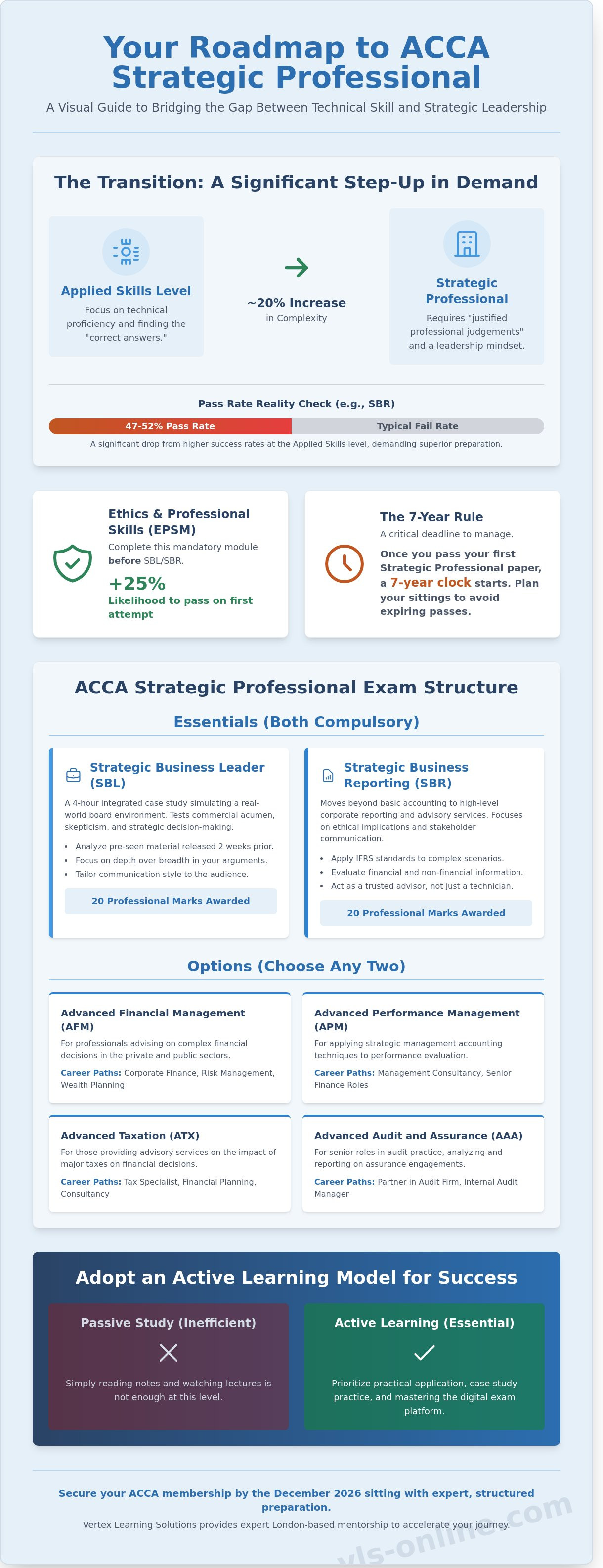
The curriculum for the ACCA Strategic Professional is divided into two distinct categories. Every candidate must pass the two "Essentials" modules: Strategic Business Reporting (SBR) and Strategic Business Leader (SBL). These provide a foundation in corporate reporting and leadership strategy. To complement these, students select two "Options" papers from a choice of four specialized subjects, including Advanced Audit, Advanced Performance Management, Advanced Taxation, or Advanced Financial Management. This structure allows for a tailored professional profile that aligns with specific career trajectories in risk management or wealth planning.
The Transition from Applied Skills to Strategic Professional
The shift from the Applied Skills level to these final papers is often a significant hurdle. Pass rates for papers like SBR frequently hover between 47% and 52%, which is a sharp decline from the higher success rates seen in earlier modules. This occurs because the examiners stop looking for "correct answers" and start requiring "justified professional judgements." You're expected to act as a consultant rather than a student. Additionally, the 7-year rule becomes a critical factor; once you pass your first professional paper, a 7-year clock starts. If you don't finish the level within this window, your oldest professional passes will expire. Planning for the 2026 exam cycle requires a disciplined approach to avoid this professional risk.
Entry Requirements and Prerequisites
Accessing the ACCA Strategic Professional level requires the successful completion of the nine Applied Skills papers or holding equivalent professional exemptions. Beyond technical exams, the Ethics and Professional Skills Module (EPSM) is a mandatory prerequisite for membership. Data from previous exam sittings shows that students who complete the EPSM before attempting SBL or SBR are 25% more likely to pass on their first attempt. The module provides the behavioral framework and commercial awareness needed to handle complex case studies. We recommend finishing this module early to build the professional safeguard necessary for these high-stakes assessments.
The Essentials: Mastering SBL and SBR
The ACCA Strategic Professional journey begins with two compulsory modules that redefine your role from a financial technician to a trusted advisor. SBL and SBR aren't just exams; they're the pillars of your strategic identity. Since the 2023 updates, ACCA has standardized the inclusion of 20 professional marks across these papers, accounting for 20% of the total score. This shift ensures that candidates holding this globally recognized qualification possess the communication and analytical skills required at the board level.
Strategic Business Leader (SBL) Exam Technique
The SBL exam is a four-hour integrated case study that mirrors the complexities of a real-world board environment. Under the 2026 format, you'll analyze pre-seen material released two weeks before the exam to identify risks and opportunities. Success requires more than theoretical knowledge. You must demonstrate commercial acumen by evaluating how a 12% increase in operational costs affects long-term liquidity. Skepticism is equally vital; don't accept management's data at face value without questioning the underlying assumptions. Strategic Business Leader acts as a rigorous simulation of a senior consultancy role where your advice dictates the organization's trajectory.
- Analyze the pre-seen material to understand the industry context before entering the exam hall.
- Focus on the "Professional Skills" marks by tailoring your tone to the specific audience, whether it's a skeptical board or an anxious shareholder group.
- Prioritize depth over breadth; one well-argued point is worth more than three superficial observations.
Strategic Business Reporting (SBR) Deep Dive
SBR moves beyond the mechanics of double-entry bookkeeping to focus on the narrative behind the numbers. Mastering IFRS standards is essential, but you must apply them in an advisory context rather than just calculating balances. Rote memorization fails in SBR because examiners prioritize your ability to explain the impact of a standard on stakeholder perception. For instance, explaining why a change in lease accounting under IFRS 16 affects debt-to-equity ratios is more valuable than the calculation itself.
You'll link financial reporting to ethical dilemmas, ensuring investor needs for transparency are met. This level of strategic risk management is what separates a bookkeeper from a professional accountant. Accountants must act as the ethical compass of the firm, especially when reporting on complex areas like deferred tax or group consolidations. Every report you draft should provide clarity, not just compliance, to ensure the long-term stability of the enterprise.
Choosing Your Options: AFM, APM, ATX, or AAA?
The ACCA Strategic Professional qualification allows you to curate your expertise through two elective papers. This isn't a mere administrative choice; it's a strategic decision that aligns your technical capabilities with your long-term career trajectory. You're building a professional shield of knowledge that defines your value in the global market.
Advanced Financial Management (AFM) serves as the foundation for aspiring CFOs and corporate finance specialists. It focuses on complex investment appraisals, acquisitions, and hedging strategies. Conversely, Advanced Performance Management (APM) suits those dedicated to strategic planning; it offers frameworks to optimize organizational efficiency and management accounting systems. For professionals entering public practice or regulatory environments, Advanced Taxation (ATX) and Advanced Audit and Assurance (AAA) provide the necessary compliance and technical depth.
A Strategic Framework for Paper Selection
Success requires analyzing historical performance data to mitigate risk. In the September 2023 exam session, the AAA pass rate was 34%, while ATX reached 48%. These statistics highlight the rigorous nature of audit papers. Many candidates find success by leveraging the synergy between papers; for instance, the technical reporting standards in SBR comprise nearly 60% of the knowledge required for AAA. Matching your choice to your daily tasks often reduces study time by 20% due to practical familiarity. If you're already performing audit fieldwork, AAA isn't just an exam; it's a validation of your existing skill set.
Specialising in the UK vs. International Markets
Geography dictates your technical focus and your future mobility. The ATX-UK variant is essential for professionals operating within the London financial hub, as it covers specific HMRC regulations and UK-specific tax planning. If your goals involve global mobility, the International versions of AAA and AFM provide a portable skillset recognized in 178 countries. Vertex supports this diversity by offering tailored resources for both UK and International variants. We ensure your ACCA Strategic Professional preparation reflects the specific legal and tax environment of your chosen market. This approach provides a safety net for your professional ambitions, ensuring you're ready for the complexities of regional legislation.
- AFM: Best for treasury, investment banking, and high-level corporate finance.
- APM: Ideal for management consultants and internal performance analysts.
- ATX: Necessary for tax advisors and private wealth managers.
- AAA: The gold standard for external auditors and compliance officers.
Your choice should be a calculated move. It's about finding the intersection between what you enjoy and where the market demands expertise. We provide the structured guidance to make this decision with absolute certainty.
Effective Study Strategies for Professional Success
Success at the ACCA Strategic Professional level demands a transition from passive absorption to active application. Passive learning, such as watching hours of video lectures without engagement, often results in a false sense of competence. Statistics indicate that students who prioritize active question practice within the first 14 days of their study cycle achieve significantly higher consistency in their scores. You need to immerse yourself in the digital environment from the start of your preparation.
Mastering the ACCA CBE platform isn't optional; it's a structural requirement for passing. You must practice your spreadsheet and word processing skills in the exact environment you'll face on exam day. A 12-week study plan provides the necessary structure to cover the syllabus while preventing the cognitive fatigue that leads to burnout. This timeline allows for eight weeks of core learning followed by a rigorous four-week revision phase focused on high-stakes simulation and technical refinement.
The Vertex Method: Tutor Support on Demand
The Vertex Method utilizes dedicated WhatsApp support to bridge the critical gap between lectures and the exam. This real-time access allows you to resolve technical queries instantly, ensuring your momentum remains unbroken during late-night study sessions. Weekly live sessions are essential for dissecting the 2026 syllabus updates, providing the clarity needed for complex regulatory changes. Expert analysis confirms that receiving professional feedback on tutor-marked mocks can increase your pass probability by up to 30% by identifying specific technical gaps that self-marking often misses.
Exam Day Technique for Strategic Papers
Strategic papers require a disciplined "Read, Plan, Write" approach. Many candidates fail because they rush into writing without a structural map, leading to "knowledge dumping" that ignores the specific requirements of the case study. You should allocate at least 15 minutes of a 100-minute question to planning your response. This ensures you effectively capture the 20-mark professional skills requirement, which focuses on skepticism, commercial acumen, and communication. Don't simply state what you know; answer exactly what the examiner asks to secure your ACCA Strategic Professional status.
Secure your professional future by adopting a proven preparation framework. Explore our strategic study programs to ensure your exam success.
Achieving ACCA Membership with Vertex Learning
Reaching the final stage of your qualification requires more than just academic persistence. It demands a structured approach that mirrors the complexity of the global financial market. Vertex Learning Solutions provides this framework by delivering London-based pedagogical excellence to students in over 50 countries. Our instructors bring decades of collective experience from the City of London, ensuring your preparation for the ACCA Strategic Professional exams is grounded in real-world application and technical precision.
The journey to becoming a Chartered Certified Accountant involves more than passing four papers; it's about professional transformation. You must also complete the 36-month Practical Experience Requirement (PER). Vertex prepares you for this by integrating professional ethics and strategic thinking into every module. Our comprehensive packages are designed to reduce study time by an average of 150 hours per level compared to traditional self-study methods, providing a clear return on your educational investment through accelerated career progression.
Why Students Choose Vertex for Strategic Papers
Success at this level depends on mastering the synthesis of complex data. Our recorded lectures provide 24/7 access to expert insights, allowing you to pause and reflect on difficult concepts like consolidated financial statements or risk management frameworks. We replace 800-page textbooks with streamlined, exam-focused notes that target the specific marking schemes used by examiners. You can learn more about our Strategic Business Reporting (SBR) course to see how we simplify complex international standards into actionable knowledge.
Your Next Steps to Qualification
The transition from a student to a member is a definitive career milestone. To begin your final ascent, select your first ACCA Strategic Professional module and review our technical requirements. Most successful candidates follow this structured checklist to ensure they remain on track for the next exam sitting:
- Confirm your exemptions and prior exam status via the ACCA portal.
- Allocate 10 to 12 hours of weekly study time for consistent progress.
- Engage with our mock exam services to test your stamina under timed conditions.
- Document your PER objectives concurrently with your technical studies.
Don't let the complexity of the final level stall your professional growth. Our tutors act as strategic partners, ensuring you meet the rigorous standards of the global accounting profession. Explore our ACCA Strategic Professional packages and start your journey today to secure your future as a qualified leader in finance.
Secure Your Strategic Future in Global Finance
Navigating the final phase of your qualification requires a transition from technical knowledge to executive-level analysis. Success in 2026 hinges on mastering the 4-hour SBL case study and the 100-mark technical syllabus of SBR. By strategically selecting two specialized subjects from the 4 available option papers, you define your professional niche. VLS Online provides the structural safety net necessary to manage this complexity. Our candidates benefit from 24/7 active WhatsApp tutor support and 52 weekly live interaction sessions that bridge the gap between theory and practice. With 100+ hours of recorded lectures and exam-focused study notes, you'll have the tools to master the ACCA Strategic Professional level. You're not just preparing for an exam; you're investing in a professional legacy built on stability and expert insight.
View our ACCA Strategic Professional Exam Packages
Your membership is within reach, and we're ready to help you claim it.
Frequently Asked Questions
How many Strategic Professional exams are there in total?
You must successfully complete four exams to finish this final stage of the qualification. These consist of two mandatory Essentials modules, Strategic Business Leader (SBL) and Strategic Business Reporting (SBR), plus two elective Options chosen from a list of four specialized subjects. This structure ensures you develop a 360-degree view of corporate leadership and financial oversight. Selecting the right combination requires a methodical assessment of your long-term career objectives within the global regulatory framework.
Can I take the Strategic Professional exams before finishing Applied Skills?
You can't attempt these advanced modules until you've cleared or been exempted from all nine Applied Skills papers. ACCA's progression rules mandate a logical sequence to ensure every student possesses the foundational technical knowledge required for high-level strategic analysis. Attempting to bypass this structure would compromise the integrity of your professional development. It's essential to build a stable knowledge base at the lower levels to handle the complexity of the final papers.
What is the 7-year rule for ACCA Strategic Professional papers?
The 7-year rule dictates that you have exactly 84 months to complete all remaining exams once you pass your first ACCA Strategic Professional paper. If you don't finish the level within this timeframe, any passed results for these specific modules will expire and you'll need to retake them. This regulation ensures your professional expertise remains current and aligned with 2024 industry standards. Maintaining a consistent exam pace is a vital risk management strategy for your professional journey.
Which is the easiest ACCA Optional paper to pass?
Pass rates vary between sittings, but Advanced Taxation (ATX) frequently shows higher success figures, often reaching 48% to 52% in recent global results. While some candidates find Advanced Audit and Assurance (AAA) challenging due to its 32% average pass rate, the "easiest" paper is always the one that aligns with your daily professional experience. You should choose your options based on your specific skills in areas like tax compliance or risk management rather than seeking the path of least resistance.
Do I need to complete the Ethics and Professional Skills Module (EPSM)?
Completing the Ethics and Professional Skills Module is a mandatory requirement for membership and it's statistically proven to increase your exam success. Data shows that students who finish the 20-hour EPSM before attempting the ACCA Strategic Professional exams are 25% more likely to pass their papers on the first attempt. This module provides the professional skepticism and ethical framework necessary to navigate complex corporate governance challenges with absolute discretion and integrity.
How long does it take to complete the Strategic Professional level?
Most dedicated professionals complete the four required exams within 12 to 18 months while maintaining their full-time employment. This timeline assumes a disciplined approach of sitting one exam every three months across four consecutive windows. Your individual progression depends on your existing workload and the depth of your strategic planning. Implementing a structured study schedule acts as a protective shield against professional volatility, ensuring steady advancement toward your final qualification.
Can I study ACCA Strategic Professional online while working full-time?
You can certainly balance your professional responsibilities with online study through various approved learning providers. Digital platforms offer the flexibility to access high-level technical content outside of standard 9-to-5 office hours, which is vital for busy tax and audit specialists. Modern e-learning tools provide a secure and structured environment for mastering complex syllabus topics. This method allows you to apply theoretical concepts directly to your daily workplace challenges in real-time.
What is the difference between SBR and the Applied Skills Financial Reporting paper?
Strategic Business Reporting (SBR) shifts the focus from basic technical accounting to the professional application of IFRS standards in complex stakeholder scenarios. While the Applied Skills Financial Reporting paper focuses on the mechanics of preparing accounts, SBR requires you to analyze the ethical and financial implications of reporting decisions within a 100-mark assessment. It's a significant step up that demands a more nuanced understanding of corporate transparency. You'll need to demonstrate high-level professional judgment to succeed.