

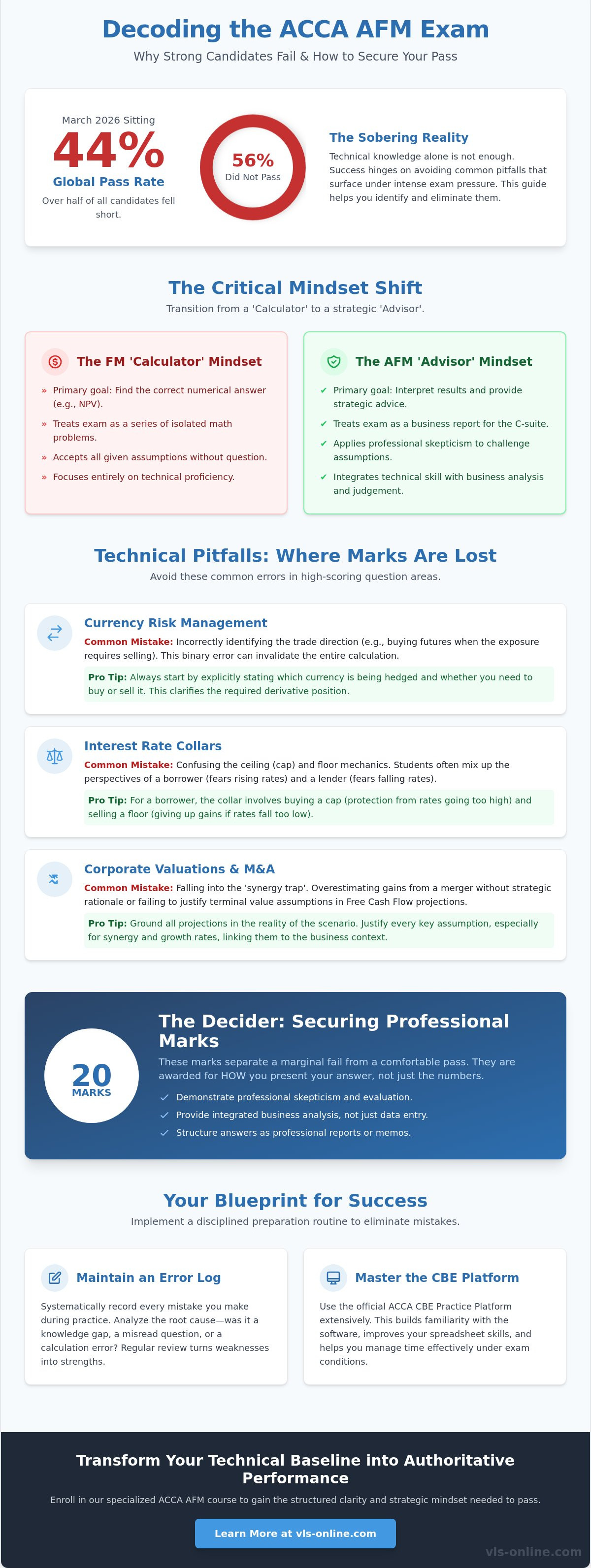
With a pass rate of only 44% in the March 2026 sitting, more than half of candidates are falling short of their goals despite months of rigorous preparation. It's a sobering reality that technical knowledge alone no longer guarantees success, often because of recurring common mistakes in ACCA AFM paper that surface under intense exam pressure. You've likely mastered the mechanics of interest rate swaps and Black-Scholes; however, the transition from precise calculation to strategic C-suite advice remains a formidable barrier. Many students find that the most frequent hurdles aren't just the numbers, but the application of those figures within a complex, integrated scenario.
We understand that the complexity of hedging calculations and the constraints of the CBE environment can feel overwhelming. This guide is designed to help you identify and eliminate the technical and professional pitfalls that prevent even the most dedicated candidates from achieving their potential. You'll gain a clear checklist of errors to avoid and learn how to structure a report that secures those elusive professional marks. By refining your approach to risk management and time allocation, you can transform your technical baseline into the authoritative performance required to become an ACCA affiliate in 2026.
Key Takeaways
- Transition from a computational mindset to a strategic advisory role by mastering the specific expectations of the 2026 Strategic Professional level.
- Identify and neutralize common mistakes in ACCA AFM paper regarding complex hedging instruments, specifically within currency risk and interest rate collar mechanics.
- Secure the critical 20 professional marks by moving beyond data entry to demonstrate professional skepticism and integrated business analysis.
- Establish a disciplined preparation routine using an Error Log and the official CBE Practice Platform to ensure technical accuracy and effective time management.
The Challenge of ACCA AFM: Why Strong Candidates Underperform
The Strategic Professional level of the Association of Chartered Certified Accountants (ACCA) represents a significant elevation in complexity compared to the Applied Skills exams. While many students approach Advanced Financial Management as a technical extension of Financial Management (FM), this assumption is one of the most common mistakes in ACCA AFM paper preparation. The 2026 syllabus demands more than just numerical accuracy; it requires a synthesis of data, risk assessment, and strategic foresight. Success at this level is predicated on your ability to provide high level consultation rather than just solving isolated equations.
The Shift from FM to AFM Mindset
Technical proficiency is merely the entry fee for this exam. Many candidates find themselves stuck with a score between 45% and 49% because they haven't transitioned from a 'calculating' mindset to an 'advising' one. In FM, your primary objective was often to arrive at the correct Net Present Value or a specific ratio. In AFM, the calculation is often just the first step. You're expected to step into the role of a Senior Financial Advisor who can interpret those results for a board of directors. If you don't explain the implications behind the numbers, you'll lose the professional marks that define a passing script.
This psychological barrier is significant. Treating AFM as a math paper rather than a business report is a critical error. The 2026 exam environment emphasizes professional skills such as skepticism and evaluation. This means you must challenge the assumptions provided in the scenario. For instance, if a case study provides a specific growth rate, a passing candidate will question its validity based on the economic context described. Those who enroll in our ACCA AFM course learn that the examiner is testing your judgment, not just your ability to use a calculator. Another of the common mistakes in ACCA AFM paper is ignoring the broader strategic focus areas, such as environmental, social, and governance (ESG) factors, which are now integral to modern financial decision making.
Technical Pitfalls: High-Scoring Areas Where Marks are Lost
Even with a strategic mindset, technical inaccuracies in high-weighting questions can compromise your entire script. One of the most common mistakes in ACCA AFM paper occurs within currency risk management. Candidates frequently fail to correctly identify the trade direction; mistakenly 'buying' futures or options when the underlying exposure requires a 'sell' position. This fundamental error often stems from a lack of clarity regarding which currency is being hedged. Mastering the mechanics of basis risk and multilateral netting is essential to avoid these binary traps that cost significant marks.
Risk Management and Hedging Errors
Interest rate collars represent another area where logic often falters. Many students confuse the ceiling and floor mechanics, failing to recognize that a borrower needs protection against rising rates while a lender fears a decline. In the Black-Scholes model, identifying the correct inputs for volatility and the 'N(d1)' or 'N(d2)' values is a frequent stumbling block. If you find these derivatives challenging, our specialized AFM modules provide the structured clarity needed to navigate these complex calculations with confidence.
Corporate Valuations and M&A Pitfalls
Investment appraisal often suffers from the omission of inflation or tax in complex Adjusted Present Value (APV) scenarios. In corporate valuations, the 'synergy trap' is particularly prevalent. Candidates often overestimate gains without providing a strategic rationale or fail to justify terminal value assumptions in Free Cash Flow (FCF) projections. Projections must be grounded in the scenario's reality rather than arbitrary percentages. Avoiding these technical oversights ensures that your strategic advice is built on a foundation of numerical integrity. Precision in these areas distinguishes a professional consultant from a student who's simply memorizing formulas.
The 20-Mark Decider: Professional Skills and CBE Technique
The 20 professional marks available in the Advanced Financial Management exam often represent the difference between a marginal fail and a comfortable pass. These marks are not awarded for technical accuracy alone; they assess your ability to communicate as a strategic leader. One of the common mistakes in ACCA AFM paper submissions is treating the professional marks as an afterthought. You must demonstrate analysis, evaluation, skepticism, and commercial acumen throughout your entire response. This requires moving beyond merely stating numbers to explaining their specific implications for the organization's future stability.
Structuring the Professional Report
A well-structured report acts as a roadmap for the marker, ensuring your logic is easy to follow. Professionalism begins with a clear introduction that sets the context and ends with a conclusion that summarizes your strategic recommendations. Use descriptive headings and sub-headings to categorize your findings. This organized approach not only earns communication marks but also prevents you from drifting off-topic or repeating arguments. If your report lacks a logical flow, you risk losing the marker's confidence before they even reach your technical analysis.
Maximising Marks in the Spreadsheet
The Computer-Based Exam (CBE) environment introduces specific hazards that can derail even the most prepared candidates. Hard-coding numbers into cells instead of using formulas is a fatal error. If you make a mistake early in a calculation, formulas allow for 'own figure rule' marks to be awarded automatically as the error flows through. Conversely, hard-coded values make it impossible for the marker to trace your logic. Avoid the time-trap of over-formatting your spreadsheets with excessive colors or borders. Your priority should be clearly labelled workings that demonstrate your methodology. To master these digital nuances, we recommend practicing within a simulated environment. You can refine these essential skills by enrolling in our comprehensive ACCA AFM course, which focuses on both technical precision and CBE efficiency.
Skepticism is another critical skill often overlooked. You're expected to challenge the assumptions provided in the scenario. For instance, if a project's cash flows are based on optimistic growth rates, you should highlight the risks of these projections. Commercial acumen involves linking your financial advice to the external economic environment of 2026, such as interest rate trends or geopolitical shifts. Demonstrating this level of insight proves you're ready for the responsibilities of a senior financial role.
Strategic Preparation: How to Eliminate AFM Mistakes
Eliminating the common mistakes in ACCA AFM paper requires a shift from passive reading to active, structured practice. A highly effective method is the implementation of an 'Error Log'. By documenting every technical slip during your practice sessions, such as misidentifying basis risk or neglecting tax in an APV calculation, you create a personalized roadmap of your weaknesses. This preventive approach ensures that patterns of failure are identified and corrected before they manifest in the high stakes environment of the final exam. It's about building a professional defensive layer against recurring lapses in logic.
Simulating exam conditions is not optional. You must use the ACCA Practice Platform exclusively to build the muscle memory required for the CBE interface. This discipline helps you manage the time-trap of spreadsheet formatting while ensuring your workings remain transparent for the marker. Prioritizing the 'Examiner Reports' is equally vital. These documents reveal the specific frustrations markers feel when candidates provide generic answers that lack commercial acumen. Understanding these recurring criticisms allows you to refine your writing style to meet the elite standards of the Strategic Professional level. It's often the 'why' behind the numbers that determines a passing grade.
The Vertex Approach to AFM Success
Our ACCA AFM course is designed to bridge the gap between technical knowledge and professional application. We prioritize the integration of professional skills, ensuring you can evaluate complex scenarios with the skepticism required of a senior advisor. Real-time support is a cornerstone of our methodology. Students can utilize WhatsApp tutor support to clarify complex hedging queries or valuation nuances as they arise, providing a professional safety net during intense study periods. This immediate feedback loop is essential for correcting common mistakes in ACCA AFM paper before they become ingrained habits.
To secure your professional future, join our ACCA courses online for a structured path through the Strategic Professional level. We focus on a solution-oriented representation of the syllabus, helping you simplify complexity without sacrificing depth. By combining rigorous practice with expert feedback, you can enter the 2026 exam hall with the calm magabiztosság of a prepared professional. Success in AFM is not a matter of luck; it's the result of a disciplined, proaktív strategy.
Securing Your Path to ACCA Affiliate Status in 2026
Mastering the Advanced Financial Management paper requires a transition from technical proficiency to strategic leadership. Success is defined by your ability to navigate the common mistakes in ACCA AFM paper, particularly the misdirection in hedging calculations and the failure to justify valuation assumptions. By prioritizing professional skills such as skepticism and evaluation, you move beyond the role of a calculator and become a trusted advisor. This shift in perspective, combined with disciplined practice on the CBE platform, ensures your preparation aligns with the rigorous expectations of the 2026 syllabus.
We invite you to secure your AFM pass with Vertex Learning Solutions’ expert-led course. Our program provides a comprehensive professional safety net, featuring weekly live sessions that simulate classroom environments and expert tutor support via WhatsApp for real-time clarification of complex queries. With our exam-focused study notes tailored specifically for the 2026 sessions, you'll have the structured resources necessary to optimize your performance. We're committed to your professional growth and look forward to supporting you as you finalize your journey to becoming an ACCA affiliate.
Frequently Asked Questions
What is the most common reason for failing the ACCA AFM exam?
Failure often results from a lack of application to the specific case study provided. Many candidates master the technical formulas but struggle to provide the high level strategic advice expected of a senior consultant. This failure to interpret data is one of the common mistakes in ACCA AFM paper attempts, leading to marginal scores in the high 40s where candidates missed the broader business context.
How do I earn professional marks in AFM?
You earn these marks by demonstrating analysis, evaluation, skepticism, and commercial acumen throughout your report. Don't just state facts; explain the strategic implications for the business. Clear structure with an introduction, logical headings, and a concise conclusion is essential. This approach signals to the marker that you're ready for the responsibilities of a senior financial role.
Is AFM harder than SBR or AAA?
AFM is perceived as more complex due to its intensive derivatives and risk management topics. However, pass rates across the optional papers remain comparable. In March 2026, the AFM pass rate was 44%. While SBR focuses on reporting standards, AFM requires a synthesis of financial strategy and geopolitical risk, making it unique in its specific professional demands.
Can I pass AFM by only focusing on the calculations?
Passing on calculations alone isn't possible because 20% of the marks are dedicated to professional skills. The discussion elements of technical questions also carry significant weight. Relying on numbers is one of the common mistakes in ACCA AFM paper preparation. You must interpret your results and link them to the external economic environment to reach the 50% pass mark.
What is the best way to practice AFM past papers in 2026?
The most effective method is using the ACCA Practice Platform to simulate the CBE environment. This builds the necessary proficiency with digital spreadsheets and word processing tools under timed conditions. Focus on papers from 2025 and 2026 to ensure alignment with the current syllabus. Using an error log to track recurring slips will further refine your exam technique before the actual sitting.