

Your technical expertise is no longer your greatest asset; at the Strategic level, it can actually become your greatest liability. Many candidates approach this final hurdle still thinking like functional managers, often finding themselves trapped in the granular details of calculations while examiners look for the "so what" factor. If you find it difficult to move away from the technical pillars of E3, P3, and F3 to provide high-level counsel, you're not alone. Mastering the CIMA strategic level case study tips required for success in 2026 means evolving from a reporter of facts into a trusted board advisor who can navigate the complexities of digital finance and ESG mandates.
We understand that the pressure of the 2026 exam windows, from the February cycle to the November sitting, requires more than just rote memorization. You'll learn exactly how to transition your writing style to meet the expectations of a senior stakeholder and how to integrate the "Evergreen" syllabus updates, such as Generative AI and green finance, into your strategic recommendations. This article provides a structured roadmap to help you pass the SCS on your first attempt by aligning your professional judgment with the rigorous demands of the modern corporate boardroom.
Key Takeaways
- Transition from an operational mindset to a strategic one by adopting the persona of a Senior Finance Manager who advises the Board of Directors on the long-term "why" behind every decision.
- Master the 2026 pre-seen material by synthesizing the critical intersection between financial health, competitive positioning, and emerging digital drivers like cyber resilience.
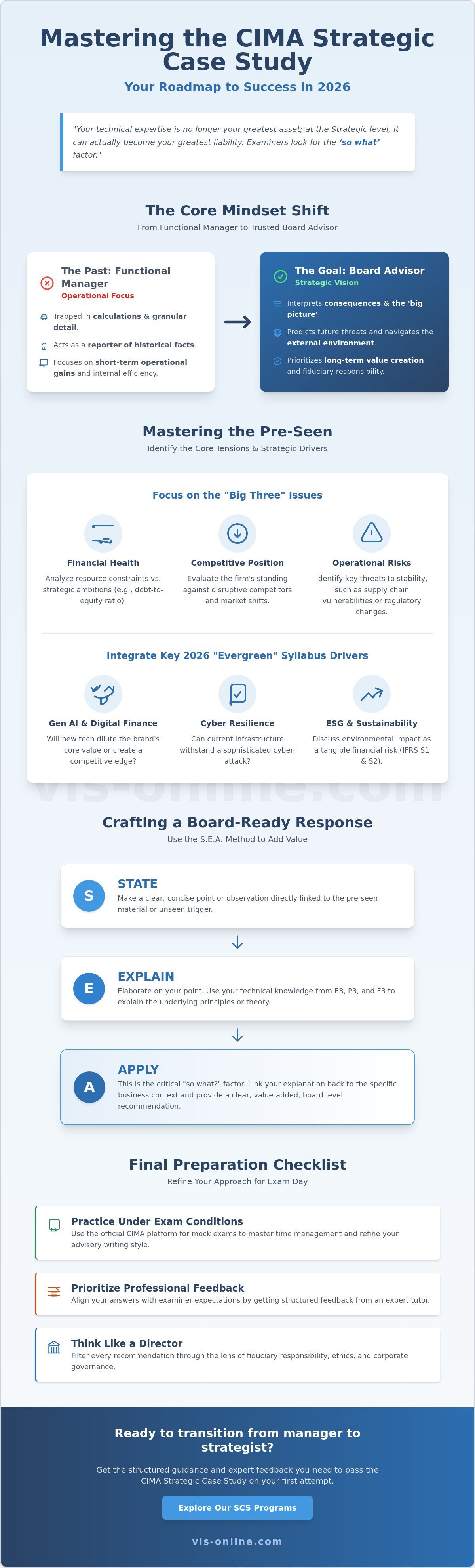
- Implement effective CIMA strategic level case study tips by using the 'State, Explain, Apply' (SEA) method to ensure technical observations always lead to a clear, value-added recommendation.
- Prioritize professional feedback and simulated exam conditions on the official CIMA platform to refine your advisory writing style and manage time constraints effectively.
The Strategic Mindset Shift: Moving from Finance Manager to Board Advisor
The leap to the Strategic Case Study (SCS) represents the final professional barrier before attaining the CGMA designation. At this level, your technical proficiency is assumed. The examiners aren't testing your ability to perform a calculation; they're testing your capacity to interpret its consequences for the organization's future. You occupy the role of a Senior Finance Manager reporting directly to the Board of Directors. This shift is absolute. You must abandon the operational "how" and embrace the strategic "why" of every business move. The Board Advisor persona is a strategic partner who prioritizes the protection and creation of long-term organizational value over short-term operational gains. When applying CIMA strategic level case study tips, remember that "dumping" technical knowledge without context leads to failure. The directors expect concise, risk-aware recommendations that address the specific nuances of the 2026 business landscape.
Differentiating SCS from the Management Case Study
While the Management Case Study (MCS) focuses on internal performance and the efficient execution of existing strategies, the SCS demands a much broader perspective. You must analyze the external environment, identifying how global shifts in digital finance and sustainability impact the firm's survival. Success at this level involves moving from reporting on historical data to predicting and mitigating future business threats. The Chartered Institute of Management Accountants (CIMA) structures this final hurdle to ensure candidates can navigate ambiguity and provide stability in complex regulatory environments. You're no longer just a manager; you're a strategist.
The Fiduciary Responsibility: Thinking Like a Director
Every response you provide must be filtered through the lens of fiduciary responsibility. This means evaluating decisions based on their impact on shareholder value and the broader stakeholder ecosystem. Ethics and corporate governance aren't merely checkboxes. They are the foundation of every strategic recommendation you make. When you integrate CIMA strategic level case study tips into your preparation, focus on how governance frameworks protect the organization from reputational and financial ruin. Your role is to act as a professional safety net, ensuring the Board's ambitions remain within the boundaries of ethical and regulatory compliance. Every word you write should reflect this gravity and professional integrity.
Mastering the Pre-Seen: Industry Synthesis and 2026 Strategic Drivers
The pre-seen document is more than a narrative; it's a complex data set that requires disciplined synthesis. To excel, you must identify the "Big Three" issues: the organization's current financial health, its relative competitive position, and the operational risks threatening its stability. Effective CIMA strategic level case study tips often begin with this triage. You aren't merely looking for facts. You're looking for the tension between the company's ambitions and its resources. In the 2026 landscape, this tension frequently manifests in Digital Transformation and Cyber Resilience. The Board doesn't need a summary of the IT department's budget. They need to know if the current infrastructure can withstand a sophisticated cyber-attack or if a pivot toward Generative AI will dilute the brand's core value.
When you link the pre-seen to the E3, P3, and F3 pillars, avoid the temptation to name-drop academic models. Instead of citing a specific financial strategy model, discuss how the debt-to-equity ratio restricts the firm's ability to fund a strategic acquisition. This demonstrates an integrated understanding of the business. You should also identify key entities, such as a disruptive competitor or a regulatory body, that represent immediate strategic threats. For those seeking structured guidance on these complexities, exploring a comprehensive CIMA Strategic Level preparation program can provide the professional safety net required to navigate such intricate scenarios.
Integrating ESG and Sustainability into Your Analysis
Sustainability is no longer a peripheral concern; the 2026 syllabus integrates IFRS S1 and S2 as core strategic requirements. You must discuss environmental impact not just as a moral obligation, but as a tangible financial risk. If a supply chain is vulnerable to climate disruption, it's a threat to shareholder value. Conversely, leading in green finance can lower the cost of capital and open new market segments.
Industry Benchmarking: Beyond the Provided Material
The pre-seen provides the foundation, but your advisory gains authority through real-world parallels. Researching the actual industry the pre-seen company mimics allows you to apply PESTEL and Porter’s Five Forces with precision. If the case study involves a global logistics firm, look at how real-world leaders are managing 2026's inflationary pressures and labor shortages. This depth transforms a standard answer into a board-ready strategic briefing.
Answer Construction: The 'Board-Ready' Framework for SCS Success
Implementing robust CIMA strategic level case study tips involves more than memorizing formulas; it requires a disciplined approach to answer construction. The Board doesn't seek a textbook definition. They require a solution. Implementing the 'State, Explain, Apply' (SEA) method ensures that every paragraph you construct remains anchored in the specific realities of the 2026 pre-seen material. You must prioritize the 'So What?' factor in every sentence. If you identify a high gearing ratio, don't stop at the calculation. You must explain how this financial constraint limits the firm's ability to pivot toward the digital transformation goals outlined in the strategy. A declining interest cover ratio doesn't just indicate financial strain; it signals a critical reduction in the firm's capacity to secure the green bonds necessary for its 2026 sustainability pivot.
Maintaining professional skepticism is equally vital when addressing the 'unseen' tasks. You shouldn't accept the assumptions provided in the exam triggers at face value. If a task suggests an acquisition is the only route to growth, your role is to question the integration risks, the validity of the valuation, and the potential impact on corporate governance. For those who want to refine this elite advisory style, our CIMA Strategic Level full access course provides the structured framework needed to transform technical knowledge into board-ready counsel.
Structuring for Readability and Impact
Examiners often grade dozens of scripts daily. You can improve your scores by using clear headings and sub-headings that mirror the logical flow of an executive briefing. Short, punchy paragraphs are more effective than dense blocks of text. Each paragraph should lead with a strong strategic point, followed by evidence from the scenario and a concluding recommendation that addresses the risk-aware culture of a modern boardroom.
Time Management: The 45-Minute Per Task Rule
Discipline during the exam is non-negotiable. You should allocate exactly 10 minutes for planning and 35 minutes for high-quality writing for each task. Use the planning phase to map your SEA points and ensure you've addressed every sub-task. This structured approach prevents the panic that often arises when 'unseen' information contradicts your initial expectations, allowing you to maintain your strategic focus until the final second.
Final Preparation: Mock Exams and Expert Tutor Integration
Self-marking is often the most significant risk a candidate takes during their final preparation. At the Strategic level, the marking criteria focus heavily on judgment and professional tone; these are nuances that are nearly impossible to assess objectively on your own. You need an expert eye to determine if your advice carries the weight of a senior advisor or the hesitation of a functional manager. Integrating CIMA strategic level case study tips into your final weeks must include professional feedback loops that highlight gaps in your strategic logic. This process ensures your recommendations aren't just technically correct, but also commercially viable within the 2026 business environment.
Simulating the actual environment is equally critical. You should conduct all mock exams using the official CIMA exam platform interface to build muscle memory for the software. This familiarity reduces cognitive load on exam day, allowing you to focus entirely on the 'unseen' triggers. For a broader view of your professional journey, a final review of our CIMA Professional Qualification guide provides the necessary level-wide context to align your knowledge with the specific demands of the case study.
The VLS Advantage: WhatsApp Support and Live Sessions
Direct access to tutors through WhatsApp support bridges the gap between theoretical frameworks and real-time strategic application. When you encounter a complex scenario in the pre-seen, immediate clarification from an expert prevents the solidification of incorrect assumptions. Our weekly live sessions further enhance this by simulating a boardroom environment. These discussions allow you to defend your recommendations against peer critiques, refining your ability to think and respond with the calm confidence expected of a future CGMA.
Developing Soft Skills: Leadership and Persuasion
Success in the SCS isn't just about what you say, but how you say it. Demonstrating 'Leadership' competencies requires a tone that's authoritative yet collaborative. You must use language that persuades the Board while acknowledging the risks inherent in your proposals. If you're considering parallel strategic paths, you might also find value in our ACCA Strategic Professional guide. Ultimately, your goal is to prove you're ready to act as a proactive thinker who can simplify complexity without sacrificing professional depth.
Securing Your Professional Future as a CGMA
Success in the Strategic Case Study requires a total synthesis of high-level advisory skills and a disciplined understanding of the 2026 digital and sustainability drivers. It's no longer enough to be technically accurate; you must be commercially indispensable. By integrating the CIMA strategic level case study tips discussed, you've already begun the transition from a functional manager to a proactive board advisor. This final hurdle is less about testing what you know and more about evaluating how you apply that knowledge to protect and create organizational value in an increasingly complex global market.
To ensure you have a professional safety net during this critical transition, Enroll in the VLS CIMA Strategic Level Case Study Course for Expert Tutor Support. Our program provides the structured environment you need to succeed, offering active tutor support via WhatsApp and weekly live classroom simulations that mirror the pressures of a real boardroom. Combined with our exam-focused study notes updated for 2026, you'll have every tool required to navigate the final stage of your qualification. Your journey toward the CGMA designation is almost complete. We're here to ensure you cross the finish line with the confidence and integrity that your future career demands.
Frequently Asked Questions
How is the CIMA Strategic Case Study graded compared to MCS?
The SCS grading criteria focus on high-level strategic evaluation and fiduciary responsibility rather than operational management. While the Management Case Study assesses your ability to implement strategies, the Strategic level evaluates your capacity to advise the Board on the validity of the strategy itself. You're graded on your professional judgment and ability to manage long-term risks. Technical proficiency is taken as a baseline; the differentiator lies in your ability to offer counsel that protects shareholder value.
Do I need to perform complex calculations during the SCS exam?
You won't be required to perform complex, multi-step calculations during the exam. CIMA provides the necessary financial data or ratios within the scenario or the 'unseen' materials. Your task is to interpret these figures and explain their strategic implications. For example, a falling interest cover ratio should be discussed as a barrier to securing green finance for 2026 sustainability projects rather than just a numerical result.
How much of the E3, P3, and F3 theory should I mention by name?
You should prioritize the application of theory over the explicit naming of academic models. Mentioning "Porter's Five Forces" or "Ansoff's Matrix" by name adds little value to a Board report. Instead, demonstrate your understanding by discussing competitive threats or market penetration strategies directly. Effective CIMA strategic level case study tips emphasize that directors want to see professional insights that solve business problems, not a recitation of a textbook.
What happens if I don't finish all the tasks in the SCS exam?
Failing to complete all tasks within a section often results in a significant loss of marks. The examiner's marking grid allocates specific points to every sub-task identified in the requirement. If you leave a sub-task unaddressed, you're essentially forfeiting those marks. It's better to provide a concise, structured response to every requirement than to write an exhaustive answer for one while neglecting the others.
How many mock exams are recommended for the Strategic level?
We recommend completing between three and five high-quality mock exams under timed conditions. Simply reading through past papers isn't enough; you must practice the physical act of typing and structuring your thoughts within the 45-minute task window. Utilizing CIMA strategic level case study tips from an expert tutor who provides personalized feedback on these mocks is essential for refining your professional tone and ensuring your logic is board-ready.