
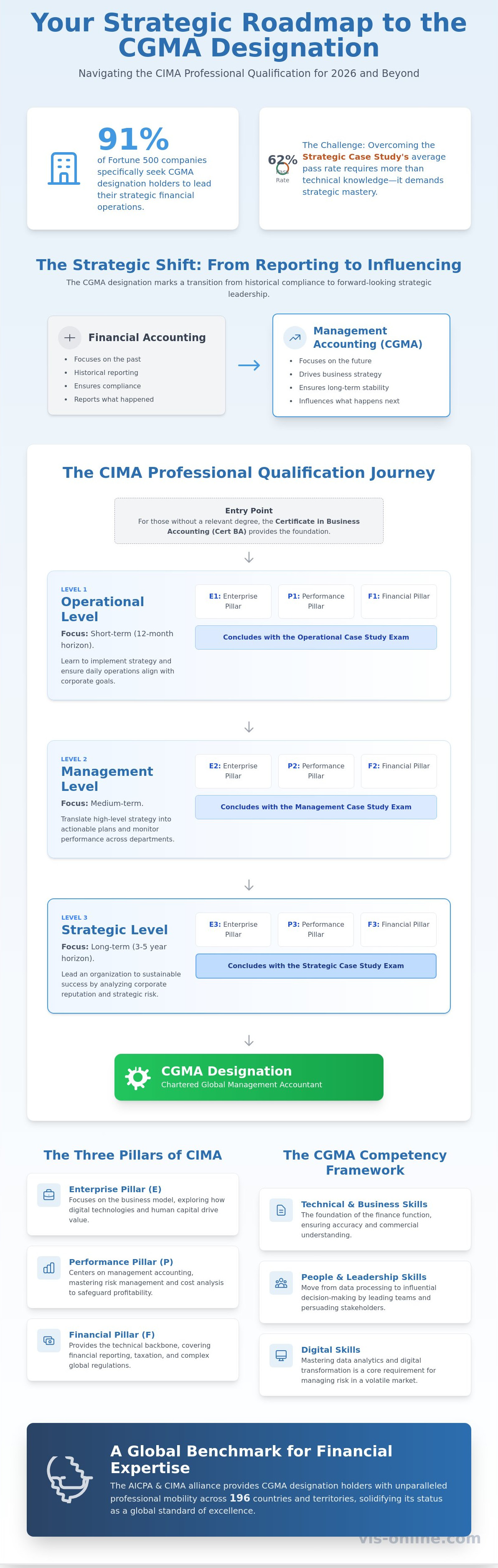
According to recent AICPA & CIMA data, 91% of Fortune 500 companies specifically seek CGMA designation holders to lead their strategic financial operations. You likely understand that pursuing the CIMA Professional Qualification is a significant commitment that requires more than just technical knowledge. It demands a sophisticated grasp of business strategy. It's common to feel overwhelmed by the 2024 syllabus complexities or the 62% average pass rate of the Strategic Case Study, especially when official documentation feels like a labyrinth of technical jargon rather than a clear career path.
This guide serves as your professional protective net, distilling years of examination data and pedagogical expertise into a streamlined strategy for 2026. We'll provide you with a precise, step-by-step roadmap to the CGMA designation, including proven techniques to master Objective Tests and a clear analysis of the qualification's long-term ROI. You'll gain the clarity needed to choose your entry level with confidence and navigate the transition from financial accounting to high-level strategic management.
Key Takeaways
- Understand the strategic transition from traditional financial reporting to the forward-looking management accounting expertise required for the CGMA designation.
- Navigate the three pillars of the curriculum to build a robust foundation in business modeling, strategic management, and complex risk mitigation.
- Master the distinct preparation strategies needed for the CIMA Professional Qualification, specifically the shift from objective testing to the Integrated Case Study format.
- Assess the professional impact and long-term ROI of the qualification within the 2026 landscape of ESG initiatives and digital transformation.
Understanding the CIMA Professional Qualification: A Strategic Overview
The CIMA Professional Qualification acts as the rigorous pathway to the Chartered Global Management Accountant (CGMA) designation. It's a distinction that separates traditional bookkeepers from strategic leaders. While financial accounting concentrates on historical reporting and compliance, management accounting focuses on the future. It involves analyzing data to drive business strategy and ensure long-term stability. You don't just report on what happened; you influence what happens next.
The 2017 alliance between the AICPA and CIMA solidified this qualification as a global benchmark. This partnership offers professionals unparalleled mobility across 196 countries and territories. By 2026, the demand for cross-border financial expertise will only intensify. For those entering the field without a relevant university degree, the Certificate in Business Accounting (Cert BA) serves as the essential entry point. It provides the structural knowledge required to navigate the complexities of the higher professional levels at VLS Online.
The CGMA Competency Framework
The framework centers on four essential pillars that define a modern finance professional:
- Technical and Business Skills: These form the foundation of the finance function, ensuring accuracy in reporting and a deep understanding of the commercial environment.
- People and Leadership Skills: These competencies allow you to move from data processing to influential decision-making. It's about leading teams and persuading stakeholders through logical, evidence-based arguments.
- Digital Skills: The 2026 syllabus recognizes that technology is the core of modern finance. Mastering data analytics and digital transformation is no longer optional; it's a requirement for managing risk in a volatile market.
Managing the finance function in a digital world requires a proactive mindset. This qualification prepares you to act as a strategic protector of corporate assets. You'll gain the wisdom to simplify complex financial structures into clear, actionable plans. It's about providing a professional safety net for organizations through disciplined risk management and precise forecasting.
Navigating the Three Pillars and Levels of the CIMA Journey
The CIMA Professional Qualification is built upon a rigorous three-pillar framework designed to produce well-rounded strategic leaders. This structure ensures that candidates don't just memorize formulas but understand the interconnected nature of modern business. The Enterprise Pillar (E) focuses on the business model, exploring how digital technologies and human capital drive value. The Performance Pillar (P) centers on management accounting, where you'll master risk management and cost analysis to safeguard the organization's profitability. The Financial Pillar (F) provides the technical backbone, covering financial reporting, taxation, and the complex regulatory requirements that govern global markets.
Progression through these pillars is vertical, moving through three distinct levels. Each level concludes with a comprehensive Case Study exam that tests your ability to apply knowledge to real-world scenarios. This logical advancement ensures that your skills grow in tandem with your professional responsibilities, moving from technical execution to high-level advisory roles.
The Operational and Management Levels
The Operational Level is your first step into the professional tier. It focuses on the short-term, typically looking at a 12-month horizon. You'll learn how to implement strategy and ensure daily operations align with corporate goals. As you transition to the Management Level, the focus shifts to the medium-term. Here, you're responsible for translating high-level strategy into actionable plans and monitoring performance across departments. For those ready to commit to this multi-year progression, enrolling in full access courses provides the structured support needed to clear these hurdles efficiently.
The Strategic Level: The Final Hurdle
At the Strategic Level, the perspective shifts to long-term decision-making. You'll analyze how to lead an organization to sustainable success over a three to five-year period. This level requires a deep understanding of corporate reputation and strategic risk. Students transitioning from other accounting bodies often find that an expert SBR foundation is vital for mastering the complex reporting standards required at this stage. Success here proves you've the vision to navigate the uncertainties of the 2026 business climate. To ensure your preparation meets these high standards, consider a professional review of your strategic study plan to identify any knowledge gaps.
Strategic Preparation: How to Pass CIMA Exams in 2026
Achieving the CIMA Professional Qualification requires a dual-track strategy that respects the distinct nature of its assessment methods. By mastering both technical precision and strategic application, you ensure your progress through the CIMA Professional Qualification remains steady and predictable. You aren't just preparing for a test; you're training for a career where precision and strategic foresight are non-negotiable. Success in 2026 hinges on your ability to pivot between technical accuracy and high-level commercial advice.
Mastering the Objective Tests
Objective Tests (OTs) are high-pressure, 90-minute computer-based assessments that require absolute syllabus coverage. With 60 questions per exam, you have exactly 1.5 minutes to process, calculate, and select the correct answer. It's vital to use simulation software that replicates the real exam environment to build your speed and reduce anxiety. A candidate must achieve a scaled score of 100 out of 150 to meet the 70% pass mark requirement for each Objective Test.
Conquering the Integrated Case Study
The Integrated Case Study (ICS) demands a complete mindset shift from calculation to consultation. You must move beyond explaining how to calculate a variance and instead explain why it matters to the board of directors. The VLS approach focuses on a meticulous deep-dive into the pre-seen material, treating the fictional company as a real-world client. You'll need to adopt a specific persona, acting as a Finance Officer, Manager, or Senior Manager depending on your level. Incorporating these accounting exam study tips will help you draft responses that satisfy the specific competencies CIMA examiners look for in 2026.
Managing a full-time career alongside this rigorous schedule is the greatest challenge for many professionals. Data shows that candidates with active tutor support and peer communities are 40% more likely to maintain momentum through the final levels. Consistent, small blocks of study are more effective than weekend marathons. Don't leave your professional future to chance; secure your path to the CGMA designation with expert guidance and a structured plan.
Take the next step in your career: Access our comprehensive CIMA exam preparation modules today.
Future-Proofing Your Career with CIMA Global Recognition
The 2026 job market requires strategic foresight rather than mere historical reporting. Recent industry data indicates that 72% of CFOs now prioritize candidates who can bridge the gap between financial data and digital transformation. The CIMA Professional Qualification provides this exact framework. It equips you to lead ESG initiatives and manage AI-driven financial ecosystems, ensuring you remain indispensable as automation reshapes traditional accounting roles.
Investing in this path offers a quantifiable return. Qualified CGMAs report earning potentials up to 31% higher than their non-qualified peers. In the UK, the average salary for a CIMA member exceeds £63,000, reflecting the high value businesses place on management accounting expertise. This isn't just a certificate; it's a strategic asset for long-term financial security.
If you're still deciding on a specialisation, consider your ultimate career destination. While the ACCA Applied Knowledge route is the ideal foundation for technical audit or tax specialisations, CIMA remains the premier choice for those aiming for executive leadership and commercial strategy.
Vertex Learning Solutions provides the professional safety net you need to succeed. Our hybrid learning model combines:
- High-definition recorded lectures for flexible, self-paced study.
- Weekly live sessions to clarify complex syllabus areas.
- Direct WhatsApp access to expert tutors for immediate support.
Global Mobility and Professional Ethics
Holding the CGMA designation grants you professional entry into key markets across the UK, Middle East, Asia, and Africa. It's a passport for global mobility recognized in 179 countries. Beyond technical skill, CIMA’s 2026 framework emphasizes rigorous ethics. This commitment to integrity is vital in a corporate world where governance is under constant scrutiny. Your journey toward leadership starts with a structured plan. Visit Vertex Learning Solutions to register and select your first module today.
Secure Your Strategic Advantage in the 2026 Global Economy
Achieving the CIMA Professional Qualification represents a definitive commitment to long-term career optimization and analytical mastery. By 2026, the demand for CGMA designation holders is expected to accelerate as organizations across 180 countries prioritize risk management and structured financial planning. Success requires a methodical approach to the 12 professional examinations, balancing technical knowledge with strategic application. Vertex Learning Solutions provides a professional safety net for your ambitions, offering active tutor support via WhatsApp and weekly live sessions that recreate 100% of a traditional classroom environment. Our exam-focused study notes and interactive practice tools simplify the complexity of the three pillars, ensuring you're prepared for the specific rigors of the current syllabus. You don't have to navigate this demanding path without a strategic partner to guide your progress. Start your CIMA journey today with Vertex Learning Solutions and transform your professional potential into a globally recognized asset. Your path to elite financial leadership is ready for activation.
Frequently Asked Questions
What is the difference between CIMA and ACCA for my career?
CIMA focuses on strategic management accounting and internal business performance, while ACCA prioritizes statutory audit, taxation, and financial reporting. Choosing the CIMA Professional Qualification aligns your career with corporate leadership and strategic decision-making roles. Statistics from 2024 show that 87% of CIMA members work in industry rather than public practice, making it the preferred route for aspiring Chief Financial Officers.
How long does it typically take to complete the CIMA Professional Qualification?
Most candidates complete the full qualification within 3 to 4 years while maintaining full-time employment. Students who dedicate 15 hours of study per week can often accelerate this timeline to roughly 2.5 years. Your progress depends on your starting point and how many of the 12 Objective Tests and 3 Case Study exams you pass on your first attempt.
Can I get exemptions from CIMA exams if I have a university degree?
You're eligible for exemptions if your degree is from a CIMA-accredited institution and covers relevant accounting or business modules. Graduates with specialized accounting degrees often bypass the initial Certificate level and start directly at the Operational level. The CIMA database currently recognizes over 3,000 degree programs worldwide, so you'll need to submit your transcripts for a formal assessment to confirm your specific credits.
What is the pass rate for CIMA Case Study exams?
Pass rates for CIMA Case Study exams generally fluctuate between 52% and 71% depending on the level and sitting. In the November 2023 session, the Operational Case Study pass rate was 65%, while the Strategic Case Study reached 62%. These numbers demonstrate the rigorous standards required to prove you can apply theoretical knowledge to real-world business scenarios.
Is the CIMA qualification recognized in the United States?
The qualification is widely recognized in the United States thanks to a strategic partnership with the AICPA that launched in 2012. This collaboration created the Chartered Global Management Accountant (CGMA) designation, which serves as the premier standard for management accountants in North America. There are now more than 150,000 CGMA designation holders in the US, ensuring your professional credentials have high visibility and respect among American employers.