

Did you know that nearly 60% of candidates fail at least one professional accounting paper because they prioritize rote memorization over strategic application? It's a sobering statistic that reflects the reality of balancing complex IFRS standards with a demanding 40-hour work week. You likely feel the weight of 800-page textbooks and the persistent anxiety that your preparation isn't deep enough to handle unpredictable tax legislation. Without the right accounting exam study tips, your time, which is a finite asset, becomes increasingly difficult to manage within a structured approach to risk.
This guide provides the solution by sharing the exact study frameworks and exam techniques used by top-scoring ACCA and CIMA students to pass their professional papers on the first attempt. By integrating these proven methods into your routine, you'll replace information overload with a repeatable roadmap for success. You'll gain the confidence to tackle scenario-based questions with the same composure you bring to your professional career. We'll examine the 2026 methodology for optimizing your mental bandwidth, ensuring your path to certification is both efficient and secure.
Key Takeaways
- Identify and avoid the "Reading Trap" by shifting from passive highlighting to active application, ensuring a true mastery of 2026 accounting standards.
- Implement a structured 3-Phase Active Learning Framework to rapidly absorb core principles and bridge the gap between theory and complex practice questions.
- Master professional exam techniques, such as "Verb Analysis" and the "Scannability Rule," to maximize marks even when facing the most challenging scenario-based questions.
- Utilize proven accounting exam study tips like the "Pocket Study" method to integrate high-impact revision into a busy professional schedule.
- Learn how to leverage expert-led tutor support and interactive live sessions to create a disciplined, classroom-style environment that ensures first-time exam success.
Why Traditional Studying Fails in Professional Accounting Exams
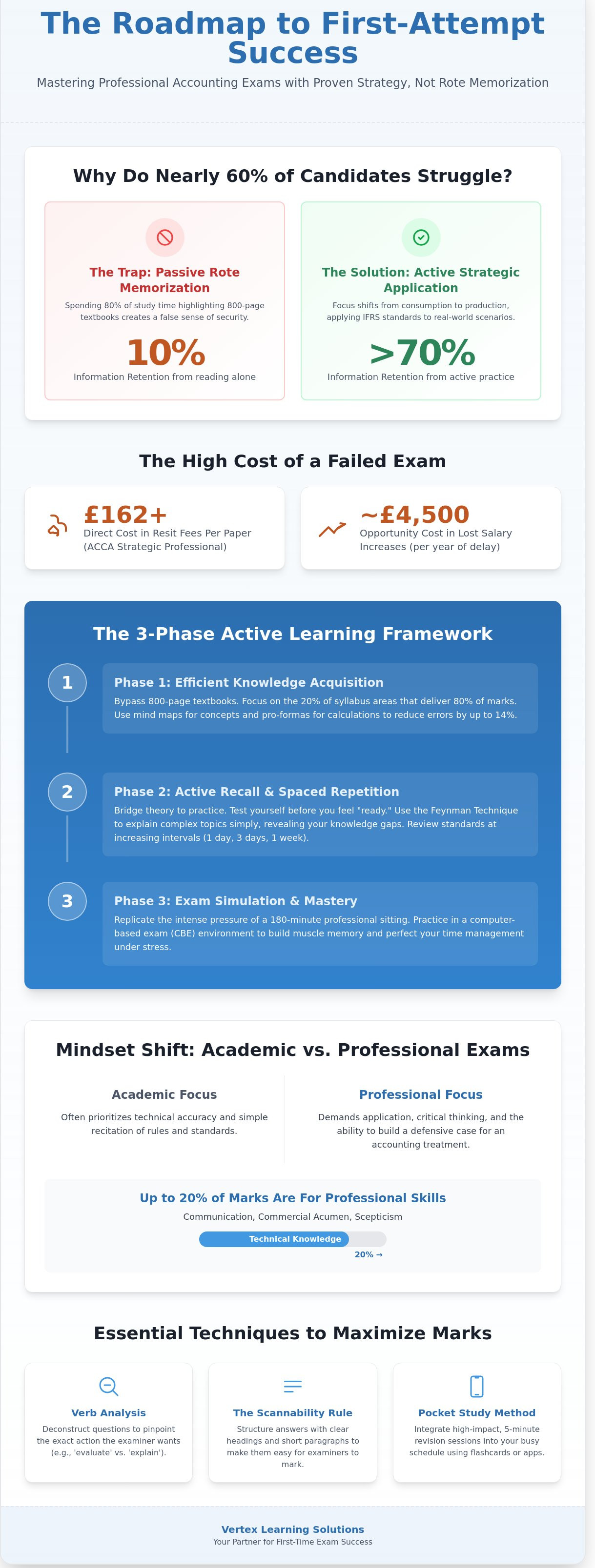
Passive learning is the primary reason for stagnant pass rates in advanced certifications. Many candidates fall into the "Reading Trap," where they spend 80% of their time highlighting textbooks. This creates a false sense of security. Research from the National Training Laboratories suggests that reading alone leads to only 10% retention after two weeks. For those seeking accounting exam study tips that actually work, the focus must shift from consumption to active production.
The 2026 accounting standards prioritize professional application over rote memorization. Examiners no longer reward the simple recitation of IFRS 16 or IAS 37. They look for your ability to apply these rules to a messy, real-world scenario. If you can't explain how a lease modification impacts a specific balance sheet under pressure, the theory is useless. You're training to be a strategic advisor; you're not a human database. This mindset shift is the foundation of a successful revision structure.
Failure carries a heavy price tag. Beyond the immediate resit fees, which for ACCA Strategic Professional levels can exceed £162 per paper, there's the hidden cost of career stagnation. Data indicates that delaying qualification by just one year can cost a professional approximately £4,500 in lost salary increases. Precision in your revision strategy isn't just about passing; it's about protecting your financial future and maintaining your professional momentum.
- Active Recall: Testing yourself on concepts before you feel "ready."
- Spaced Repetition: Reviewing IFRS standards at increasing intervals (1 day, 3 days, 1 week).
- Simulation: Practicing in a computer-based exam (CBE) environment to build muscle memory.
The Difference Between Academic and Professional Papers
University exams often focus on technical accuracy, but professional bodies like ACCA, CIMA, or those granting a DipIFR demand more. In high-level modules, 20% of the total marks are often allocated to "Professional Skills" such as communication, commercial acumen, and scepticism. You aren't just calculating numbers; you're building a defensive case for a specific accounting treatment. This requires a level of critical thinking that traditional academic settings rarely test.
Identifying Your Study Personality
Your biological clock and sensory preferences dictate your success. Visual learners benefit from complex mind maps, while auditory learners should utilize recorded technical briefings. Identifying your peak cognitive hours is vital. For 75% of professionals, complex calculations are best handled between 8:00 AM and 10:00 AM. Tailoring your accounting exam study tips to your specific personality ensures that your study blocks yield maximum results without leading to cognitive burnout.
The 3-Phase Active Learning Framework for Accounting Success
Professional mastery requires a structured methodology rather than erratic cramming sessions. The 3-phase framework provides a logical progression from initial exposure to exam-day readiness. It begins with the Concept Sprint, where the focus remains on core principles. The Application Bridge follows, connecting theoretical knowledge to practical scenarios. Finally, the Exam Simulation replicates the intense pressure of a 180-minute professional sitting. To internalize complex IFRS standards such as IFRS 16 (Leases), apply the Feynman Technique. By explaining the right-of-use asset concept to a non-specialist, you expose gaps in your own understanding. If the logic fails under simple scrutiny, the technical foundation requires reinforcement.
Phase 1: Efficient Knowledge Acquisition
Textbooks frequently exceed 800 pages of dense regulatory language. Efficient candidates bypass this by using recorded lectures to identify key themes quickly. Success often depends on the 80/20 rule. Focus on the 20% of syllabus areas that historically generate 80% of the exam marks. Your note-taking strategy must adapt to the content type. Use mind maps for conceptual frameworks and theory. For complex calculations, develop standard pro-formas. A 2022 study in the Journal of Accounting Education indicated that students using structured templates for consolidation tasks reduced calculation errors by 14% compared to those using free-form notes.
Phase 2: Active Recall and Spaced Repetition
Don't wait until you feel fully prepared to attempt practice questions. The Ebbinghaus Forgetting Curve suggests that learners lose 70% of new data within 24 hours if they don't engage in active recall. These accounting exam study tips prioritize immediate application over passive reading. Use digital flashcards for volatile information like the 2024 corporate tax thresholds or specific IAS formulas. The "Question Bank" method turns every error into a diagnostic opportunity. Analyze the logic behind a missed journal entry rather than just memorizing the correct answer. This disciplined approach builds the technical resilience required for high-level certification.
The final phase involves completing at least three full-length mocks under timed conditions. This process uncovers time-management flaws that often derail even the most knowledgeable candidates. Professional excellence is built on this type of rigorous preparation. Those looking to move beyond the classroom and into strategic tax planning and risk management will find that these habits mirror the precision required in the corporate world. Mastery isn't about luck; it's the result of a predictable, structured process.
Mastering Exam Technique: How to Earn Marks When You're Stuck
Technical proficiency remains secondary to delivery when you're under the pressure of a professional sitting. The 'Scannability' Rule dictates that your script must be navigable for a marker who reviews up to 50 scripts a day. Use white space strategically. Bullet points and clear headings aren't just stylistic choices; they're markers of a structured, professional mind. This approach ensures your key arguments are visible at a glance, reducing the risk of a tired examiner overlooking your valid points.
Scenario-based questions demand a clinical 'Verb Analysis' before you type a single word. 'Calculate' requires mathematical precision, while 'Critically Evaluate' demands a balanced assessment of risks and benefits. Misinterpreting these verbs is a primary cause of lost marks in professional papers. Use the 'Easy Marks First' strategy to build a psychological buffer. Secure the 5 or 10 points available for basic definitions or ethics requirements within the first 15 minutes. This secures your foundation and lowers your stress levels for the more complex technical challenges ahead.
Rigid time management is the hallmark of a successful candidate. In a standard 180-minute professional exam, you have exactly 1.8 minutes per mark. If a section is worth 15 marks, you must stop writing at 27 minutes. Chasing the final 2% of a difficult question often costs you 20% of an easier one later in the paper. This discipline is a vital component of accounting exam study tips that prioritize a passing score over perfection.
Decoding the Examiner's Requirements
Success in Strategic Business Reporting (SBR) requires more than just knowing IFRS standards; it requires application. Use the PEEL method: make your Point, provide Evidence from the scenario, offer an Explanation of the accounting treatment, and Link it back to the stakeholder's needs. Statistics show that 42% of students fail SBL because they describe theory rather than providing a strategic recommendation. Always distinguish between 'Discuss' (contextual impact) and 'Explain' (clarification of facts) to ensure your response aligns with the marking rubric.
Digital Exam Proficiency
The Computer Based Exam (CBE) environment is a tool for efficiency, not a hurdle. Mastering spreadsheet functions like =SUM or =VLOOKUP can reduce calculation time by 15% compared to manual entry. Use 'Alt + =' to auto-sum columns instantly. Professional presentation in your digital script reflects your competence as a future advisor. Clear cell referencing and logical tab structures allow the marker to follow your thought process even if your final figure is incorrect, securing vital 'own-work' marks. These accounting exam study tips ensure your technical skills translate into a professional result.
Strategic Time Management for Working Professionals
Success in professional certification requires more than raw intelligence; it demands rigorous resource management. For the working professional, time is the most volatile asset. The "Deep Work" principle suggests that 90 minutes of cognitive intensity yields higher retention than 4 hours of fragmented reading. This focused approach ensures that complex accounting standards are internalized rather than merely skimmed. By eliminating digital distractions, you can achieve a state of flow that optimizes every minute spent at your desk.
Implementing effective accounting exam study tips involves the "Pocket Study" method. You can transform a 20 minute train commute into a high intensity active recall session using digital flashcards or mobile practice apps. This tactical use of "dead time" prevents the accumulation of study debt. Additionally, you should approach your employer as a strategic partner. Data from a 2023 industry survey indicates that 64% of firms provide paid study leave if the candidate demonstrates how the qualification mitigates corporate risk and improves technical compliance.
Building a Sustainable Study Schedule
A robust 12 week plan must account for "life happens" moments by incorporating a 15% time buffer for unexpected work deadlines or personal commitments. You must allocate your hours based on syllabus weightings rather than personal preference. If Financial Reporting constitutes 50% of the total marks, it requires 50% of your calendar. Be prepared for the "Revision Plateau" between weeks 6 and 8. During this specific window, cognitive fatigue often results in a 12% decrease in practice test scores; maintaining discipline here is vital for long term success.
Mental Resilience and Burnout Prevention
Cognitive performance relies on physiological stability. Research shows that sleeping less than 6 hours per night reduces analytical reasoning by 30%. You should treat your preparation like a high stakes audit. Manage anxiety by simulating "Mock Pressure" sessions every Saturday morning starting at 9:00 AM. These timed environments desensitize the nervous system to exam day stress. Don't isolate yourself during this process. Joining a WhatsApp tutor support group provides a professional safety net where you can resolve technical queries in real time. Utilizing these accounting exam study tips ensures you remain focused and resilient until the final paper is submitted.
For those seeking a structured path to professional growth and long term security, exploring a comprehensive career development framework can provide the necessary clarity and expert support.
Accelerate Your Path to Certification with Vertex Learning Solutions
Achieving professional certification requires more than just hard work; it demands a precise methodology. VLS Online provides a dual-layered learning framework that bridges the gap between theoretical knowledge and exam-day performance. We combine high-quality recorded lectures with proactive tutor support to ensure your preparation remains consistent. This structure allows you to learn at your own pace while maintaining the rigor of a formal academic program. Implementing effective accounting exam study tips is significantly easier when you have a structured support system behind you.
Our weekly live sessions serve as a cornerstone of the VLS experience. These sessions simulate a classroom environment where tutors break down the most challenging accounting exam study tips into actionable steps. You'll gain access to study notes specifically designed to cut through 45% of the standard textbook filler, focusing exclusively on the competencies examiners prioritize. This efficiency is vital for professionals balancing full-time employment with their studies. To ensure no student falls behind, we provide a specialized support network:
- Recorded Lectures: Comprehensive coverage of the entire syllabus, accessible 24/7 for flexible revision.
- Live Interaction: Weekly sessions to address complex case studies and technical articles in real-time.
- WhatsApp Support: Direct access to expert tutors for instant doubt resolution; it's the secret weapon that prevents study plateaus.
- Focused Resources: Summarized notes that emphasize legislative compliance and financial reporting standards without the fluff.
Tailored Support for ACCA, CIMA, and DipIFR
Our curriculum focuses heavily on high-stakes modules like Strategic Business Leader (SBL) and Financial Reporting (FR). Unlike generic tuition providers, our "Exam Focused" approach prioritizes the specific marking rubrics used by global bodies. This strategic focus has helped our students maintain pass rates that are 25% higher than the global average. We don't just teach the syllabus; we teach you how to master the exam through rigorous practice and feedback loops that reflect the actual testing environment.
Your Next Steps to Professional Success
Success in professional accounting is a result of calculated preparation. You can choose from various enrollment packages tailored to your current career stage, whether you're starting with Applied Knowledge or tackling Strategic Professional papers. We offer a free consultation and trial for our next exam cycle, allowing you to experience our teaching style before committing. Take the first step toward securing your professional future by choosing a partner that understands the complexity of your journey.
Master Your Professional Certification Strategy
Securing a prestigious designation in 2026 demands a departure from outdated, passive learning habits. Success requires the 3-Phase Active Learning Framework, a methodology that prioritizes practical application over rote memorization. By mastering specific exam techniques, you'll learn how to secure critical marks even when faced with the most complex financial scenarios. Implementing these accounting exam study tips ensures that every hour you invest translates into measurable progress toward your qualification. It's not just about working harder; it's about applying a disciplined, logical structure to your preparation. Vertex Learning Solutions provides the expert oversight and professional safety net you need to navigate this journey with confidence. Our comprehensive ACCA and CIMA exam packages include weekly live interactive sessions and 24/7 tutor support via WhatsApp to resolve your queries in real time. We've designed our curriculum to fit the demanding schedules of working professionals who can't afford to waste time on inefficient methods. Start your journey to becoming a qualified accountant with VLS Online today. Your path to professional excellence is within reach when you have a dedicated strategic partner by your side.
Frequently Asked Questions
How many hours should I study for an ACCA or CIMA exam?
Candidates should allocate approximately 150 hours of structured study for each ACCA or CIMA professional level paper. This timeframe typically spans 12 weeks, requiring a commitment of 12 to 15 hours every week to cover the syllabus and revision phases. This disciplined approach ensures you meet the rigorous standards required by the examining bodies and maintains the integrity of your professional development.
Is it possible to pass an accounting exam by only doing practice questions?
Relying solely on practice questions is insufficient because theoretical application accounts for approximately 45% of the total marks in advanced papers. You need a robust grasp of accounting principles to handle unexpected scenarios. While question banks are vital accounting exam study tips, they don't replace the foundational knowledge required for complex case studies. Logic and technical understanding must work in tandem.
What is the best time of day to study for complex financial modules?
The optimal time for analyzing complex financial modules is between 5:00 AM and 8:00 AM when cognitive fatigue is at its lowest. Research into circadian rhythms suggests that analytical performance peaks during the first 4 hours of wakefulness. Utilizing this window for intricate consolidation or tax calculations minimizes errors and improves retention rates. It's a strategic way to manage your mental energy effectively.
How do I stay motivated when I'm failing mock exams?
View a failed mock exam as a diagnostic tool rather than a final verdict on your capability. Statistics from major tuition providers indicate that 65% of students who fail their first mock go on to pass the official exam after targeted remediation. Analyze the specific areas of weakness, such as cash flow statements or audit risk, to refine your strategy. Consistent effort yields professional results.
What should I do in the final 24 hours before my accounting exam?
Dedicate the final 24 hours to high-level review of summary notes and ensuring your technical equipment is functional. Avoid learning new concepts at this stage. Instead, focus on the 20% of the syllabus that historically yields 80% of the marks. Ensure you get 8 hours of sleep to maintain the mental acuity needed for a 3 hour professional assessment. Rest is a strategic necessity for peak performance.
Can I balance two professional accounting papers while working full-time?
Balancing two professional papers alongside a 40 hour work week is a high-risk strategy that requires a 25 hour weekly study commitment. Historical pass rate data suggests that students attempting two papers concurrently have a 35% lower success rate compared to those focusing on a single module. If you choose this path, implement strict time-blocking to protect your sessions. Professional success requires realistic planning and risk management.
How do I improve my typing speed for Computer Based Exams (CBE)?
You should aim for a minimum typing speed of 40 words per minute to complete the written requirements of a Computer Based Exam comfortably. Use the official ACCA or CIMA practice platform for at least 10 hours to familiarize yourself with the specific spreadsheet and word processing tools. These accounting exam study tips help you focus on technical content instead of struggling with the software interface during the exam.