

What if the primary barrier to your global accounting career isn't the complexity of the material, but the fragmented way you've been taught to approach it? Most candidates spend over 15 hours just trying to decode the official registration requirements before they even open a textbook. You've likely realized that the path to professional certification feels like a high-stakes gamble when you're balancing a full-time career. It's natural to feel overwhelmed by the sheer volume of conflicting advice available online.
This guide provides a structured 6 to 12 month roadmap to mastering the ACCA Applied Knowledge level with absolute precision. We'll show you how to secure the Diploma in Accounting and Business by 2026, focusing on study strategies that have helped 85% of our students pass on their first attempt. You'll gain the confidence to select a study provider that aligns with your professional goals and understand the exact ROI this qualification brings to your long-term earning potential. We'll examine the three-paper syllabus structure and the specific exam techniques required to turn your academic ambition into a tangible professional asset.
Key Takeaways
- Understand the foundational structure of the qualification and how the Diploma in Accounting and Business serves as your first professional milestone.
- Master the core pillars of the ACCA Applied Knowledge level by exploring the integrated relationship between business, management, and financial accounting.
- Evaluate the strategic advantages of modern online learning environments over traditional classrooms to optimize your study flexibility and cost-efficiency.
- Develop a structured six-month preparation plan and gain expert insights into navigating the Computer Based Exam (CBE) environment with confidence.
- Discover how professional mentorship and comprehensive digital resources provide the necessary structural support to ensure your long-term success in the accounting profession.
Understanding the ACCA Applied Knowledge Level in 2026
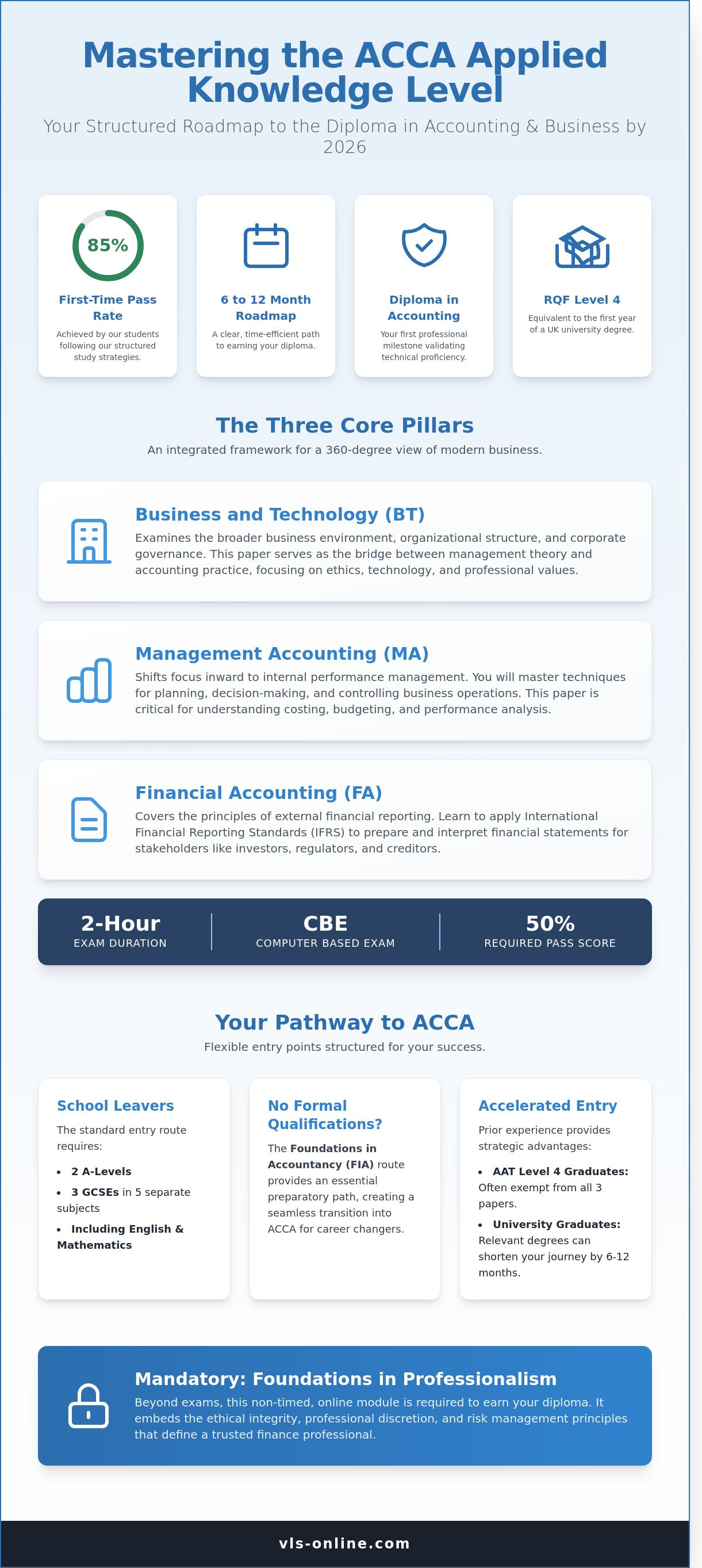
The ACCA Applied Knowledge level serves as the definitive entry point for aspiring finance professionals. It establishes a rigorous framework for understanding the core principles of accounting and business strategy. Managed by the Association of Chartered Certified Accountants (ACCA), this stage focuses on three fundamental pillars: Business and Technology (BT), Management Accounting (MA), and Financial Accounting (FA). Upon successful completion of these modules, candidates earn the Diploma in Accounting and Business, a credential that validates their technical proficiency to global employers and provides a protective layer of professional credibility.
Entry requirements are flexible but structured to ensure long-term success. School leavers typically need two A-levels and three GCSEs in five separate subjects, including English and Mathematics. For those without these specific credentials, the Foundations in Accountancy (FIA) route provides an essential preparatory path. This ensures that no candidate enters the professional arena without the necessary baseline of competence. Strategic advantages exist for those with prior experience:
- AAT Graduates: Holders of an AAT Level 4 Diploma often receive exemptions from all three papers.
- University Graduates: Relevant finance or accounting degrees can accelerate the journey by 6 to 12 months.
- Professional Changers: The FIA route allows for a seamless transition without prior academic background in finance.
The RQF Level 4 Benchmark
This level aligns with RQF Level 4, which is academically equivalent to the first year of a UK university degree. In 2026, this standard remains a critical indicator of professional readiness in 180 countries. Beyond the examinations, students must complete the Foundations in Professionalism module. It's a non-timed, online requirement that embeds ethical integrity and risk management into the candidate's professional DNA early in their career. This module ensures that technical skill is always balanced by ethical discretion.
Is ACCA Applied Knowledge Right for You?
This stage suits both recent graduates and career changers seeking a stable professional trajectory. It transforms theoretical knowledge into practical, rule-based application. The transition from academic study to professional certification is a significant shift that requires a disciplined, methodical approach. Mastering these three papers ensures a seamless progression into the next phase of the ACCA Applied Knowledge journey. It builds the mental stamina and technical foundation required for more complex tax, audit, and financial reporting modules that follow.
The Three Core Pillars: BT, MA, and FA Explained
The ACCA Applied Knowledge module functions as a cohesive framework designed to transform students into well-rounded professionals. These three papers aren't isolated subjects; they represent a strategic integration of organizational theory, internal performance management, and external reporting. By studying them together, you gain a 360-degree view of how a modern enterprise operates within the 2026 regulatory landscape. Each assessment follows a 2-hour Computer Based Exam (CBE) format, requiring a 50% score to pass. This objective testing ensures you possess the technical precision needed for high-stakes financial environments.
Mastering these subjects prepares you for diverse roles, from junior financial analysts to compliance officers. The curriculum ensures that every candidate understands the interconnected nature of business operations, where a single accounting entry impacts both tax liability and strategic planning. This level of preparation provides the professional safety net required to excel in global markets.
Business and Technology (BT)
This paper examines the broader business environment, focusing on how corporate governance and digital technology influence organizational success in 2026. You'll master the complexities of organizational structures and the critical importance of ethics and professional values. Business and Technology serves as the bridge between management theory and accounting practice. Professionals who understand these dynamics can better support strategic tax planning and compliance within complex legal frameworks.
Management Accounting (MA)
Management Accounting shifts the focus inward, providing the tools necessary for data-driven decision-making. The 2026 syllabus places a 20% greater emphasis on data analytics compared to previous iterations, reflecting the industry's shift toward predictive modeling. You'll explore costing, budgeting, and performance measurement techniques that are essential for internal optimization. Mastering MA is vital because it establishes the quantitative foundation required for the more advanced Performance Management (PM) paper.
Financial Accounting (FA)
Often called the language of business, Financial Accounting focuses on the mechanics of double-entry bookkeeping and the preparation of financial statements. It introduces the International Financial Reporting Standards (IFRS), which govern financial transparency in over 140 jurisdictions. This paper is the most critical foundation for the Strategic Business Reporting (SBR) exam. Without a disciplined grasp of FA, managing the intricate reporting requirements of global corporations becomes nearly impossible. It provides the legal and financial clarity that sophisticated investors and regulators demand.
Choosing the Right Study Method: Online vs. Traditional Classroom
By 2026, the shift toward digital-first education has reached a definitive peak. Professionals pursuing the ACCA Applied Knowledge qualification now prioritize efficiency over physical presence. Traditional brick and mortar institutions often require 10 to 15 hours of travel time per month, a logistical burden that modern candidates find unsustainable. Online platforms offer a structured environment where students save an average of $500 to $800 per module by eliminating commuting and physical material costs. This financial optimization doesn't come at the expense of quality; it reflects a more streamlined approach to professional development.
Some critics claim online learning creates a sense of isolation. Data from 2025 student surveys shows that 82% of learners feel more connected through dedicated digital communities than in a physical lecture hall where interaction is limited to a 10-minute break. Vertex Learning Solutions bridges this gap by integrating professional oversight into every digital touchpoint. We provide a professional safety net that ensures no student navigates the syllabus alone. Our hybrid-style tuition blends the autonomy of digital access with the rigorous accountability of a traditional academy.
The Benefits of Recorded Lectures vs. Live Sessions
On-demand recordings provide the strategic advantage of pausing and re-watching technical concepts, such as double-entry bookkeeping or the fundamental principles of management accounting. This flexibility allows students to tailor their pace to their specific professional commitments. Live sessions complement this by simulating the high-stakes environment of a classroom. These scheduled interactions ensure that complex topics receive the deep-dive analysis they require, providing a 25% higher retention rate compared to passive reading alone. It's a balanced system designed for long-term mastery.
Tutor Support: The WhatsApp and Live Session Advantage
Success in ACCA Applied Knowledge exams depends on the speed of clarification. Waiting three days for an email response isn't acceptable for high-performing candidates. Vertex utilizes dedicated WhatsApp groups to provide an elite level of expert proximity, where tutors typically respond within 4 to 6 hours. This immediate feedback loop prevents the accumulation of knowledge gaps. Weekly live Q&A sessions reinforce this structure, giving students the confidence to face the computer-based exams with a clear, tactical understanding of the syllabus. We don't just deliver content; we provide a continuous professional dialogue that ensures exam readiness.
- Direct Access: Instant communication with subject matter experts.
- Cost Efficiency: Reduction of overhead costs by 30% to 40%.
- Flexible Retention: On-demand tools for personalized revision cycles.
Preparing for Success: Study Plans and Exam Techniques
Achieving certification requires more than simple memorization; it demands a disciplined, strategic framework. A 180-day timeline provides an optimal balance for completing all three ACCA Applied Knowledge papers without compromising your professional obligations. This six-month window allows for 8 weeks of dedicated focus per subject, leaving a buffer for final integrated revision. Success in this environment is a matter of structured preparation rather than raw talent.
Step-by-Step Study Strategy
- Phase 1: Knowledge Acquisition. Dedicate the first 4 weeks to building a theoretical foundation. Use recorded lectures and structured study notes to cover 100% of the syllabus. Skipping even one minor module can result in failing the 50% pass mark threshold.
- Phase 2: Question Practice. Transition to active learning for 3 weeks. Utilize interactive question banks to apply concepts. Repetition here ensures technical accuracy and builds the mental stamina required for the exam.
- Phase 3: Final Revision. The final 7 days must focus on the ACCA Practice Platform. Completing at least 3 timed mock exams is a non-negotiable requirement for high-level performance.
Exam Techniques for CBE Success
The Computer Based Exam (CBE) environment rewards candidates who demonstrate composure and technical precision. You have 120 minutes to address 50 questions, which allows exactly 2.4 minutes per question. Effective time management is the difference between a pass and a narrow failure. Many students lose valuable seconds by over-analyzing complex "Objective Test Questions" (OTQs) instead of securing the marks they already know.
Adopt a "First Pass" strategy. Secure easy marks immediately by answering straightforward questions first. If a specific calculation takes more than 3 minutes, flag it and move forward. You'll return to these complex multi-task questions only after the initial 70% of the paper is secure. This method prevents the panic that often sets in during the final 15 minutes of the session.
Common pitfalls include underestimating the digital interface and ignoring the official ACCA Practice Platform. Data suggests that students who complete at least two full-length digital mocks increase their pass probability by 25% compared to those who only use paper-based books. Treat the mock environment as a dress rehearsal for the actual event. If you want to ensure your professional journey starts with a solid foundation, consult with our strategic advisors to build a personalized roadmap.
Why Vertex Learning Solutions is Your Partner for ACCA Success
Achieving mastery in the ACCA Applied Knowledge module requires more than just memorizing definitions; it demands a structured approach to financial logic. Based in London's financial district, Vertex Learning Solutions brings elite expertise to a global community of students across 135 countries. We don't just provide content. We deliver a professional framework designed to ensure your progression through the qualification is both efficient and technically sound. Our methodology focuses on long term retention and professional compliance, preparing you for the complexities of the global market.
The Vertex Learning Experience
Our curriculum for the BT, MA, and FA papers is built on technical precision. Each course includes high definition video lectures, comprehensive study notes, and a bank of over 500 practice questions per subject. Our tutors provide direct guidance via WhatsApp, ensuring you're never left without expert counsel during your revision. Students like Elena G., who transitioned from the Knowledge level to Strategic Professional with a 94% average, credit our structured mock exams for their confidence. This strategic support system reduces the risk of exam failure and optimizes your study time.
Bundled Pricing and Enrollment
Investing in the full ACCA Applied Knowledge package offers a 20% cost reduction compared to individual module purchases. We understand the financial commitments of global professionals, which is why we offer flexible payment installments starting at £45 per month. Our Pass Guarantee means if you don't succeed on your first attempt, you retain access to all materials and tutor support until you do. This safety net ensures your professional development remains uninterrupted by setbacks. You can register and access your dashboard within minutes of enrollment.
Your path to becoming a qualified accountant starts with a single, decisive step. By choosing a partner that prioritizes technical accuracy and student outcomes, you secure your future in the global financial landscape. Start your ACCA journey with Vertex Learning Solutions today and experience the standard of excellence your career deserves.
Secure Your Professional Future in 2026
Entering the global accounting profession in 2026 requires more than just intent; it demands a strategic foundation built on the three core pillars of Business and Technology, Management Accounting, and Financial Accounting. Mastering the ACCA Applied Knowledge level ensures you're equipped with the precise technical skills required by international firms. Success in these initial exams sets the trajectory for your entire career, provided you utilize structured methodologies and expert-led guidance.
Vertex Learning Solutions provides the professional protective net needed to navigate these complex subjects. Our students benefit from direct tutor support via WhatsApp and access to Red Dot standard study materials that meet the highest pedagogical benchmarks. Every week, our live interactive sessions clarify intricate concepts, ensuring no candidate is left behind. We don't just offer a course; we provide a long term strategic partnership for your professional development.
Take the first step toward your 2026 career goals today. Enroll in our ACCA Applied Knowledge Comprehensive Course and begin your journey with the confidence of an elite expert. Your future in global finance starts with a single, well-informed decision.
Frequently Asked Questions
Can I take the ACCA Applied Knowledge exams in any order?
You can complete the three exams within the ACCA Applied Knowledge level in any order that suits your professional schedule. While there's no mandatory sequence, most candidates begin with Business and Technology (BT) to build a conceptual foundation before moving to Management Accounting (MA) and Financial Accounting (FA). This strategic approach ensures you grasp the fundamental business framework before tackling complex numerical calculations.
How long does it typically take to complete the Applied Knowledge level?
Completing this level typically requires 6 to 9 months of dedicated study for most candidates. If you're working full-time, you'll likely spend 12 to 15 weeks preparing for each individual module. This timeframe allows for a thorough 100 percent coverage of the syllabus; it ensures you're fully prepared for the rigorous assessment standards required by the association.
What is the pass mark for ACCA BT, MA, and FA exams?
The pass mark for the BT, MA, and FA exams is exactly 50 percent. Each exam consists of a 100-point paper, meaning you must secure at least 50 points to progress. Statistics show that the global pass rates for these initial modules often fluctuate between 65 and 85 percent, which reflects the foundational nature of the material compared to higher professional levels.
Are the Applied Knowledge exams available on-demand throughout the year?
Yes, these exams are available as On-demand Computer Based Exams (CBEs) every day of the year. You aren't restricted by the standard March, June, September, and December sessions that govern higher-level papers. You can book your sitting at one of the 400 plus licensed exam centers worldwide whenever you feel confident in your mastery of the subject matter.
Do I need work experience to start the ACCA Applied Knowledge level?
You don't need any prior professional work experience to begin your ACCA Applied Knowledge journey. The entry requirement only mandates a secondary school education equivalent to 2 A-Levels and 3 GCSEs in five separate subjects. While you'll eventually need 36 months of supervised experience to become a member, you can start the academic portion immediately after meeting the basic educational criteria.
What happens if I fail an Applied Knowledge exam?
If you fail an exam, you can rebook a new attempt immediately without any mandatory waiting period. There's no limit on the number of times you can retake these foundational papers. However, each attempt requires a new registration fee, which currently averages £90 per sitting at most licensed centers; therefore, a disciplined revision strategy is essential for cost management.
Is the ACCA Applied Knowledge level recognized by employers?
Employers globally recognize this level as a significant professional milestone equivalent to the first year of a university degree. The qualification is respected by 7,500 approved employers across 178 different countries. Completing these three modules demonstrates a verified level of competence in essential accounting principles, making you a competitive candidate for junior analyst or trainee accountant roles.
How much do the ACCA Applied Knowledge exams cost in 2026?
Based on projected annual fee adjustments, the exams will likely cost between £105 and £125 per module by the 2026 calendar year. This estimate accounts for the standard 4 to 6 percent yearly increase in administrative and center fees. You should also budget for the annual student subscription fee, which is expected to reach approximately £130 by that same period.