
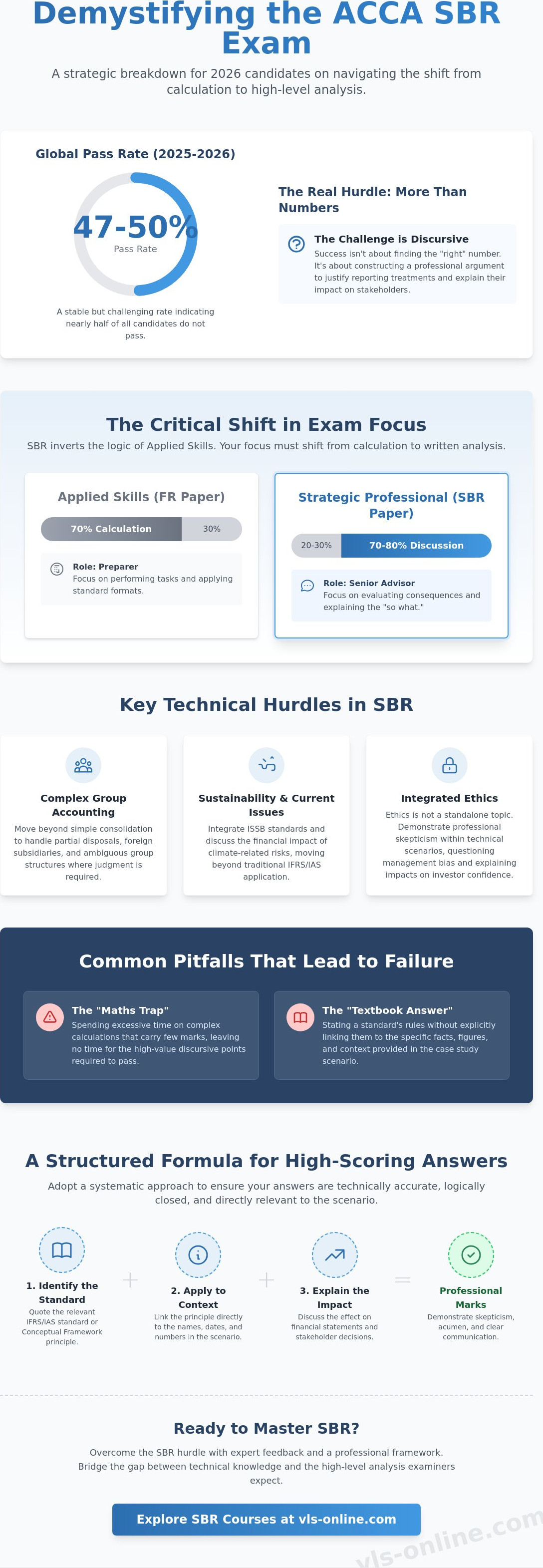
While the global pass rate for the March 2026 session reached 50%, nearly half of all candidates still face a "fail" result on their transcript. If you're feeling overwhelmed by the sheer volume of IFRS standards or the daunting shift from calculation to discursive writing, you aren't alone. It's natural to ask how difficult is the ACCA SBR exam when the safety net of clear-cut numbers is replaced by the nuance of professional judgment. The transition from the Applied Skills level to Strategic Professional requires more than just rote memorization; it demands a fundamental shift in your professional identity.
This strategic analysis provides the clarity you need to approach your 2026 studies with absolute confidence. You'll learn exactly how to bridge the gap between technical knowledge and the high-level analysis examiners expect. We'll explore the latest syllabus trends, including the integration of sustainability standards and the move toward stakeholder-focused reporting. By the end of this guide, you'll have a clear roadmap to move beyond the role of a preparer and embrace the mindset of a senior advisor who can defend complex accounting decisions with precision.
Key Takeaways
- Identify the critical transition from numerical calculation to discursive analysis that distinguishes the Strategic Professional level from earlier Applied Skills papers.
- Develop a realistic understanding of how difficult is the ACCA SBR exam by evaluating the specific cognitive demands reflected in the 47-50% global pass rates.
- Adopt a structured "Answer Formula" to ensure your responses remain technically accurate and logically closed when interpreting complex IFRS and IAS standards.
- Learn to navigate the complexities of group accounting and sustainability reporting by applying the Conceptual Framework as a strategic safety net.
- Understand why expert feedback on the subjective nature of professional writing is a vital component in securing a passing mark in this high-level assessment.
The Reality of ACCA SBR Difficulty: More Than Just Numbers
Many candidates approach Strategic Business Reporting expecting a more advanced version of Financial Reporting. However, the question of how difficult is the ACCA SBR exam often finds its answer in the dramatic shift from numbers to narrative. While the global pass rates for the Association of Chartered Certified Accountants (ACCA) SBR paper have remained relatively stable, hovering between 47% and 50% in recent sessions like December 2025 and March 2026, the underlying challenge remains the discursive nature of the assessment. Success at this level isn't about finding the "right" answer in a spreadsheet, but about constructing a professional argument that justifies a specific reporting treatment.
In the Applied Skills level, specifically the FR paper, you likely spent 70% of your time on calculations. SBR inverts this logic. You're now expected to dedicate 70-80% of your marks to written discussion. This isn't just about writing more; it's about shifting from being a preparer of accounts to a strategic advisor who evaluates the impact of reporting decisions on various stakeholders. In the 2026 regulatory environment, 'Strategic Business Reporting' encompasses more than just IFRS compliance. It now integrates sustainability standards from the ISSB and demands a higher cognitive level of analysis regarding how financial position and performance are communicated to the market. You're no longer just reporting data; you're explaining what that data means for the entity's future.
The 'Step-Up' from Applied Skills
The transition to the Strategic Professional level is often where candidates encounter their first significant hurdle. Memorizing proformas or standard formats is no longer a viable strategy for success. The examiner isn't interested in whether you can perform a task; they want to see if you can evaluate the consequences of that task. This requires a deeper understanding of the Conceptual Framework to handle ambiguous scenarios where a single standard might not provide a clear answer. Understanding this shift is central to mastering the ACCA Strategic Professional Level. You must move from the 'what' to the 'so what', explaining the implications of reporting choices for investors, lenders, and management with professional skepticism.
The Technical Hurdles: Why Candidates Struggle with SBR
Grasping how difficult is the ACCA SBR exam requires looking beyond the syllabus list. It isn't just about knowing IFRS 16 or IAS 37; it's about the depth of application. While lower level papers focus on simple recognition and measurement, SBR asks you to analyze the impact of these standards on financial performance and position. You'll encounter complex group structures involving partial disposals or foreign subsidiaries where the accounting logic isn't immediately obvious. SBR ultimately tests your ability to apply rigid standards to messy, ambiguous real world scenarios where management's judgment might be biased.
For 2026 candidates, the "Current Issues" element is no longer a peripheral topic. The integration of International Sustainability Standards Board (ISSB) requirements means you must discuss how climate related risks affect financial reporting. This reflects a broader shift toward transparency and accountability that modern advisors must navigate. If you're looking for a structured way to master these technicalities, exploring a dedicated ACCA SBR course can provide the necessary professional framework.
The Ethics and Professionalism Pillar
Ethics is no longer a standalone, easy section. It's woven into technical scenarios where you might find a CFO pressuring you to misstate revenue or hide liabilities. To earn the four professional marks, you must demonstrate professional skepticism. This means questioning management's assumptions and showing commercial acumen by explaining how a reporting choice affects investor confidence. Candidates who treat ethics as a separate "memorization" task often miss the nuances that examiners look for in 2026.
Common Pitfalls in Technical Application
Many candidates fall into the "maths trap." They spend too much time on complex calculations that only carry a few marks, leaving no time for the high value discursive points. Another frequent error is providing a "textbook" answer. If you state a standard without linking it to the specific facts of the case study, you'll struggle to reach the 50% pass mark achieved by half of the March 2026 cohort. Success requires you to bridge the gap between technical theory and the specific commercial reality presented in the exam paper.
Strategic Preparation: How to Mitigate Exam Difficulty
Understanding how difficult is the ACCA SBR exam is the first step toward building a resilient study plan. Success doesn't come from working harder, but from working with a strategic focus on the examiner's specific requirements. You need a system that translates technical knowledge into passing marks without getting lost in the complexity of the standards. It's about building a structured defense for every accounting treatment you propose.
Your most powerful tool is the 'Conceptual Framework'. It acts as a professional safety net. When you encounter a complex scenario where the specific IFRS standard feels elusive, the framework allows you to derive a logical answer based on fundamental principles. Pair this with the 'SBR Answer Formula'. First, state the relevant standard. Second, apply it precisely to the facts of the case. Finally, conclude on the specific impact on the financial statements. This three step approach ensures clarity and technical completeness while preventing the common mistake of writing vague, unlinked paragraphs.
Technical mastery means little if you can't perform under the constraints of the digital environment. You should utilize the ACCA Practice Platform from the very beginning of your revision. Getting used to the spreadsheet and word processing interface is essential for managing the intense 'SBR time pressure'. Mock exams aren't just for testing knowledge; they're for training your brain to make professional judgments when the clock is ticking. If you can't finish the paper, you can't pass, regardless of your technical depth.
Effective Revision Techniques for Discursive Papers
Efficiency is paramount when balancing professional commitments with your studies. Ditch the 500-page textbooks in favor of condensed, exam-focused materials that prioritize application over theory. Our ACCA Strategic Business Reporting Course is designed to strip away the noise and focus on the high-yield areas that actually appear on the paper. Use 'Question Debriefs' as your primary learning tool. Instead of just checking if your final answer is correct, analyze the examiner's logic and the structure of their model answers. This active recall method is far more effective for discursive success than passive reading. To secure your 2026 success, enroll in our ACCA SBR course and gain access to expert-led strategies that simplify the most complex reporting standards.
Overcoming the SBR Hurdle with Professional Support
Self-studying for a strategic level paper often leads to a cycle of frustration. While technical standards can be learned from a page, the subjective nature of discursive writing makes it hard to gauge your own performance accurately. This is essentially how difficult is the ACCA SBR exam in practice; it isn't just about what you know, but how you communicate that knowledge to a marker who expects professional skepticism. Without an external expert to critique your application of IFRS to a specific case study, you might repeat the same structural errors without ever realizing why your marks are stagnating.
Expert feedback provides the professional protective net you need to move forward with certainty. It bridges the gap between understanding a concept and earning marks for it. Weekly live sessions serve a dual purpose: they clarify complex technicalities and simulate the high pressure environment of a professional advisory meeting. This interaction forces you to think on your feet and refine your commercial acumen. Vertex Learning Solutions addresses this by combining deep dive recorded content with proactive WhatsApp tutor support. This ensures that when a technical doubt arises during your revision, it's resolved immediately, preventing any loss of momentum in your preparation.
Choosing the Right Learning Partner for 2026
Selecting a partner for your final professional papers requires a careful evaluation of their methodology. You shouldn't settle for generic theory. Instead, look for a support system that addresses your specific technical weaknesses in real time. A strategic partner doesn't just teach the syllabus; they provide the mental and technical framework required to pass one of the most challenging papers in the professional qualification. You can explore our full access ACCA packages to find a structured path that fits your professional schedule. By choosing the right guidance, you transform the question of how difficult is the ACCA SBR exam from a source of anxiety into a manageable professional milestone. Success in 2026 depends on having a roadmap that prioritizes exam application over simple memorization.
Securing Your Strategic Professional Success in 2026
Mastering Strategic Business Reporting is less about memorizing standards and more about evolving into a senior advisor capable of defending complex judgments. While the data surrounding how difficult is the ACCA SBR exam might seem daunting, success is entirely achievable when you replace trial and error with a structured, professional methodology. By focusing on the discursive application of IFRS and utilizing the Conceptual Framework as your strategic foundation, you can navigate the 2026 syllabus with precision.
True confidence comes from knowing you have a professional safety net. Our approach simplifies the most intricate reporting issues through exam-focused study notes and weekly live interactive sessions that simulate real-world scenarios. With active tutor support via WhatsApp, you're never left to struggle with complex technicalities in isolation. Take the definitive step toward your professional qualification today. Enroll in the Vertex SBR Preparation Course for Expert Tutor Support and gain the elite insight required to transform technical knowledge into exam success. Your journey to becoming a Chartered Certified Accountant is within reach.
Frequently Asked Questions
Is SBR harder than the Financial Reporting (FR) exam?
Yes, SBR represents a significant increase in cognitive demand compared to the Financial Reporting (FR) exam. While FR focuses primarily on the mechanics of preparing financial statements, SBR requires you to act as a senior advisor. You must justify reporting treatments through discursive analysis rather than just performing calculations. The transition from 70% calculation in FR to nearly 80% discussion in SBR is why many find the shift challenging.
What is the pass rate for the ACCA SBR exam in 2026?
The global pass rate for the ACCA SBR exam reached 50% in the March 2026 session. This follows a consistent trend where pass rates typically hover between 47% and 52% across different sittings. These statistics confirm that while the exam is rigorous, it's entirely passable for candidates who adopt a strategic approach. Understanding how difficult is the ACCA SBR exam involves recognizing that half of all candidates succeed by mastering the discursive requirements.
Can I pass SBR by self-studying the textbook alone?
Passing SBR through textbook self-study alone is remarkably difficult due to the subjective nature of the discursive questions. A textbook provides technical knowledge, but it cannot offer the critical feedback required to refine your professional writing style. Success at this level depends on your ability to apply standards to specific case facts. Most students benefit from expert guidance to bridge the gap between theory and the examiner's specific marking criteria.
How much time should I dedicate to studying for the SBR exam?
Candidates should typically dedicate between 150 and 200 hours to their SBR preparation. This time must be balanced between a technical review of IFRS standards and intensive question practice on the ACCA Practice Platform. Consistency is more valuable than cramming. Aim for 10 to 12 hours of focused study per week over a three month period to ensure you've sufficiently mastered complex group accounting and ethical scenarios.
What are the most important IFRS standards to know for SBR?
While the entire syllabus is examinable, certain standards like IFRS 15 (Revenue), IFRS 16 (Leases), and IFRS 9 (Financial Instruments) frequently appear in complex scenarios. You must also have a robust command of IFRS 3 and IFRS 10 for group accounting questions. In 2026, the examiner also places high importance on sustainability reporting standards. Mastering these core areas provides a stable foundation for addressing the diverse requirements of the paper.