

The DipIFR exam pass rate climbed to 46% in December 2025, yet this figure masks the significant gap between those who merely study and those who prepare strategically. You likely feel the pressure of mastering complex reporting standards while managing a full-time professional portfolio, and the fear of failing such a high-stakes assessment is a valid concern. Success in 2026 requires more than just technical knowledge; it demands a disciplined command of the exam's practical application and a clear understanding of the evolving regulatory environment, including the implementation of IFRS 18.
We believe that professional certification should be a milestone of growth rather than a source of uncertainty. This analysis provides the clarity you need to navigate the 2026 exam landscape with total confidence. You'll discover actionable techniques to beat the historical failure rates, insights into the 50-minute consolidation strategy, and a roadmap for choosing a tuition provider that acts as your strategic partner. We'll show you exactly how to secure your certification and protect your professional trajectory in an increasingly complex financial world.
Key Takeaways
- Understand why the DipIFR exam pass rate has stabilized between 40% and 50% and how this historical context dictates your preparation timeline.
- Identify the critical "rote learning" trap and learn why memorizing standards is the leading cause of candidate failure in modern sittings.
- Discover how to allocate 60% of your study time to practical application to master complex standards like IFRS 9 and IFRS 16 effectively.
- Learn the importance of mastering the official CBE platform at least eight weeks before your exam to ensure technical fluency under pressure.
- Explore how real-time expert support and modular lectures can transform your preparation into a structured, strategic professional journey.
Analyzing the DipIFR Exam Pass Rate: 2026 Trends and Historical Data
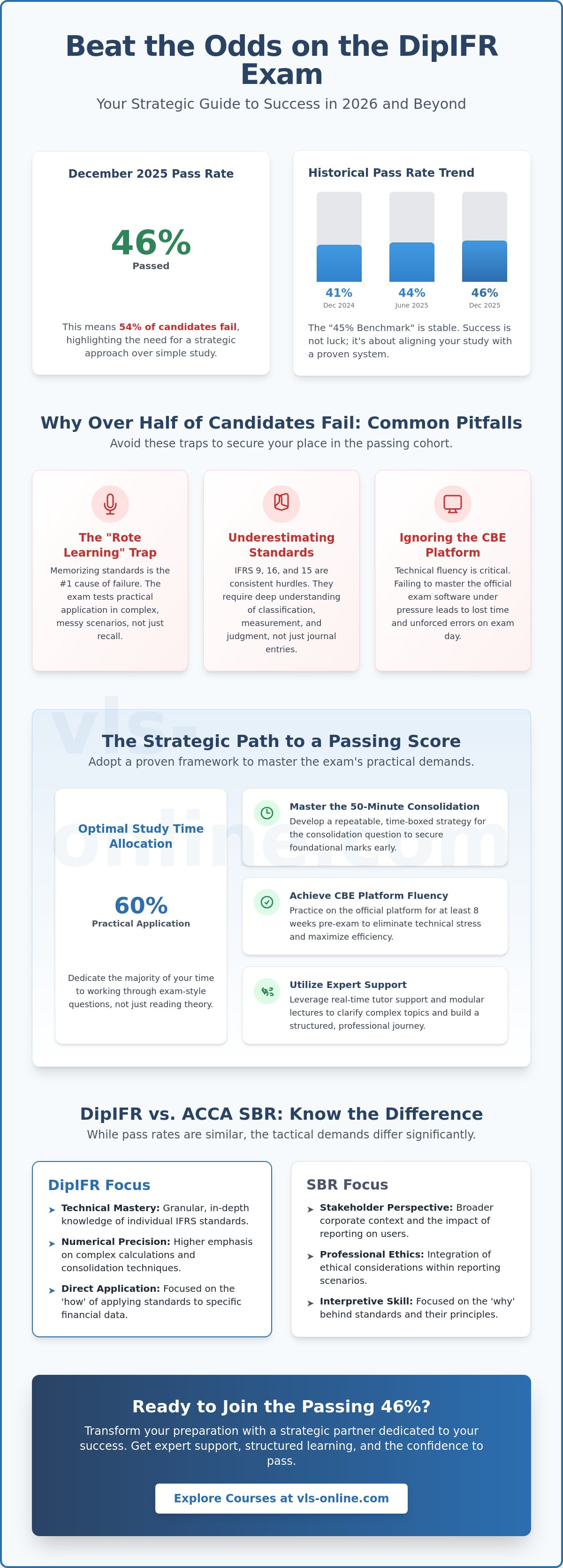
The DipIFR exam pass rate serves as a critical barometer for financial professionals aiming to validate their expertise in International Financial Reporting Standards. Defined as the percentage of candidates who achieve a score of 50% or higher, this metric reflects both the rigor of the assessment and the effectiveness of the candidate's preparation strategy. Recent data illustrates a stabilizing trend; the pass rate reached 46% in December 2025, following a 44% result in June 2025 and 41% in December 2024. These figures suggest that the Association of Chartered Certified Accountants (ACCA) maintains a consistent level of difficulty that rewards methodical, application-based study.
For those entering the 2026 cycle, this consistency provides a degree of strategic predictability. The "45% Benchmark" isn't an indicator of an impossible hurdle, but rather a sign that nearly half of all candidates who approach the exam with a structured framework succeed on their first attempt. Succeeding in 2026 isn't about luck. It's about aligning your study habits with a proven system that accounts for the standardized complexity of the syllabus. When you understand that the exam is designed to test professional judgment rather than simple memorization, the path to the passing bracket becomes much clearer.
Comparative Analysis: DipIFR vs. ACCA SBR
Many candidates compare this qualification to the Strategic Business Reporting (SBR) paper. While the DipIFR exam pass rate often mirrors SBR's performance metrics, the tactical demands differ significantly. SBR focuses heavily on stakeholder perspectives and professional ethics within a broader corporate context. In contrast, the Diploma in IFRS requires a more granular, technical mastery of individual standards and their consolidated application. Understanding these structural nuances is essential for professionals transitioning from local GAAP to a global reporting framework; the Diploma demands a higher precision in numerical calculations and consolidation techniques.
Seasonal Fluctuations: June vs. December Sessions
A common misconception suggests that either the June or December session offers a path of least resistance. Historical data from the past five years refutes this, showing that fluctuations are typically marginal and tied to candidate readiness rather than varying exam difficulty. Whether you're targeting the June 4th or December 10th sitting in 2026, the playing field remains level. The ACCA ensures that every session tests a representative cross-section of the syllabus, maintaining the integrity of the certification regardless of the season. Success depends on your long-term preparation window, not the month on the calendar.
Why the DipIFR Pass Rate Remains Challenging: Common Pitfalls
The DipIFR exam pass rate reflects a rigorous standard that demands more than mere academic familiarity with reporting rules. Many professionals underestimate the shift from local GAAP to a principles-based framework, leading to a persistent gap between effort and results. Understanding the Factors Influencing ACCA Pass Rates reveals that technical proficiency is only half the battle; the ability to interpret the intent behind the standards is what separates successful candidates from the rest.
The primary cause of failure in 2026 remains the "rote learning" trap. Candidates often attempt to memorize the specific wording of standards rather than practicing their application in varied contexts. This approach fails because the exam presents messy, multi-layered scenarios where the correct accounting treatment isn't immediately obvious. You must be able to synthesize information quickly and provide a reasoned argument for your chosen methodology.
Technical Standards That Lower the Average
IFRS 9 (Financial Instruments) and IFRS 16 (Leases) continue to be the most significant technical hurdles in recent sittings. These standards require a deep understanding of classification and measurement that goes beyond basic journal entries. Similarly, IFRS 15 (Revenue from Contracts) presents challenges when candidates must identify distinct performance obligations in complex, multi-element arrangements. In the 2026 DipIFR syllabus, markers evaluate professional judgment by assessing the clarity and logical consistency of the written explanation used to support a specific accounting treatment.
The Impact of "Exam Fatigue" and CBE Navigation
Question 1, which focuses on consolidated financial statements, acts as a major bottleneck. Candidates frequently spend over 60 minutes on this single task, which triggers "exam fatigue" and leaves insufficient time for the remaining 60 marks. This pressure is compounded by slow navigation within the CBE software. Poor spreadsheet formatting can obscure your logic, making it difficult for markers to award follow-through points even if your final figures are incorrect. This technical dexterity is a hallmark of specialist accounting qualifications that bridge the gap between theory and practice. To ensure you don't fall victim to these common errors, consider enrolling in a structured DipIFR preparation program that prioritizes exam technique alongside technical knowledge.
Strategic Steps to Ensure You Are in the Passing 45%
Joining the successful 45% of candidates requires a fundamental shift from passive reading to active application. You should devote at least 60% of your study hours to practical scenarios rather than theoretical review. This methodology ensures you don't just memorize definitions but are prepared to apply them under the specific constraints of the exam. Focus your energy on the "Big Three" standards; IFRS 9, 15, and 16 consistently appear in various sessions and form the technical backbone of the assessment. Mastery here provides a significant safety net for your overall score.
Technical fluency on the Computer Based Exam (CBE) platform is just as critical as your accounting knowledge. You must start using the official practice portal at least 8 weeks before your exam date. This early adoption prevents the navigation errors and formatting delays that often depress the DipIFR exam pass rate. Additionally, you should internalize the marking scheme to identify "easy marks." Learning that you can earn credit for a logical explanation or a correctly applied principle, even if a final calculation is wrong, allows you to maintain composure when faced with a difficult question.
A 12-Week Study Roadmap for 2026
A structured timeline provides the professional security needed to manage your preparation alongside other commitments. Use Weeks 1-4 to build a robust conceptual framework of IFRS, focusing on the core principles of recognition and measurement. During Weeks 5-8, pivot to intensive question practice and standard-specific drills to sharpen your application skills. For those seeking to optimize their mental performance during this period, these accounting exam study tips offer proven techniques for memory retention and sustained focus.
The Role of Mock Exams in Boosting Success Rates
Completing a timed mock exam serves as the most accurate predictor of your actual performance. It exposes vulnerabilities in time management and technical application before they become fatal errors on exam day. Use the feedback from these sessions to pivot your strategy in the final 14 days, focusing exclusively on high-impact areas where you can gain the most marks. To secure your path to certification with a structured, expert-led approach, explore our comprehensive DipIFR preparation course designed for the 2026 syllabus.
Vertex Learning Solutions: Your Partner in Conquering IFRS
Vertex Learning Solutions serves as more than a tuition provider; we act as a strategic partner for finance professionals navigating the complexities of international reporting. Our approach simplifies the most intricate standards into structured, logical frameworks. The global DipIFR exam pass rate highlights the inherent difficulty of this certification, but it also underscores the value of a guided, disciplined preparation path. We provide a professional safety net that ensures your effort translates into a successful result.
Our expert-led lectures distill complex IFRS standards into precise, manageable modules that respect your limited study time. These recordings allow you to master the material at your own pace without sacrificing technical depth. In addition, our interactive WhatsApp support provides a discreet channel for real-time clarification, ensuring that technical hurdles don't stall your progress. We also host weekly live sessions that maintain your study momentum and simulate the accountability of a classroom environment while offering the flexibility of digital access.
Why VLS Students Consistently Outperform the Global Average
VLS candidates consistently achieve results that surpass the global 45% benchmark. We achieve this by moving beyond syllabus coverage to focus on high-yield exam techniques and the specific nuances of the 2026 CBE environment. Professionals from the 2025 and 2026 sessions have successfully secured their certification while managing high-stakes roles, proving that a structured approach can overcome the constraints of a full-time career. Our exam-focused study notes are specifically designed to maximize your marks by targeting the application-heavy marking scheme. You can view the full curriculum and enrollment options in our Diploma in IFRS course.
Start Your IFRS Journey Today
We offer full-access packages that include everything from recorded technical drills to weekly live mentoring. These flexible learning options are designed to fit into your professional life without compromising on the depth of instruction. Choosing VLS means choosing a professional safeguard that ensures your investment in your career is protected and productive. Join the elite group of IFRS-certified professionals and enroll in the DipIFR course now. We're ready to help you navigate the DipIFR exam pass rate trends and secure your professional future.
Securing Your Professional Milestone in 2026
The historical stability of the DipIFR exam pass rate confirms that this qualification is a fair but rigorous test of professional judgment. Success isn't a matter of chance; it's the result of a disciplined study roadmap and a deep focus on practical application. By avoiding the pitfalls of rote learning and mastering the CBE environment, you position yourself among the successful elite who lead the global reporting landscape.
Navigating this journey alone can be daunting, but you don't have to manage the complexity without a strategic partner. Our framework provides a professional protective net through real-time WhatsApp tutor support and weekly live interactive sessions that keep your momentum steady. With comprehensive 2026 exam-focused study materials, we ensure you have every tool needed to translate your hard work into a world-class certification.
Master IFRS and pass your exam with Vertex Learning Solutions. We're committed to your professional growth and look forward to seeing you succeed in your upcoming session.
Frequently Asked Questions
Is the DipIFR exam harder than the ACCA SBR exam?
The difficulty of these assessments is comparable, but they demand different professional focuses. Strategic Business Reporting (SBR) evaluates your ability to discuss accounting standards within a broader corporate and ethical context, whereas the Diploma in IFRS requires a more granular, technical precision. While the global pass rates often mirror one another, candidates frequently find the Diploma more challenging due to its concentrated focus on complex numerical applications and consolidation techniques.
How many hours of study are required to pass DipIFR in 2026?
A minimum of 150 to 200 hours of disciplined study is recommended to achieve a passing score. Successful candidates typically allocate at least 12 weeks to their preparation, ensuring they have sufficient time for both conceptual understanding and intensive question practice. Devoting approximately 80 hours specifically to the CBE practice platform is a strategic necessity for managing the technical rigors of the 2026 syllabus.
Can I pass the DipIFR exam through self-study alone?
While self-study is a possible route, statistical data suggests it significantly lowers your probability of success. Candidates who prepare without expert guidance often struggle with the practical application of complex standards like IFRS 9 or IFRS 16. Research indicates that structured support and completing a high volume of practice questions can nearly double a candidate's chances of success compared to those who rely solely on independent reading.
What is the passing mark for the DipIFR exam?
The passing mark is exactly 50%. You must achieve this score within a three hour computer based assessment that tests both your theoretical knowledge and your ability to apply IFRS to practical scenarios. To reach this threshold, you don't need a perfect paper; instead, you must demonstrate a consistent ability to explain the principles behind your calculations and earn marks through logical, structured responses.
Why do the DipIFR pass rates fluctuate between sessions?
Fluctuations in the DipIFR exam pass rate are generally tied to the collective readiness of the candidate pool and the specific mix of technical standards featured in a session. While the exam difficulty is standardized to ensure professional integrity, certain topics like complex business combinations can challenge candidates more than others. In 2026, the introduction of IFRS 18 is expected to be a focal point that will require candidates to demonstrate updated, precise technical knowledge to maintain these passing averages.