

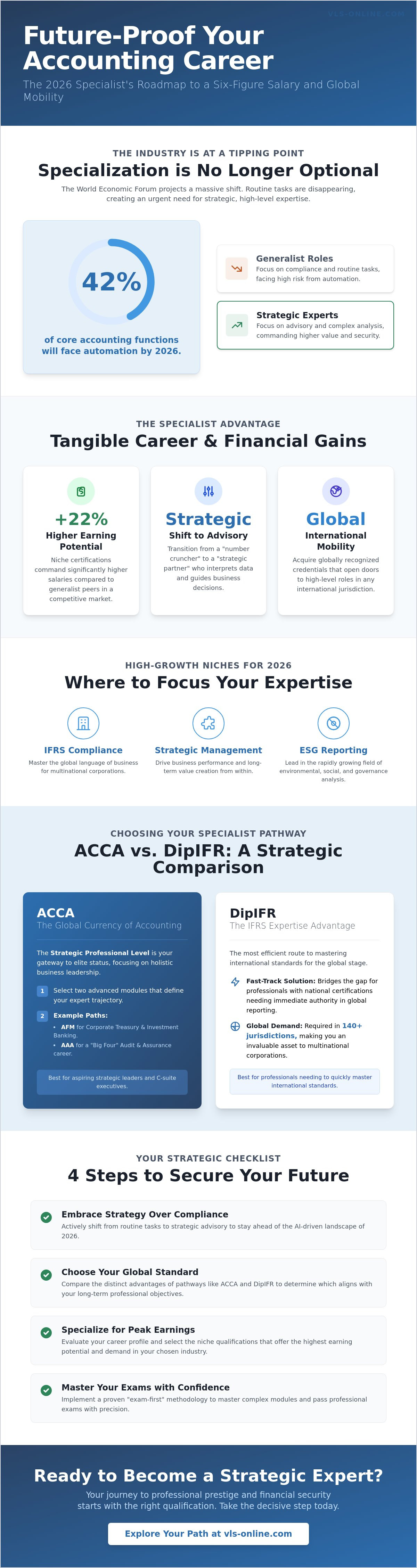
The World Economic Forum’s data suggests that 42% of core accounting functions will face automation by 2026, creating a sharp divide between generalists and strategic experts. You've likely felt the limitations of a standard certification when competing for high-level roles in a saturated market. It’s common to feel apprehensive about the complexity of international exams or the portability of your current status. However, remaining in a generalist position offers little protection against the shifting regulatory environment. Selecting the correct specialist accounting qualifications is a decisive step toward securing your professional legacy and ensuring global mobility. You deserve a career path that offers both intellectual prestige and financial stability.
This guide provides a clear roadmap to the credentials that will maximize your earning potential and future-proof your career in the 2026 global economy. We'll analyze the specific benefits of IFRS and Strategic Management niches to help you achieve expert status and secure a six-figure salary. By focusing on these high-demand areas, you can transform your professional profile into a strategic asset that commands respect in any international jurisdiction.
Key Takeaways
- Understand why shifting from compliance-based tasks to strategic advisory is essential for navigating the AI-driven landscape of 2026.
- Compare the distinct advantages of ACCA and CIMA pathways to determine which global standard aligns with your professional objectives.
- Evaluate your career profile to select the specialist accounting qualifications that offer the highest earning potential in your chosen industry.
- Implement a proven "exam-first" methodology to master complex modules such as SBR with professional confidence and precision.
The Shift Toward Specialist Accounting Qualifications in 2026
The finance industry reached a critical inflection point in early 2025. Automation now handles approximately 70% of routine data entry and basic reconciliation tasks, according to recent industry benchmarks. This shift forces a rapid transition from generalist roles to specialized expertise. Specialist accounting qualifications aren't just certificates; they're strategic assets that distinguish a professional from an algorithm. These credentials move beyond basic compliance, focusing instead on complex risk assessment and the structural integrity of global financial systems.
By 2026, the premium on specialized knowledge has translated into tangible financial gains. Recruitment data from the final quarter of 2025 shows that professionals with niche certifications command salaries 22% higher than their generalist peers. This gap continues to widen as borderless business operations demand a deep, nuanced understanding of global standards. Adopting a specialized path is the most effective method to ensure professional security and authority in a competitive market.
Why Specialization is No Longer Optional
The era of the "number cruncher" has ended. Modern corporate structures require a "strategic partner" who interprets data rather than just recording it. Specialized skills in complex regulation and data forensic analysis provide a protective moat for your career. These skills are difficult to replicate through AI, ensuring long-term stability. Professionals who focus on niche areas like tax litigation or forensic accounting offer a level of protection that software cannot match.
Future-Proofing Your Finance Career
Identifying high-growth niches is the first step toward long-term security. In 2026, three areas dominate the demand: ESG reporting, IFRS compliance, and Strategic Management. While these certifications provide the theoretical framework, technical execution remains vital. Understanding how Advanced Excel for Accountants masterfully handles data strategy is a necessary complement to any professional certification.
Success in this environment requires a structured approach to learning. Professionals must choose paths that align with global trends, such as the DipIFR for international reporting or specialized ACCA courses that focus on strategic business leadership. Precision in education leads to precision in practice, providing the safety net required in a complex regulatory world.
Comparing the Top Specialist Accounting Pathways
The transition from a generalist to a specialist requires a strategic assessment of global market demands. As of 2024, the complexity of international tax laws and reporting standards has increased the value of specialist accounting qualifications by approximately 22% in senior management roles. Professionals must decide between broad strategic certifications and niche technical credentials to secure their career trajectory.
ACCA: The Global Currency of Accounting
The ACCA Strategic Professional level serves as the final gateway to elite status. Candidates select two options from four advanced modules, a decision that defines their professional trajectory for years. Choosing Advanced Financial Management (AFM) over Taxation often signals a move toward corporate treasury or investment banking. AFM focuses on complex hedging and multinational finance; conversely, Advanced Audit and Assurance (AAA) prepares experts for the rigorous demands of the "Big Four" environment. You can explore the specific requirements for these modules through VLS ACCA Courses to ensure your preparation meets the 2026 standards.
IFRS Expertise: The DipIFR Advantage
The Diploma in IFRS is the most efficient route to acquiring specialist accounting qualifications for the global stage. It bridges the gap for professionals holding national certifications who need to master international standards. With over 140 jurisdictions requiring IFRS for domestic listed companies, this qualification isn't just a certificate; it's a tool for managing consolidated accounts in multinational corporations. It's a fast-track solution for those who don't require a full three-year program but need immediate authority in international reporting. Before committing, consult the DipIFR Online Training guide to select a course that aligns with your professional schedule.
CIMA remains the gold standard for management accounting, focusing on the CGMA designation. It prioritizes business strategy over traditional audit, making it ideal for internal leadership roles. Whether you choose a broad certification or a sector-specific credential like the IFRS specialist path, your choice should reflect a commitment to long-term professional stability and precision.
Choosing Your Niche: Which Qualification Fits Your Goals?
Selecting the right path requires more than just looking at syllabus topics; it's a strategic alignment of your professional temperament with market demands. You must first determine if you're a "Rules Expert" or a "Value Creator." Rules Experts thrive in audit and tax environments where regulatory compliance, risk mitigation, and precision are the primary objectives. Value Creators, conversely, find their purpose in management accounting, using financial data to drive corporate strategy and operational efficiency.
Your choice of specialist accounting qualifications should also reflect your target industry. The banking and public sectors often demand the rigorous compliance standards of the ACCA. In contrast, the fast-paced tech industry frequently prioritizes the strategic foresight provided by the CIMA professional qualification. Global mobility is another critical factor to weigh. Certifications like the ACCA are recognized in 181 countries, providing a secure professional protective net for those seeking international careers in major financial hubs.
Strategic Career Mapping
Choosing between frameworks depends on your long-term vision. If your goal is a CFO role in a multinational corporation, the broad reporting expertise of ACCA is often the industry standard. If you aim for a Chief Strategy Officer position, CIMA's focus on business simulation is often superior. Before committing, audit your current employer's leadership team; data from 2024 shows that 74% of senior finance roles in FTSE 100 companies are held by individuals with specific chartered status. This helps you identify which credentials your organization values most.
The ROI of Specialization
The 2024 Hays Salary Guide indicates that professionals with specialist accounting qualifications earn an average of 18% more than their non-specialized peers. While the initial investment includes exam fees and study materials, the long-term career earnings typically recoup these costs within the first 24 months of achieving status. We recommend a "stacking" strategy, where you combine a foundational chartership with a niche diploma like the DipIFR to maximize your market value and professional security.
A Strategic Framework for Passing Professional Exams
Acquiring specialist accounting qualifications in 2026 demands a departure from passive learning. The "Exam-First" methodology focuses on the practical application of concepts from the start of the study cycle. Instead of spending weeks reading textbooks, candidates should engage with past papers and case studies immediately. This approach builds the cognitive stamina required for high-stakes assessments. It's about understanding the logic behind the standards, which is essential for complex modules like SBR.
Time is the most scarce resource for working professionals. Utilizing recorded lectures allows you to integrate study sessions into a 40-hour work week without sacrificing quality. Active feedback loops, such as tutor WhatsApp support, ensure that technical doubts don't stall your progress for more than a few hours. These real-time interactions provide the professional safety net necessary to navigate intricate tax and reporting frameworks with confidence. You'll find that immediate clarity on a single complex point can save days of independent research.
Modern Study Techniques for 2026
Traditional textbooks often fail to capture the nuances of current exam environments. By 2026, examiners expect candidates to demonstrate strategic foresight rather than rote memorization. Digital platforms provide the agility needed to stay updated with shifting regulations. For a deeper dive into these methodologies, read our guide on Accounting Exam Study Tips. This resource outlines how to transition from a student mindset to that of a strategic advisor.
The VLS Advantage: Exam-Focused Preparation
Vertex Learning Solutions structures every course for the Strategic Professional level to mirror the rigors of the actual exam. Weekly live sessions provide a structured environment where you can test your knowledge against peer benchmarks. This disciplined approach ensures you're not just prepared, but poised for success. Explore our full range of specialist accounting courses here to begin your professional advancement with a partner that values precision and results.
Secure Your Strategic Advantage for 2026
The accounting landscape in 2026 demands more than foundational knowledge; it requires a precise focus on niche expertise. Navigating the shift toward specialist accounting qualifications is the most reliable way to ensure long-term professional security and career advancement. Success in these rigorous examinations depends on a structured framework and access to elite resources that simplify complex regulatory environments.
Since 2016, VLS Online has provided the professional scaffolding needed to master these challenges. Our methodology combines exam-focused study materials with direct expert tutor support via WhatsApp, ensuring you're never left without guidance. You'll benefit from weekly live interactive sessions that transform dense theoretical concepts into actionable strategic insights. By choosing a path that aligns with your specific career goals, you aren't just passing an exam; you're building a defensive perimeter around your professional future.
Start your journey to becoming a specialist with our full access packages and gain the stability that comes with true expertise. You've the potential to lead in this evolving market, and we've the proven tools to get you there.
Frequently Asked Questions
Is it better to get a Master's degree or a specialist accounting qualification?
Choosing specialist accounting qualifications over a Master's degree provides a more direct path to technical mastery and regulatory compliance. The 2024 Robert Half Salary Guide indicates that 72% of hiring managers prioritize specific certifications over advanced degrees for technical financial roles. While a Master's offers academic depth, these qualifications ensure you're prepared for the precise requirements of modern tax and audit environments. This focus on immediate applicability makes them a superior choice for strategic career advancement.
Can I study for ACCA or CIMA while working a full-time job?
You're fully capable of completing ACCA or CIMA while working full-time by utilizing flexible, digital learning platforms. Statistics from ACCA Global show that 80% of their students maintain employment to meet the mandatory 36 months of practical experience. Success requires a disciplined schedule, typically involving 15 to 20 hours of study per week. This dual approach integrates theoretical knowledge with real-world financial scenarios, which builds your professional integrity and practical skill set simultaneously.
Which accounting specialization pays the highest salary in 2026?
Forensic accounting and ESG reporting specialists are projected to command the highest salaries in 2026. Data from the 2025 Financial Recruitment Trends report suggests these experts earn a 25% premium compared to general practitioners. As global reporting standards like CSRD become mandatory for 50,000 companies, professionals who hold specialist accounting qualifications in sustainability will see the most significant compensation growth. These roles demand precise risk management and rigorous ethical oversight in a complex regulatory landscape.
How long does it typically take to complete a specialist accounting qualification?
It typically takes 3 to 4 years to earn a specialist accounting qualification, assuming you're balancing exams with professional experience. For example, the CIMA qualification includes 16 exams, which most candidates finish within 48 months. If you hold a relevant undergraduate degree, you might receive up to 9 exemptions from ACCA, which can reduce your timeline to just 24 months. This structured progression ensures you develop the necessary depth of expertise required for high-level financial stability.
Are specialist accounting qualifications recognized globally?
Most major qualifications are recognized in more than 180 countries, providing a portable professional license for international career mobility. The ACCA maintains over 100 formal partnerships with global accounting bodies, ensuring your credentials meet international audit and tax standards. This global reach offers a secure professional safety net. It allows you to operate with confidence across different jurisdictions while maintaining the highest standards of legal and financial excellence.