

What if the barrier to passing the ACCA Financial Management (FM) exam isn't the volume of content, but the lack of a structured, professional safety net? It's understandable to feel a sense of apprehension when confronting the 2026 syllabus, especially as Section C discussion questions require a level of analytical depth that goes beyond simple arithmetic. You've likely spent late nights struggling with the intricacies of WACC or NPV calculations, only to find that the absence of immediate expert feedback leaves you feeling exposed and uncertain about your progress.
Our comprehensive guide eliminates this uncertainty by providing a logical, disciplined path to success. We'll show you how to leverage CBE tools with the precision of a seasoned financial consultant, ensuring you're prepared for every complexity the 2026 examiners present. From optimizing your investment appraisal techniques to securing expert-led resolution for your most difficult queries, this article outlines the exact framework you need to achieve a passing grade and advance your career with confidence.
Key Takeaways
- Understand the strategic transition from technical accounting to high-level financial leadership through the lens of modern finance management.
- Identify the seven fundamental syllabus pillars that form the professional toolkit for managing complex investment and financing structures.
- Optimize your performance in the CBE environment by shifting focus from raw calculations to the analytical "why" behind financial data.
- Secure your path to success in ACCA Financial Management (FM) by leveraging an active support model that simulates a professional advisory environment.
- Gain the foresight to evaluate how global economic policies and financial market volatility influence long-term corporate decision-making.
What is ACCA Financial Management (FM) and Why Does it Matter in 2026?
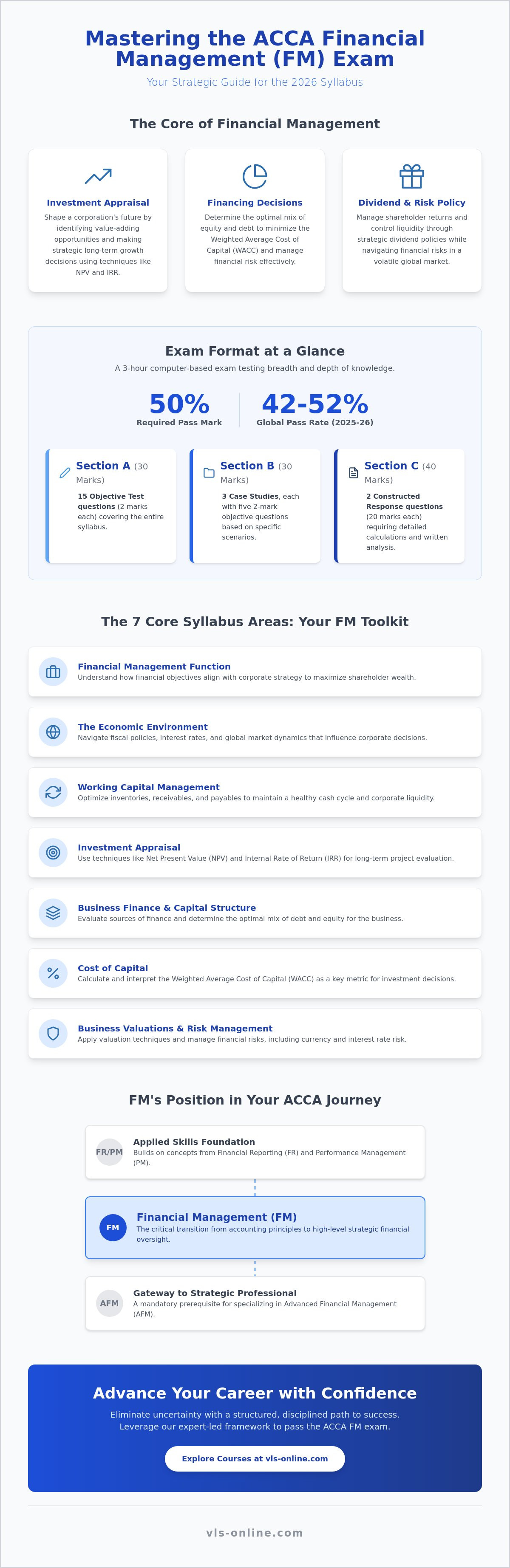
ACCA Financial Management (FM) serves as the critical transition point where foundational accounting principles evolve into high-level strategic oversight. While earlier modules focus on recording and reporting past events, FM equips professionals with the analytical tools required to shape a corporation's future. This syllabus focuses on three pillars of corporate finance: investment appraisal, financing decisions, and dividend policy. By mastering these areas, candidates gain the expertise needed to manage liquidity and risk within the Association of Chartered Certified Accountants (ACCA) framework.
In the 2026 global economy, the role of a finance manager extends beyond traditional profit maximization. Digital finance and sustainable investment strategies are now integrated into the core curriculum. Professionals must navigate complex ESG (Environmental, Social, and Governance) metrics and utilize data-driven forecasting to ensure long-term stability. This paper isn't just a hurdle; it's a mandatory prerequisite for those aiming to specialize in the ACCA Advanced Financial Management (AFM) module. It provides the technical bedrock for identifying value-adding opportunities in an increasingly volatile market.
The Position of FM in the ACCA Applied Skills Journey
ACCA Financial Management (FM) represents the culmination of the Applied Skills level. It builds upon the cost management techniques learned in Performance Management (PM) and the asset valuation concepts from Financial Reporting (FR). This integration ensures a cohesive understanding of how financial statements influence strategic choices. For a detailed roadmap of this stage, candidates should consult the ACCA Applied Skills ultimate guide. Successfully completing FM grants the necessary credits to progress toward the Strategic Professional level, marking a significant milestone in the certification path.
Exam Format and Passing Requirements
The examination is a three-hour computer-based assessment divided into three distinct segments designed to test both breadth and depth of knowledge:
- Section A: 15 objective test (OT) questions, each worth 2 marks, covering the entire syllabus.
- Section B: Three case studies, each containing five 2-mark OT questions, focusing on specific scenarios.
- Section C: Two 20-mark constructed response questions requiring detailed calculations and written discussions.
The pass mark is strictly set at 50%. Global pass rates for the 2025-2026 cycle are expected to fluctuate between 42% and 52%, reflecting the rigorous standard required for professional competency. Candidates must demonstrate a balanced ability to perform complex arithmetic and provide qualitative analysis of financial risks.
The 7 Core Syllabus Areas: A Deep Dive into the FM Toolkit
The ACCA Financial Management (FM) syllabus demands a transition from technical accounting to strategic decision-making. At its core, the financial management function ensures that a firm's financial objectives align with its broader corporate strategy. This requires a deep understanding of the financial management environment, where fiscal policies and fluctuating market conditions dictate the boundaries of corporate action. In 2026, professionals must manage high-interest environments and shifting global trade dynamics with clinical precision.
Effective working capital management remains a cornerstone of corporate liquidity. You'll master the optimization of inventories, accounts receivable, and accounts payable to maintain a healthy cash cycle. Beyond daily operations, investment appraisal techniques like Net Present Value (NPV) and Internal Rate of Return (IRR) provide the framework for long-term growth. These calculations aren't performed in a vacuum; they must account for a 3.5% inflation rate or specific corporate tax jurisdictions to ensure project viability.
Financing and Capital Structure
Determining the optimal mix of equity and debt is critical for minimizing the Weighted Average Cost of Capital (WACC). High gearing levels increase financial risk, especially when interest rates remain volatile. You'll find that many concepts regarding capital instruments overlap with Mastering ACCA Financial Reporting (FR), particularly concerning the classification of financial liabilities. Mastering these nuances allows for better capital structure optimization and long-term stability.
Business Valuation and Risk Management
Valuing a business for mergers or acquisitions requires a multifaceted approach. You'll utilize asset-based, earnings-based, and discounted cash flow methods to arrive at a fair market price. In the current 2026 market, risk management is paramount. Techniques for hedging foreign exchange and interest rate risks protect the organization from external shocks. For those seeking to deepen their expertise in these complex areas, our structured ACCA preparation provides the necessary professional protective net.
Mastering the CBE Environment: Strategies for Section C Success
Success in the ACCA Financial Management (FM) Section C requires more than mathematical accuracy; it demands a professional command of the Computer Based Exam (CBE) environment. Markers reward candidates who treat the spreadsheet as a strategic tool rather than a simple calculator. You should adopt a marker-friendly approach by using clear cell referencing for every calculation. Don't hard-code numbers directly into formulas. When a marker can trace your logic through linked cells, they can award "own figure rule" marks even if an initial value is incorrect. This technical discipline is a core component of digital exam resilience, as outlined in these accounting exam study tips for 2026 candidates.
Precision in time management is vital. You have 180 minutes to secure 100 marks, which dictates a strict allocation of exactly 1.8 minutes per mark. If a requirement offers 10 marks, you must move on after 18 minutes to protect your performance in later sections. It's essential to remember that calculations typically account for only 40% to 50% of the marks in Section C. The remaining credit lies in your ability to interpret those figures within the context of the official FM syllabus and study guide.
Writing High-Scoring Discussion Answers
To maximize marks in the word processor, use the PEE method: state your Point, provide Evidence from the scenario, and offer an Explanation of the financial implication. Professional prose is the standard here. Markers look for cohesive arguments. You should avoid bullet points unless the requirement specifically asks for a list. Clear, structured paragraphs demonstrate the executive presence required of a professional financial manager.
Common Pitfalls to Avoid in the 2026 FM Exam
Many students fail by misinterpreting requirement verbs. A "Calculate" instruction requires a numerical output, while "Discuss" or "Evaluate" demands a critical analysis of advantages and disadvantages. Additionally, candidates often neglect the "Financial Management Environment" syllabus area. This section covers interest rates and fiscal policy, which frequently appear as written requirements worth 5 to 10 marks. Ignoring these theoretical foundations often leads to avoidable failure.
Secure your professional future by enrolling in our structured ACCA preparation courses today.
Choosing the Right Study Partner: Why Vertex Learning Solutions?
Traditional online education often suffers from a "static" delivery model where students are left to navigate complex syllabi in isolation. Vertex Learning Solutions replaces this passivity with an active, classroom-simulated environment. Instead of forcing candidates to wade through 500-page textbooks that contain redundant theory, we provide exam-focused study notes. These materials distill the 2026 syllabus into high-impact, actionable knowledge. Our weekly live sessions bridge the gap between theory and practice, allowing for real-time interaction on difficult FM topics. You can explore our specific enrollment options and start your journey on the ACCA courses page.
The Power of 24/7 Tutor Support via WhatsApp
Mastering ACCA Financial Management (FM) requires solving intricate calculations where a single error can derail an entire NPV or WACC analysis. Our dedicated WhatsApp support provides a professional safeguard against study bottlenecks. When you hit a technical wall, you don't have to wait days for an email response. Instant feedback from a professional mentor allows you to maintain your study momentum. For our global student body, this 24/7 availability offers a psychological safety net, ensuring that expert guidance is accessible regardless of your time zone or schedule.
Comprehensive Learning Materials for the 2026 Cycle
Success in the 2026 exam cycle demands a structured, multi-layered approach to revision. Our curriculum integrates high-definition recorded lectures with interactive practice questions that reflect the current CBE environment. We provide rigorous mock exams to ensure your time management is as precise as your technical knowledge. If you're planning to sit multiple Applied Skills papers, the Full Access package serves as a strategic investment. It provides the resources needed to transition seamlessly between subjects, ensuring your professional development remains on a steady, successful trajectory. This holistic framework ensures you aren't just memorizing formulas but are developing the analytical precision required by the modern financial landscape.
Secure Your Strategic Advantage for the 2026 Exams
Navigating the 2026 exam cycle requires a methodical approach to the 7 core syllabus areas and a precise command of the Section C CBE environment. Professional success isn't left to chance; it's built on a foundation of structured learning and expert oversight. By integrating exam-focused study notes with comprehensive video lectures, candidates transform complex financial theories into practical, exam-ready knowledge. Our framework provides a professional safety net through weekly live interactive sessions and direct expert tutor support via WhatsApp. This ensures every technical hurdle is cleared with the clinical precision required by the current regulatory landscape. Mastering ACCA Financial Management (FM) is the definitive step toward long-term career stability and professional authority in the global market. You've the talent to succeed, and we've the strategic tools to ensure you reach the finish line with confidence.
Enroll in the Vertex ACCA Financial Management (FM) Course Today
Frequently Asked Questions
Is ACCA FM harder than Performance Management (PM)?
Performance Management (PM) historically yields lower pass rates than ACCA Financial Management (FM), with September 2023 figures showing a 42% success rate for PM compared to 48% for FM. While PM focuses on complex variance analysis and performance evaluation, FM requires a more strategic grasp of corporate finance and investment appraisal. You'll find FM more logical if you prefer structured mathematical frameworks over the subjective interpretations required in PM.
Can I pass ACCA FM by self-studying with just a textbook?
You can pass using only a textbook, but ACCA statistics indicate that students utilizing structured tuition are 25% more likely to succeed. Relying solely on a 500 page study text often leads to gaps in exam technique and spreadsheet proficiency. We recommend supplementing your reading with the ACCA Practice Platform. It's essential for mastering the 60% of the exam that requires practical application and technical precision.
What is the most difficult topic in the FM syllabus?
Candidates identify Working Capital Management and Business Valuations as the most challenging areas because they comprise roughly 40% of the exam's weighted marks. These sections require you to integrate complex ratios with strategic decision making rather than just performing isolated calculations. Mastering the interplay between risk and return in Section E is critical for securing the 50% pass mark required for professional qualification.
How much time should I dedicate to studying for the FM exam?
You should allocate approximately 150 hours of focused study time to master the ACCA Financial Management (FM) syllabus. This schedule typically spans 10 to 12 weeks, requiring 10 hours of weekly reading and practice. Dedicating 20% of this time specifically to mock exams on the official CBE environment is a proven strategy for mitigating exam day risks. It's the most effective way to ensure long term retention.
Are the formulas provided in the ACCA FM exam?
A standard formula sheet is provided within the digital exam environment, covering approximately 12 essential equations such as the Capital Asset Pricing Model (CAPM) and the Weighted Average Cost of Capital (WACC). You won't receive formulas for basic financial ratios or net present value (NPV) calculations. It's vital to memorize the 15 to 20 foundational ratios that aren't included in the provided tables to maintain your pace.