

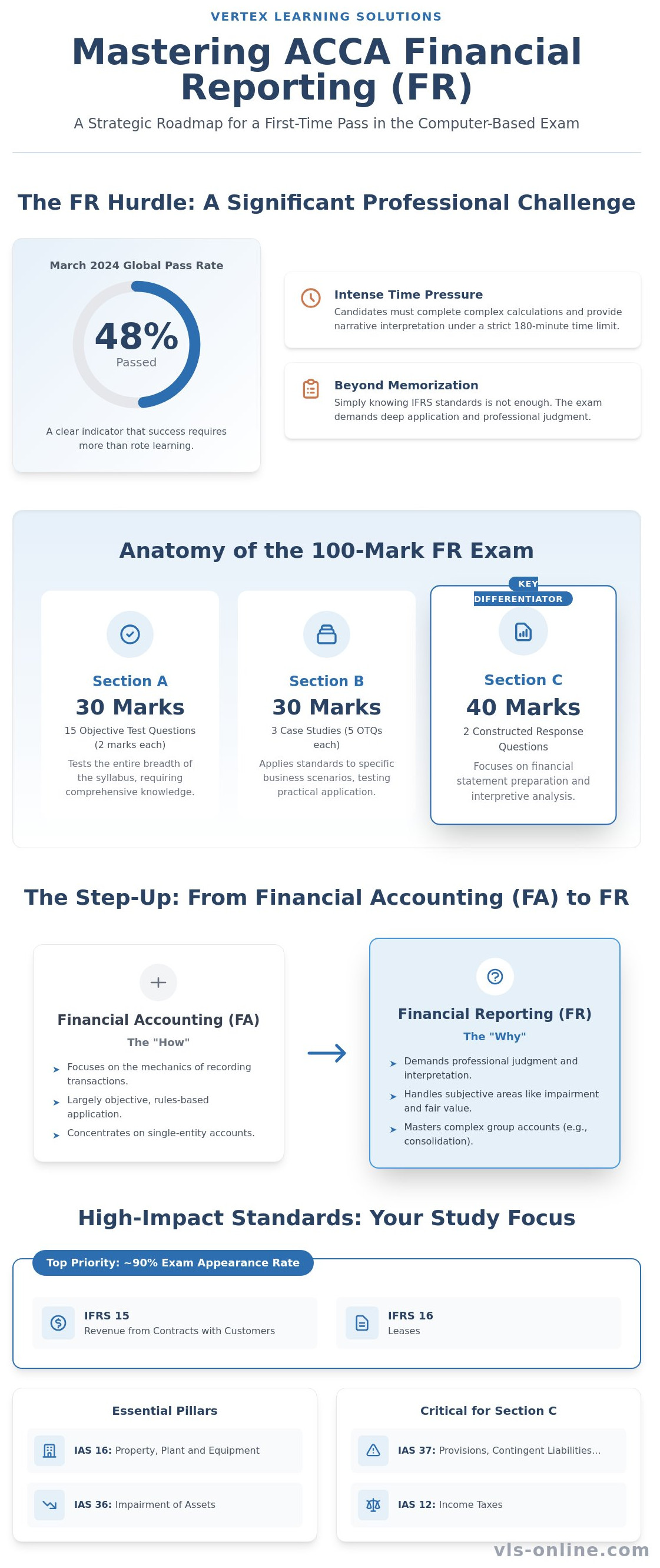
With the global pass rate for the March 2024 session sitting at just 48%, it's clear that many candidates find the transition to ACCA Financial Reporting (FR) a significant professional hurdle. You've likely felt the weight of the IFRS framework, where simply memorizing standards isn't enough to secure a passing mark. It's a common frustration to spend hours on complex calculations only to realize the examiner requires a deep, narrative interpretation of those figures under the 180-minute time constraint of the computer-based exam.
We recognize that your time is a finite asset and you require a study structure that offers both security and measurable progress. You're right to believe that the 2026 syllabus demands more than just rote learning; it requires a strategic approach to consolidation and a precise understanding of financial statement analysis. This guide provides the professional protective net you need, offering a 12-week roadmap to master complex accounting standards and ensure a first-time pass. We'll break down the mechanics of group accounts and demonstrate how to turn raw ratios into the insightful commentary that top-tier firms expect.
Key Takeaways
- Understand the structural transition from basic bookkeeping to the complex requirements of ACCA Financial Reporting (FR) to build a solid professional foundation.
- Identify the high-weightage IFRS and IAS standards, such as revenue recognition and leases, that consistently anchor the ACCA Financial Reporting (FR) exam syllabus.
- Master the mechanics of consolidated financial statements and interpretation techniques to gain confidence in the most challenging technical areas of ACCA Financial Reporting (FR).
- Implement a structured 12-week ACCA Financial Reporting (FR) study roadmap and leverage the official practice platform to ensure peak performance under exam conditions.
- Discover how strategic online tuition and direct tutor support for ACCA Financial Reporting (FR) provide the professional safety net required for a definitive first-time pass.
Understanding the ACCA Financial Reporting (FR) Exam Structure
The transition to ACCA Financial Reporting (FR) represents a critical juncture for aspiring professionals. It's more than a simple academic progression; it's the bridge connecting fundamental bookkeeping with the complexities of strategic corporate reporting. This stage, overseen by the Association of Chartered Certified Accountants (ACCA), ensures that candidates can move beyond data entry to provide high-level financial analysis and regulatory compliance.
Success in this module requires a shift from memorization to application. You must understand the conceptual and regulatory framework, which serves as the legal and logical foundation for all accounting standards. This framework isn't just theory; it's the protective shield that ensures transparency in global markets.
The Step-Up: How FR Differs from Financial Accounting (FA)
Financial Accounting (FA) focuses on the mechanics of recording transactions. It's largely objective. In contrast, ACCA Financial Reporting (FR) demands a deeper level of professional judgment. You'll move beyond single-entity accounts to master complex group structures, often involving parent-subsidiary relationships where a 51% stake triggers full consolidation. The shift is from "how to record" to "why we report this way." Understanding the "why" allows you to handle subjective areas like impairment or fair value adjustments with precision.
Breakdown of the Exam Sections (A, B, and C)
The Computer Based Exam (CBE) utilizes a structured three-part approach to test the 100-mark syllabus. This format ensures a comprehensive evaluation of both technical knowledge and analytical skill. The exam is divided as follows:
- Section A: 15 objective test questions, each worth 2 marks, totaling 30 marks. These questions cover the entire breadth of the syllabus, leaving no room for selective studying.
- Section B: Three case-study scenarios. Each scenario features 5 objective test questions, contributing another 30 marks. This section tests your ability to apply standards to specific business contexts.
- Section C: Two 20-mark constructed response questions. These focus on the preparation of financial statements and the interpretation of performance through ratio analysis.
Mastery of Section C is often what separates successful candidates from the rest. It requires you to construct logical arguments and explain the financial health of an entity, rather than just calculating numbers. You're expected to provide a strategic overview that a board of directors could rely on for long-term decision-making. This rigorous structure prepares you for the professional demands of modern financial management.
Mastering the Core Syllabus: IFRS and IAS Standards
Success in the ACCA Financial Reporting (FR) exam requires a surgical focus on the standards that form the backbone of the official ACCA Financial Reporting (FR) syllabus. Statistical analysis of exam sittings between 2018 and 2023 reveals that IFRS 15 (Revenue from Contracts with Customers) and IFRS 16 (Leases) appear in nearly 90% of cycles. These standards aren't just theoretical; they dictate the timing of recognized income and the fundamental structure of the statement of financial position.
IAS 16 (Property, Plant and Equipment) remains a constant pillar. You've got to master the transition from cost to revaluation models, ensuring every depreciation adjustment is calculated precisely to the nearest month. When asset values fluctuate, IAS 36 (Impairment of Assets) serves as the professional safety net. Candidates must accurately identify the higher of fair value less costs of disposal and value in use. Mastering these mechanics ensures your non-current asset register remains beyond reproach.
Section B often presents "mixed standard" questions designed to test your logical agility. A single scenario might require you to apply IAS 2 (Inventory) alongside IAS 10 (Events After the Reporting Period). To succeed, isolate each accounting issue. Don't rush the analysis. Treat each requirement as a distinct professional obligation to the stakeholders, ensuring the economic reality of the transaction is captured with precision.
Crucial Standards for Section C Success
Section C demands a deep understanding of IAS 37 (Provisions, Contingent Liabilities and Contingent Assets) and IAS 12 (Income Taxes). These standards often create the complex adjusting entries that bridge the gap between a draft trial balance and the final published accounts. IFRS 15's core objective is to recognize revenue in a way that depicts the transfer of promised goods or services to customers in an amount that reflects the consideration to which the entity expects to be entitled, following a rigorous five-step identification and measurement process.
The Conceptual Framework: The Examiner’s Favourite Tool
The Conceptual Framework provides the logical structure when specific standards don't offer direct guidance. It's the ultimate professional protective layer. Focus your revision on the fundamental qualitative characteristics: Relevance and Faithful Representation. Relevance ensures information is capable of making a difference in user decisions; Faithful Representation ensures the economic substance of a transaction is recorded, not just its legal form. Using these definitions in discussion-based questions can secure the final 3-4 marks needed to exceed the 50% pass mark. For those seeking a higher level of preparation, the strategic support at VLS Online provides the structured clarity needed for these complex areas.
The Art of Consolidation and Interpretation
Consolidated financial statements often represent the primary source of anxiety for students sitting the ACCA Financial Reporting (FR) exam. This fear is usually misplaced. Success in consolidation doesn't require creative flair; it requires a disciplined, mechanical application of the standard workings approach. By isolating the net assets of the subsidiary at both the acquisition date and the reporting date, you create a logical foundation for the entire question. This structured methodology ensures that even the most complex group structures become manageable under exam pressure.
Simplifying Group Accounts and Consolidation
Mastering the mechanics of the consolidated statement of financial position relies on five core workings. You must prioritize the Net Assets working, as it directly influences Goodwill, Non-controlling interest (NCI), and Group Retained Earnings. In the September 2023 sitting, many candidates struggled with mid-year acquisitions. If a parent acquires a subsidiary on 1 October for a 31 December year-end, you must time-apportion the subsidiary’s profit for the 3 months of ownership. Precision in intra-group eliminations is equally vital. Whether it's removing intra-group balances or calculating the Provision for Unrealized Profit (PURP), these adjustments ensure the group is viewed as a single economic entity. These requirements are strictly defined by the International Financial Reporting Standards (IFRS), which provide the legal and professional framework for all group reporting tasks.
Ratio Analysis: Moving Beyond the Calculations
The 20-mark interpretation question is the most misunderstood part of the ACCA Financial Reporting (FR) paper. Candidates often spend 15 minutes calculating dozens of ratios, yet the marking scheme typically allocates only 1 mark per ratio for the calculation itself. The remaining 10 to 15 marks are awarded for the interpretation. You'll succeed by linking the movement in a ratio to the specific facts provided in the exam scenario. If the gross profit margin fell from 32% to 26% in 2023, don't just state the figure. Explain that the 6% drop likely relates to the 12% increase in energy costs or the warehouse fire mentioned in the text.
To provide a professional, high-scoring answer, structure your analysis using these distinct categories:
- Profitability: Focus on Gross Profit and Operating Profit margins. Analyze how revenue growth compares to the increase in cost of sales.
- Liquidity: Evaluate the Current Ratio and Quick Ratio. Determine if the company has sufficient liquid assets to meet its short-term obligations within the next 12 months.
- Efficiency: Examine inventory turnover and receivable days. If receivable days increased from 45 to 60, identify if this suggests poor credit control or a strategic decision to offer longer terms to attract new customers.
This strategic approach transforms a basic numerical exercise into a sophisticated business report. It demonstrates that you don't just see the numbers; you understand the underlying commercial reality they represent.
Proven Exam Techniques and Study Strategies
Success in the ACCA Financial Reporting (FR) exam demands a disciplined, strategic approach rather than mere rote memorization. For working professionals, a 12-week study plan provides the necessary structure to balance career commitments with academic rigor. You should dedicate the first eight weeks to syllabus coverage, focusing on the core principles of IFRS and IAS. The subsequent two weeks must transition into intensive application on the ACCA Practice Platform, leaving the final 14 days for simulated mock exams and targeted refinement of weak areas.
Mastering the technical content is only half the battle; time management determines the final outcome. The 180-minute exam allocates 1.8 minutes per mark. You must strictly adhere to this ratio to ensure Section C, which carries 40% of the total marks, isn't rushed. If a complex consolidation adjustment in Section C is consuming too much time, move on. Securing easy marks across the entire paper is more efficient than perfecting a single calculation at the expense of unread questions.
Active Recall is the most effective psychological tool for internalizing accounting standards. Instead of passively re-reading notes on IAS 36 or IFRS 16, hide your materials and attempt to write down the recognition and measurement criteria from memory. This method strengthens neural pathways; it ensures that when you face a challenging scenario, the relevant financial reporting framework is immediately accessible.
Leveraging the ACCA Practice Platform
You must stop practicing on paper immediately. The actual exam occurs in a Computer Based Exam (CBE) environment, and familiarity with the interface is a strategic advantage. Use the spreadsheet tool to master "Copy and Paste" functions and basic formulas like =SUM or =ROUND. These technical proficiencies can save you approximately 10 to 15 minutes during the live exam. Simulating full 3-hour mocks on the platform builds the mental stamina required to maintain accuracy until the final minute.
Effective Revision: The Final 2 Weeks
The final phase of your preparation should be data-driven. Analyze your mock exam performance to identify recurring errors in specific standards. Use "Question Drilling" for Sections A and B to sharpen your speed on objective test questions. It's also vital to review the 2023 and 2024 Examiner Reports. These documents provide a transparent look at common pitfalls, such as the misinterpretation of "substance over form" or errors in cash flow classifications, allowing you to avoid the mistakes that hinder many candidates.
Prepare for your professional journey with a partner who understands the complexities of global financial standards.
Secure your professional future with VLS OnlineWhy Vertex Learning Solutions is Your Strategic Partner for FR
Vertex Learning Solutions (VLS) provides more than a digital platform; it offers a structured pathway to professional certification. The online tuition model balances the flexibility of self-paced learning with the academic rigor required by the ACCA. Many students struggle with the transition from basic bookkeeping to complex financial analysis, but VLS addresses this by providing a strategic framework. This ensures 100% syllabus coverage while respecting your professional commitments. It's a system designed for the modern professional who demands efficiency without sacrificing depth.
Success in the ACCA Financial Reporting (FR) exam demands immediate resolution of technical queries. VLS integrates direct WhatsApp tutor support to eliminate the friction of waiting for email responses. This allows for instant clarification on complex IFRS applications as they arise during your study sessions. Weekly live sessions complement this by transforming theoretical knowledge into exam-room proficiency. These sessions focus on high-yield topics like consolidated financial statements, which historically account for a significant portion of the marks in Section C. VLS stands as the definitive solution for students who require a proactive partner rather than just a static textbook.
Expert Tutors and Comprehensive Study Materials
The curriculum is delivered through recorded lectures that dissect intricate IFRS standards into manageable, bite-sized modules. These resources are paired with exam-focused study notes designed for 85% retention during the final revision phase. Our tutors bring over 15 years of industry experience, ensuring that every lesson is grounded in practical application. For those looking to build a broader foundation, our ACCA Applied Skills packages provide a cohesive roadmap across multiple subjects, ensuring long-term professional compliance and growth.
The VLS Community: Global Support, Local Success
VLS operates as a global hub for a network of over 10,000 aspiring accountants across the UK, Asia, and Africa. This community facilitates peer-to-peer motivation and shared insights into regional accounting practices. Our students consistently achieve pass rates that exceed the global average by 20% or more. This success stems from a proactive approach to risk management in exam preparation. You aren't just buying a course; you're securing a professional partnership that prioritizes your career stability. To begin your journey with an elite expert team, enrol in the ACCA FR course today and secure the results your hard work deserves.
Secure Your Professional Future in 2026
Transitioning from theory to application is the definitive hurdle in the 2026 exam cycle. You've seen how mastering the specific nuances of IFRS and IAS standards accounts for the majority of the syllabus. Success isn't just about reading; it's about the precision of your consolidation techniques and the depth of your financial analysis. Data indicates that candidates who complete at least 5 full-length mock exams on the official practice platform see a marked increase in their performance. It's about building a robust framework that withstands the pressure of the 3-hour CBE format.
Navigating the complexities of ACCA Financial Reporting (FR) requires more than just self-study; it demands a strategic partner. Vertex Learning Solutions provides the professional structure you need to succeed. Our students benefit from direct WhatsApp tutor support for real-time query resolution and weekly live interactive sessions that break down technical standards. We provide 300+ pages of comprehensive exam-focused study notes to ensure no detail is overlooked. You don't have to face these complex regulations alone.
Start your ACCA FR journey with expert tutor support at Vertex Learning Solutions
Your path to becoming a qualified professional is within reach; let's secure that pass together.
Frequently Asked Questions
Is ACCA Financial Reporting (FR) hard to pass?
The ACCA Financial Reporting (FR) exam presents a moderate challenge, requiring a transition from basic bookkeeping to complex analysis. Historical data shows that approximately 48% of candidates successfully clear this paper each session. You'll need to master consolidated financial statements and the conceptual framework to succeed. Success depends on your ability to apply accounting standards to practical scenarios rather than just memorizing rules.
What is the difference between ACCA FA and FR?
ACCA FA focuses on the mechanics of double-entry bookkeeping and basic financial statements. In contrast, the ACCA Financial Reporting (FR) syllabus expands into group accounting, complex IFRS applications, and ratio analysis. While FA tests your ability to record transactions, FR demands a strategic understanding of how these figures impact the broader business narrative. It's a progression from data entry to professional interpretation.
Can I pass ACCA FR in 12 days?
Passing this exam in 12 days is statistically improbable for most candidates. The ACCA recommends approximately 150 hours of structured study to master the syllabus. Attempting to compress this into a two-week window often leads to gaps in knowledge, specifically in Section C requirements. A disciplined 8-week study plan provides the professional safety net needed to ensure a first-time pass.
How many marks is Section C in the FR exam?
Section C accounts for exactly 40% of your total marks. It consists of two 20-mark constructed response questions that require you to prepare financial statements or analyze business performance. These questions are manually marked by experts, allowing you to earn partial credit for your workings. Precision in your calculations is vital, as this section often determines the final outcome of the assessment.
Do I need to memorise all IFRS standards for the exam?
You don't need to recite every word of the IFRS standards to pass. The exam focuses on your ability to apply the core principles of approximately 25 key standards to specific business cases. Focus your energy on understanding the recognition and measurement criteria for assets and liabilities. Demonstrating a clear logical flow in your application of these rules carries more weight than verbatim memorization.
What is the pass rate for ACCA Financial Reporting?
The global pass rate for this exam typically fluctuates between 47% and 52%. For the September 2023 session, the pass rate was 48%, reflecting the rigorous nature of the professional qualification. These figures underscore the importance of a structured approach to your studies. Consistent practice with past papers remains the most reliable method to stay above the 50% threshold.
How does the ACCA Practice Platform help with the FR exam?
The ACCA Practice Platform replicates the live exam environment, providing the exact spreadsheet and word processing tools you'll use on test day. Using this tool helps you build the digital literacy required to complete Section C within the 180-minute time limit. Students who complete at least three mock exams on the platform increase their chances of success by familiarizing themselves with the software's functionality.
Is there any negative marking in the FR exam?
There's no negative marking in any section of the exam. You won't lose points for incorrect answers in the 30 objective test questions or the constructed response tasks. This structure encourages you to provide an answer for every single question, even if you're uncertain. Strategic guessing in Section A and Section B can often provide the few extra marks needed to reach the 50% pass mark.