

What if the most significant hurdle in your professional journey isn't the complexity of the tax code, but the sudden shift from simple recall to high-level strategic analysis? Many candidates find the jump to the ACCA Applied Skills level daunting, especially when 2026 CBE requirements demand a more sophisticated approach to constructive response questions. It's understandable to feel the pressure of balancing six demanding technical subjects with the rigors of a full-time career. We're here to provide the structure and professional security you need to manage this transition with absolute poise.
This guide offers a comprehensive roadmap to master the middle tier of your qualification, ensuring you optimize your study time and grasp the nuances of each module. You'll gain a clear understanding of the BSc (Hons) degree pathway and the specific techniques required to navigate the 2026 syllabus with confidence. We'll explore the strategic breakdown of all six papers and provide the analytical tools necessary to elevate your career to an elite level. By the end of this article, you'll have a logical framework to secure your professional future.
Key Takeaways
-
Understand the strategic significance of this intermediate tier, which establishes a professional foundation equivalent to a UK Bachelor’s degree.
-
Explore the comprehensive syllabus of the ACCA Applied Skills level, focusing on the six core pillars that bridge the gap between theory and high-level financial practice.
-
Master the digital CBE environment with specific time-management techniques and tool-based strategies designed to maximize efficiency under exam conditions.
-
Learn how to integrate your professional exams with academic milestones, including degree opportunities from Oxford Brookes and the University of London.
-
Develop a structured roadmap for transitioning into the Strategic Professional level, ensuring long-term career stability and professional growth.
Table of Contents
Navigating the ACCA Applied Skills Level in 2026
The ACCA Applied Skills level represents the critical intermediate phase of your professional journey, moving beyond foundational concepts into the technical complexities of modern financial management. This tier is rigorously benchmarked at the UK Bachelor’s degree level, providing a robust academic and practical framework that transforms students into competent practitioners. According to this ACCA Qualification Overview, the structure ensures that candidates develop the strategic breadth required for senior roles in the global economy.
Eligibility for this level typically requires the successful completion of the ACCA Applied Knowledge modules or holding specific exemptions based on a relevant university degree. The "Step-Up" challenge is a significant milestone where many students face a steeper learning curve. Unlike the introductory papers, ACCA Applied Skills demands a shift from simple recall to analytical application. You'll move from objective testing to complex, constructed response questions that require professional skepticism and logical precision.
-
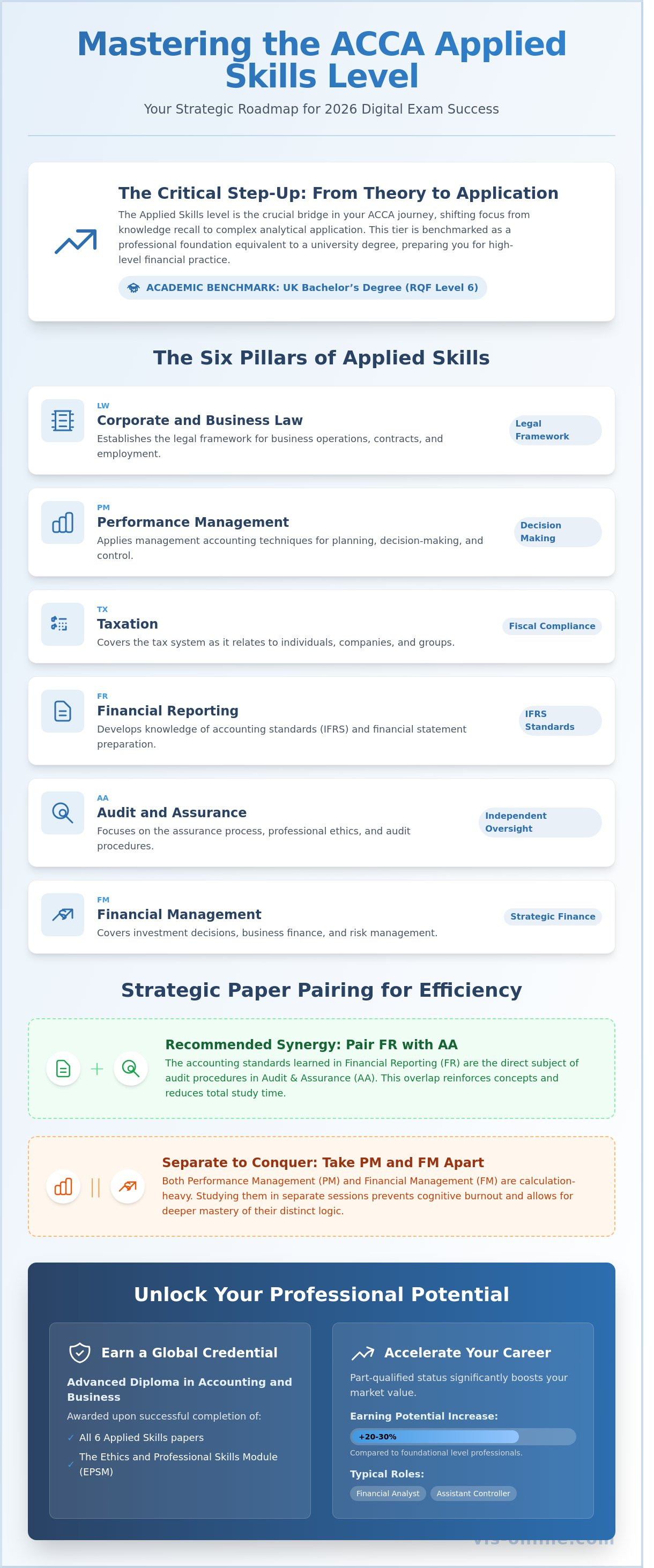
Focus on core areas: Corporate and Business Law, Performance Management, Taxation, Financial Reporting, Audit and Assurance, and Financial Management.
-
Benchmarked at Level 6 of the Regulated Qualifications Framework (RQF) in England and Wales.
-
Requires a minimum of 50% pass mark for each of the six papers.
The Advanced Diploma in Accounting and Business
Once you've cleared all six papers and completed the mandatory Ethics and Professional Skills Module (EPSM), you earn the Advanced Diploma in Accounting and Business. This certification isn't just a formality; it's a professional credential that demonstrates your readiness for high-stakes decision-making. The EPSM integration is crucial because it aligns your technical knowledge with the professional behaviors employers demand in 2026, such as commercial acumen and leadership integrity.
Global Recognition and Career Benchmarking
In 2026, multinational employers view the part-qualified status as a definitive marker of reliability and technical skill. Holding the Advanced Diploma provides a strategic advantage in the job market, often leading to roles like financial analyst or assistant controller. Industry data shows that part-qualified accountants often see a 20% to 30% increase in earning potential compared to those at the foundational level, as they possess the specific expertise to manage complex tax frameworks and audit requirements effectively.
The Six Pillars: A Deep Dive into the Applied Skills Syllabus
The ACCA Applied Skills module transitions students from foundational accounting to professional application. Corporate and Business Law (LW) acts as the starting point. It's unique because it remains the only paper available as an on-demand Computer Based Exam (CBE), providing flexibility for those balancing work commitments. Following this, Performance Management (PM) and ACCA Taxation (TX) demand a shift toward managing technical complexity and ensuring absolute compliance with fiscal regulations. These papers require a disciplined approach to both calculation and theory.
ACCA Financial Reporting (FR) represents a critical evolution in the curriculum. Candidates move beyond recording basic transactions to interpreting complex financial statements under IFRS standards. This analytical foundation is vital for the final hurdles: Audit and Assurance (AA) and Financial Management (FM). While AA tests your ability to provide independent oversight, FM focuses on strategic capital allocation and risk management. Developing a structured study plan is the most effective way to manage this workload. You can explore our comprehensive ACCA courses to find a path that fits your professional schedule.
Strategic Paper Pairing for Maximum Efficiency
Pairing FR with AA creates a natural synergy. The standards you learn in FR directly inform the audit procedures you'll design in AA. This overlap reduces total study hours and reinforces core concepts. In contrast, it's often better to separate PM and FM. Both subjects carry a heavy calculation load. Taking them in different sessions prevents burnout and allows you to master the distinct logic of cost accounting versus corporate finance without confusion.
Addressing the Hardest Papers: PM and AA
Data from recent exam cycles shows that PM and AA often see global pass rates between 39% and 43%. These papers are difficult because they require more than just technical knowledge; they demand professional judgment. In the 2026 exams, examiners focus heavily on the application of theory to specific business scenarios. To avoid common pitfalls, don't just memorize formulas. Instead, practice explaining how a 5% variance in PM affects a company's long-term strategy or how a specific control weakness in AA increases the risk of material misstatement. Success in the ACCA Applied Skills module depends on this ability to connect numbers to narrative.
Strategic Exam Techniques for 2026 Digital Success
Success in the ACCA Applied Skills exams depends on your ability to translate technical knowledge into the digital workspace. The Computer Based Exam (CBE) environment isn't just a medium; it's a core component of the assessment. You must master spreadsheet functions and word processing shortcuts to ensure your workflow remains uninterrupted during the 180-minute session. Precision in these tools allows you to focus on the logic of your answer rather than the mechanics of the software.
-
The 1.8-Minute Rule: Every mark is worth exactly 108 seconds. For a 20-mark constructive response question, you've got 36 minutes. Sticking to this limit prevents the common pitfall of leaving the final section of the paper incomplete.
-
Examiner’s Reports: These documents provide a forensic analysis of why candidates failed previous sittings. For instance, reports from the September 2024 and December 2024 sessions frequently highlight a lack of depth in narrative answers as a primary reason for lost marks.
-
The Practice Platform: This tool replicates the live exam interface. Familiarity with the scratchpad and formula functions prevents technical friction on exam day. You shouldn't walk into the exam hall without having completed at least three full mock exams on this platform.
From Theory to Application: The Constructive Response
Markers look for structured logic rather than isolated facts. Your answers should reflect the 2026 shift toward application, moving away from simple definitions to "how should this be treated" in a specific scenario. Use clear headings and short, impactful paragraphs. This professional layout allows examiners to award marks quickly for each valid point you raise. Don't simply state a rule; apply it to the data provided in the case study.
Leveraging Online Tuition and Tutor Support
Self-study often feels isolating, but strategic support systems provide a necessary safety net. Weekly live sessions and 24/7 WhatsApp support groups offer immediate clarification for complex accounting standards or tax computations. These Vertex ACCA courses bridge the gap between theoretical reading and exam-ready application. They provide the professional guidance required to navigate the intricacies of the syllabus with confidence. Having a mentor to review your constructive responses can be the difference between a 48% and a 52% result.
Secure your professional future and master the syllabus by enrolling in our expert-led ACCA Applied Skills preparation modules .
Beyond the Exams: Degrees, Career Impact, and Next Steps
Completing the ACCA Applied Skills exams marks a definitive shift in your professional trajectory. You're no longer just a student; you're a part-qualified professional with a technical foundation that carries weight in the global market. 2025 industry benchmarks suggest that completing this level can increase earning potential by 18% compared to entry-level roles. You'll find yourself eligible for positions such as Financial Analyst, Budget Manager, or Tax Consultant. This stage is the bridge to the Strategic Professional level, where the focus moves from calculation to high-level advisory and leadership.
The BSc (Hons) in Applied Accounting
The partnership between ACCA and Oxford Brookes University provides a unique opportunity to earn a BSc (Hons) in Applied Accounting. Timing is critical because the final submission date for the Research and Analysis Project (RAP) is scheduled for May 2026. You must complete the Financial Reporting, Audit and Assurance, and Financial Management exams before attempting the RAP. Your performance in the ACCA Applied Skills modules directly determines your degree classification. A 68% exam average, for instance, could secure a First Class degree, provided the project meets the required standards.
Enrolling for Success with VLS
Transitioning to the final stage of your qualification requires a shift in mindset. Our Full Access Package is designed to provide the stability and expert guidance needed for this leap. Most successful candidates choose to begin with Strategic Business Reporting (SBR). This module leverages the reporting standards you've mastered and applies them to complex, real-world corporate scenarios. VLS acts as your strategic partner, ensuring your roadmap to becoming a Chartered Certified Accountant is both clear and achievable.
Charting Your Path to Strategic Professional Excellence
Navigating the ACCA Applied Skills level in 2026 requires a disciplined approach to the six core pillars of the syllabus. Success isn't just about passing six exams; it's about building a foundation for long term career stability in a volatile financial landscape. By integrating advanced digital exam techniques with a deep understanding of tax and audit regulations, you're not just earning a qualification. You're securing a competitive edge that opens doors to senior roles and academic honors like the Oxford Brookes degree. Precision in your preparation ensures that you don't just meet industry standards but exceed them.
Effective preparation transforms complex regulatory frameworks into manageable strategic advantages. Vertex Learning Solutions provides the structural support needed to master these challenges through active tutor support via WhatsApp and weekly live classroom simulations that mirror real world scenarios. Our methodology focuses on technical efficiency, utilizing exam focused study notes and recorded lectures to ensure your progress is both measurable and steady. You don't have to navigate these technical complexities alone when expert guidance is readily available.
Master your ACCA Applied Skills with Vertex Learning Solutions and take the definitive step toward your 2026 career goals. Your commitment to excellence deserves a partner that values professional integrity and results as much as you do.
Frequently Asked Questions
What is the hardest paper in the ACCA Applied Skills level?
Performance Management (PM) is statistically the most challenging component, with pass rates often dipping to 42% or 43% in recent 2023 and 2024 exam cycles. This paper requires a high degree of analytical precision and the ability to apply complex management accounting techniques to varied business scenarios. Students often struggle with the transition from calculation to critical evaluation, which remains a core requirement for long-term professional success in any financial role.
Can I take Applied Skills exams in any order?
You can complete the ACCA Applied Skills exams in any sequence, though the ACCA official guidelines recommend following the chronological order of the syllabus. This logical progression ensures that the foundational knowledge from papers like Financial Reporting (FR) supports the more advanced concepts found in Audit and Assurance (AA). We suggest aligning your exam schedule with your professional workload to maintain a consistent success rate across all six modules.
How long does it typically take to complete the Applied Skills module?
A dedicated candidate typically completes this level within 12 to 18 months by attempting one or two papers per quarterly exam window. Since there are six distinct subjects, this timeline allows for approximately 150 study hours per module, ensuring a deep understanding of the regulatory and financial frameworks. Maintaining this structured pace is essential for balancing professional responsibilities with the rigorous demands of the qualification.
What is the pass mark for ACCA Applied Skills exams?
The passing threshold for every ACCA Applied Skills examination is strictly set at 50%. This benchmark ensures that every candidate demonstrates a sufficient level of technical competence and professional judgment required for global accounting standards. Achieving this score signifies that you've mastered the core syllabus areas and are prepared to progress toward the Strategic Professional level with the confidence and integrity that the industry demands from its leaders.
Are the Applied Skills exams purely multiple-choice?
These examinations aren't limited to multiple-choice formats; they utilize a combination of objective test questions and constructed response tasks. In a standard three-hour session, you'll encounter 60% objective questions and 40% long-form scenarios that require spreadsheet or word processing entries. This structure tests your ability to provide structured, professional advice and perform complex calculations in a simulated business environment, reflecting the practical realities of modern financial practice.