

Can a single 3-hour examination truly be the difference between a stagnant local role and a 35% salary increase at a Big Four firm by 2026? For many senior accountants, the Diploma in IFRS (DipIFR) represents exactly that pivot point, serving as a global passport to financial leadership. It’s natural to feel overwhelmed by the sheer volume of 40+ international standards or the technical complexity of consolidated financial statements. You’ve likely spent years mastering local GAAP, only to find that the global market now demands a more sophisticated, unified language to ensure regulatory compliance and long-term financial stability.
This guide will show you how the ACCA Diploma in IFRS can transform your career trajectory and provide the exact, time-efficient strategies needed to pass the exam with confidence. We’ll analyze the 2026 syllabus updates, break down the most effective study structures for busy professionals, and reveal how to master group accounting without sacrificing your work-life balance. By following this structured roadmap, you’ll gain the elite expertise required to manage complex financial reporting with the precision that modern multinational firms demand.
Key Takeaways
- Understand why this ACCA-backed qualification is essential for navigating the global shift toward unified financial reporting standards across more than 140 jurisdictions.
- Gain a comprehensive breakdown of the 2026 computer-based exam structure, focusing on the core pillars of the Conceptual Framework and group accounts.
- Learn how to implement the Active Recall method within a structured timeline to ensure you pass the Diploma in IFRS (DipIFR) on your first attempt.
- Discover how a strategic partnership with an expert online ecosystem provides the professional safety net and real-time support required to master complex reporting requirements.
What is the Diploma in IFRS (DipIFR) and Why is it Essential in 2026?
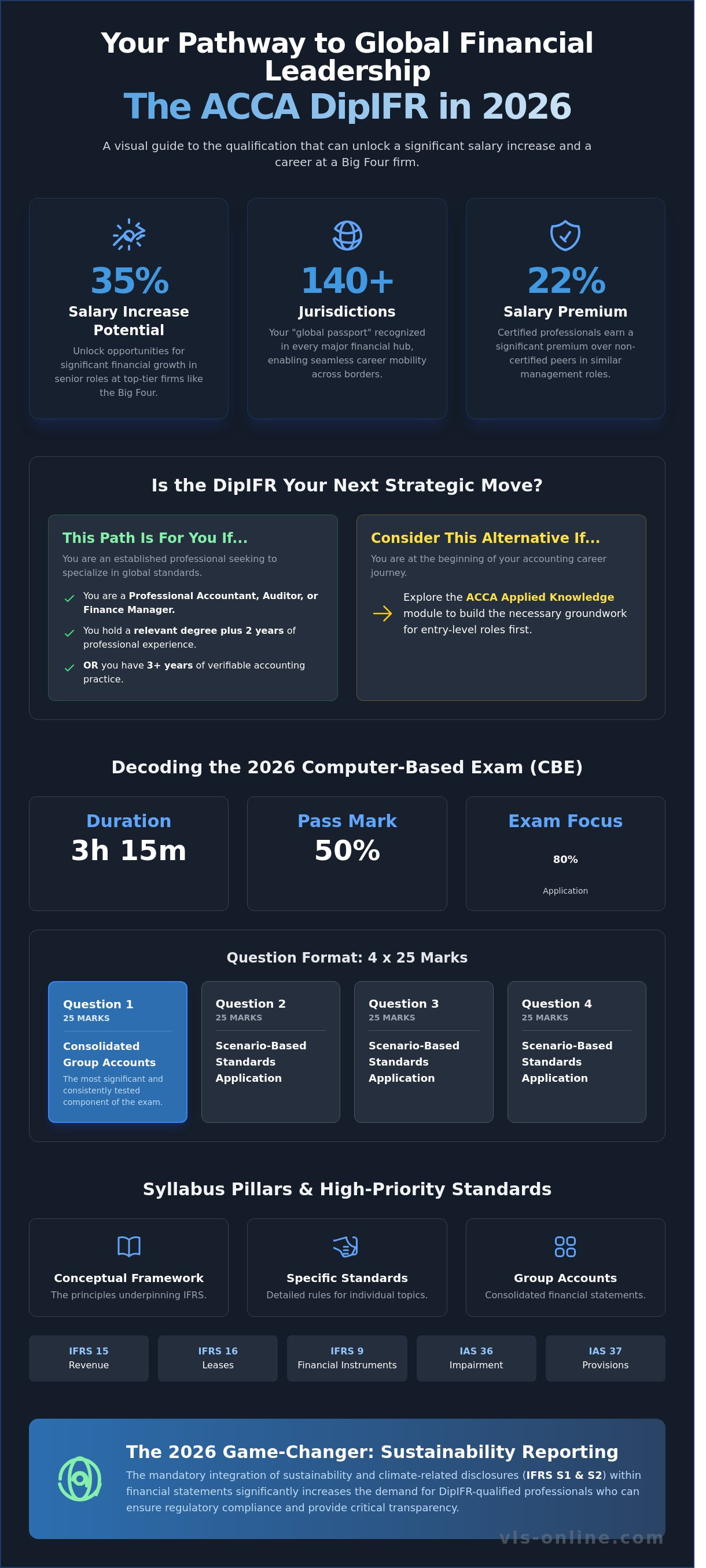
The Diploma in IFRS (DipIFR) represents the premier qualification for finance professionals seeking mastery over the global language of business. Developed by the Association of Chartered Certified Accountants (ACCA), it provides a rigorous framework for applying International Financial Reporting Standards (IFRS) across diverse economic environments. Currently, over 140 jurisdictions, including the European Union and the rapidly expanding markets of the Middle East, mandate these standards for listed companies. By 2026, the relevance of this certification will reach a new peak. This shift is driven by the mandatory integration of sustainability disclosures within financial statements, specifically following the IFRS S1 and S2 requirements. Professionals who hold this diploma don't just report numbers; they provide the transparency and professional credibility required in a high-stakes regulatory environment.
- Global Mobility: The certification is recognized in every major financial hub, allowing for seamless career transitions across borders.
- Regulatory Compliance: It ensures practitioners can navigate the complex 2026 requirements for climate-related financial disclosures.
- Professional Standing: It offers non-ACCA members a prestigious, globally recognized credential that validates their technical expertise.
Who Should Pursue the DipIFR Qualification?
This qualification serves professional accountants, auditors, and finance managers operating within multinational industries. It's designed for those who already possess a foundational understanding of accounting principles but need to specialize in international reporting. To qualify, candidates need a relevant degree plus two years of professional experience, or three years of verifiable accounting practice. It's a specialized path for established experts. If you're currently at the start of your journey, you might consider the ACCA Applied Knowledge module instead, which builds the necessary groundwork for entry-level roles.
The Career ROI of IFRS Expertise
Mastering these standards acts as a strategic gateway to senior roles within Big 4 firms and Fortune 500 corporations. Companies prioritize candidates who can navigate complex consolidation and financial instrument reporting without constant external oversight. Professional data from major financial hubs indicates that experts with a Diploma in IFRS (DipIFR) earn a salary premium of 22% compared to their non-certified peers in similar management positions. This investment provides a secure professional protective shield in a volatile global economy.
Navigating the DipIFR Syllabus and 2026 Exam Structure
The Diploma in IFRS (DipIFR) syllabus is built on three core pillars: the Conceptual Framework, specific reporting standards, and the preparation of consolidated financial statements. In 2026, the assessment remains a rigorous three-hour-and-15-minute Computer-Based Exam (CBE). Candidates must secure a 50% pass mark to earn the credential. This exam isn't a test of rote memorisation; it's a sophisticated evaluation of professional application. Approximately 80% of the marks are awarded for applying principles to complex scenarios, while simple knowledge recall accounts for a minimal portion of the total score.
The exam format typically consists of four questions worth 25 marks each. Question 1 is consistently dedicated to group accounts, making it the most significant individual component of the paper. The remaining three questions cover a broad range of standards, often presenting multi-part scenarios where you must justify specific accounting treatments. Success requires a methodical approach to the CBE environment, where spreadsheet and word processing skills are as vital as technical knowledge. Understanding the latest updates from the IFRS Foundation is essential for maintaining the precision required at this level.
High-Weightage IFRS Standards to Prioritise
- IFRS 15 & IFRS 16: Revenue recognition and Leases are foundational. These standards appear in nearly every session due to their universal impact on financial statements.
- IFRS 9: Financial Instruments remains a high-complexity area. You'll need to master classification, measurement, and the expected credit loss model.
- IAS 36 & IAS 37: Impairment of Assets and Provisions have seen increased focus in 2024 and 2025 cycles. Examiners use these to test your ability to exercise professional scepticism.
The Challenge of Consolidated Financial Statements
Group accounting is the section where most candidates either succeed or fail. It requires absolute mastery of the mechanics involving subsidiaries, associates, and joint arrangements. You'll need to calculate goodwill, non-controlling interests, and consolidated retained earnings with zero margin for error. A vital point for your study plan: the Diploma in IFRS (DipIFR) syllabus specifically excludes group cash flow statements, allowing you to concentrate your efforts on the statement of financial position and the statement of profit or loss. Developing a structured professional protection through disciplined practice of these calculations is the most reliable path to passing on your first attempt.
Strategic Preparation: How to Pass DipIFR on Your First Attempt
Success in the Diploma in IFRS (DipIFR) requires a disciplined framework rather than mere rote memorization. Statistics from previous exam cycles indicate that candidates who commit to a 3-to-6 month study window, allocating 10 to 12 hours weekly, achieve a 25% higher pass rate than those who attempt to cram in the final month. This duration allows for the deep cognitive processing needed to apply complex standards to practical scenarios.
Transitioning from passive reading to the Active Recall method is essential. You should engage with past papers by the fourth week of your study schedule. This shift builds the mental stamina required for the three-hour, 100-mark examination. Practicing within the official ACCA Computer Based Exam (CBE) environment isn't optional; it's a strategic necessity. It ensures you don't struggle with the software's functionality while trying to solve intricate consolidation problems under pressure.
Creating a Professional Study Plan
- Step 1: Complete the initial syllabus sweep using recorded lectures and structured study notes to build a theoretical foundation.
- Step 2: Transition to topic-wise practice questions to isolate and rectify technical weaknesses in specific standards like IFRS 9 or IFRS 15.
- Step 3: Dedicate the final 4-week Revision Phase exclusively to full-length past exam papers under strict timed conditions to simulate the 180-minute reality.
Common Pitfalls and How to Avoid Them
Relying on question spotting is a high-risk strategy that often leads to failure when the examiner introduces less frequent standards like IFRS 2 or IAS 41. Instead, aim for 100% syllabus coverage to ensure no mark is left on the table. Managing the psychological pressure of professional certifications is equally vital; applying these accounting exam study tips helps maintain focus and precision during the grueling session.
The primary reason for failure isn't a lack of knowledge, but poor time management. You have exactly 1.8 minutes per mark. If you spend too long on the initial 25-mark consolidation question, you'll sacrifice accessible marks in the later sections. Use the CBE software to write concise, marks-focused explanations. Clear bullet points often earn more marks than dense, rambling paragraphs that fail to address the specific requirements of the Diploma in IFRS (DipIFR) examiner.
Secure your professional future by joining our expert-led DipIFR preparation program today.
Vertex Learning Solutions: The Modern Way to Master DipIFR
Self-studying for the Diploma in IFRS (DipIFR) often feels like navigating a dense fog without a compass. While traditional textbooks provide the theory, they lack the strategic nuance required for the 2026 exam cycle. VLS Online Tuition replaces this isolation with a robust ecosystem designed for legislative precision. Our WhatsApp tutor support ensures you aren't waiting days for an email response; you get instant query resolution during those critical study hours. We've condensed over 2,000 pages of official standards into streamlined, exam-focused notes that highlight the specific application of IFRS 15 or 16. Weekly live sessions provide the necessary accountability to keep your preparation on track, simulating a high-level boardroom environment rather than a passive lecture hall.
Why VLS Online Tuition Outperforms Traditional Classrooms
Physical attendance in traditional learning centres often costs 60% more than our digital platform. VLS offers UK-standard expertise to professionals globally, allowing you to access recorded lectures on your own schedule. This flexibility is vital for senior accountants managing quarterly closings. You'll work directly with tutors who specialise exclusively in professional accounting exams, ensuring your preparation is both rigorous and relevant to current reporting requirements. Our methodology simplifies the most complex tax and reporting questions into structured, manageable frameworks.
The Path Forward: Beyond the Diploma
Securing your credentials is a strategic move that provides a significant technical head start for further qualifications. Specifically, the ACCA Strategic Professional level builds directly upon the technical foundations laid during your Diploma in IFRS (DipIFR) studies. This progression ensures your career trajectory remains upwardly mobile in an increasingly complex financial landscape. To begin your journey toward expert status, enrol in the VLS DipIFR Programme and secure your 2026 exam success today. Your professional stability and growth are our primary objectives.
Secure Your Professional Future in Global Financial Reporting
The global shift toward unified reporting standards makes the Diploma in IFRS (DipIFR) an essential asset for finance professionals aiming for senior leadership roles in 2026. Navigating the rigorous 2026 syllabus requires a strategic approach that balances technical mastery with practical application. Success depends on understanding complex standards and managing time effectively during the computer-based exam. You've now seen the roadmap to achieving this distinction through disciplined study and expert guidance.
Vertex Learning Solutions provides the structured framework needed to navigate this complexity. Since our founding in 2016, we've helped thousands of successful alumni achieve their professional goals through specialized ACCA and CIMA preparation. Our methodology prioritizes your success through direct expert tutor support via WhatsApp and weekly live interactive sessions that clarify the most challenging topics. You aren't just studying for a certificate; you're building a foundation for long-term career stability and professional integrity.
Start Your Journey to IFRS Mastery with Vertex Learning Solutions
Your professional advancement starts with the right partner. Take the next step toward your 2026 career goals today.
Frequently Asked Questions
Is the Diploma in IFRS harder than the ACCA Financial Reporting (FR) paper?
The Diploma in IFRS (DipIFR) is significantly more challenging than the ACCA FR paper because it demands a higher level of technical application and professional judgment. While the FR paper covers approximately 60% of the reporting standards at a fundamental level, the DipIFR requires mastery of nearly 40 standards with a focus on complex group consolidations. Candidates often find the 100% written format of the DipIFR more demanding than the objective test questions found in the FR exam.
Can I take the DipIFR exam online from my home country in 2026?
You can sit for the exam from your home country in 2026 using the ACCA's remote proctoring platform. This digital system allows professionals to complete the three hour assessment in a secure, private environment without the need to visit a physical testing center. Candidates must verify that their hardware meets the 2026 technical specifications, which include a stable internet connection and a high definition webcam for live invigilation throughout the session.
How many hours of study are realistically needed to pass the DipIFR?
Most successful professionals dedicate between 200 and 250 hours of focused preparation to pass the exam on their first attempt. This study plan typically spans 20 weeks, allowing for a deep dive into the complex requirements of the Diploma in IFRS (DipIFR) syllabus. Data shows that candidates who allocate at least 12 hours per week to practicing past exam papers increase their probability of success by 25% compared to those who focus only on theory.
What is the difference between IFRS and IAS in the current syllabus?
The distinction lies in the timeline and the issuing body, as International Accounting Standards (IAS) were published before 2001, while International Financial Reporting Standards (IFRS) were issued thereafter. Both sets of standards carry equal weight within the current Diploma in IFRS (DipIFR) curriculum and are part of the same regulatory framework. The 2026 syllabus requires you to understand the 24 active IAS and the 17 current IFRS to ensure full compliance with global reporting requirements.
Does the DipIFR qualification expire, or is it a lifetime certification?
The qualification is a lifetime certification that doesn't expire once you've earned your certificate. While the credential remains valid indefinitely, the ACCA recommends completing 40 units of Continuing Professional Development (CPD) each year to stay current with new amendments. This ongoing learning process protects your professional standing and ensures your technical skills remain relevant as the International Accounting Standards Board issues new updates or interpretations.