

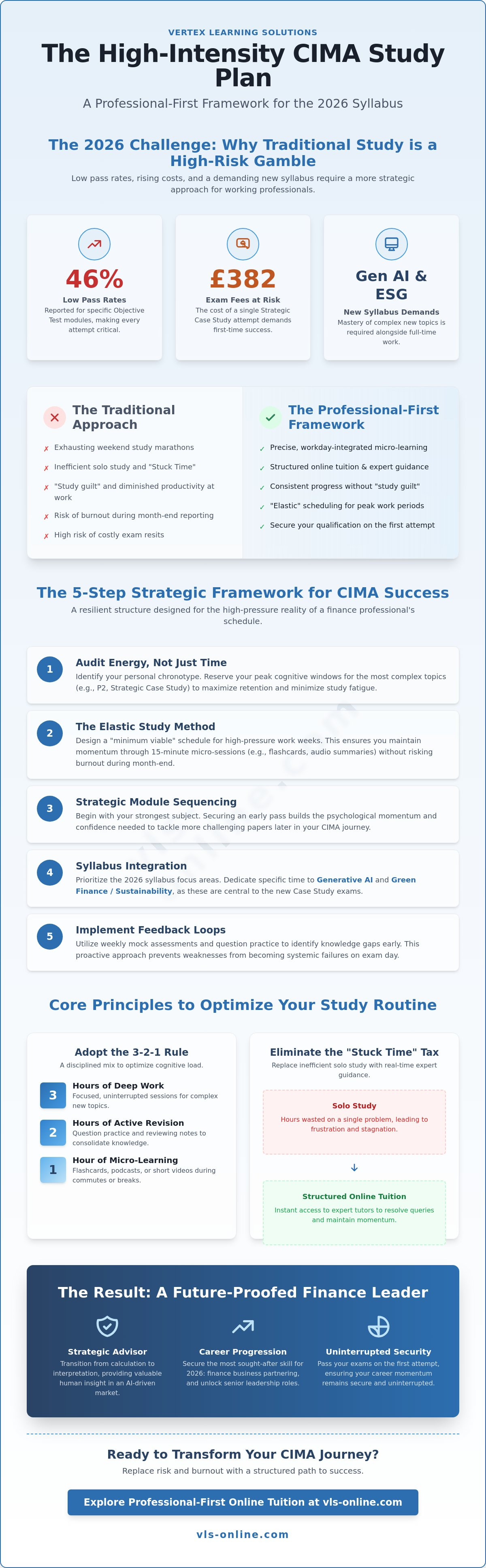
With objective test pass rates for specific CIMA modules falling as low as 46% in January 2026 reports, the traditional "study when I have time" approach has become a high-risk gamble for the modern finance leader. You likely feel the weight of this statistic as you face the 2026 syllabus updates, which now demand mastery of complex subjects like Generative AI and sustainability reporting alongside your daily corporate responsibilities. It's natural to worry that a £382 investment for a Strategic Case Study exam might be lost to a lack of consistent preparation or a schedule that simply refuses to bend.
You deserve a strategy that offers professional security and a clear path to leadership. This guide presents a high-intensity CIMA study plan for working professionals that replaces exhausting weekend marathons with precise, workday-integrated micro-learning. We'll provide a structured weekly framework aligned with the May, August, and November 2026 exam windows. This preview of our professional-first framework will show you how to maintain your career excellence while securing your qualification on the first attempt, ensuring your progression toward senior finance leadership remains uninterrupted and secure.
Key Takeaways
- Recognize the 2026 syllabus evolution as a strategic transition toward finance leadership rather than a mere academic requirement.
- Deploy a tailored CIMA study plan for working professionals that incorporates the "Elastic Study Method" to maintain structural consistency during critical month-end reporting periods.
- Adopt the 3-2-1 Rule to optimize cognitive load through a disciplined mix of daily micro-learning and dedicated deep-work sessions.
- Mitigate the risk of professional stagnation by replacing inefficient solo study with structured online tuition and real-time expert guidance to eliminate the "Stuck Time" tax.
Why a Specialized CIMA Study Plan is Essential for Working Professionals
A professional's time is a finite resource. A Chartered Institute of Management Accountants (CIMA) qualification represents more than academic success; it's a strategic asset for your career. Unlike full-time students who rely on high-volume repetition, you require a CIMA study plan for working professionals designed for high efficiency. This framework acknowledges that your primary obligation is to your organization, meaning every study hour must yield maximum results. You can't afford to waste time on redundant materials when your schedule is already compressed by corporate responsibilities.
The "professional mindset" differs from the "student mindset" because it prioritizes application over rote memorization. A structured plan prevents the common "month-end burnout" trap by acknowledging the cyclical nature of finance work. Instead of forcing study during peak reporting periods, an effective framework builds in recovery time and focuses on micro-learning during your busiest weeks. This approach ensures your progress remains steady without compromising your performance at the office.
The 2026 Management Accountant: Why CIMA Matters Now
The 2026 syllabus update reflects a significant pivot in the industry. Routine data entry is now largely automated by Generative AI, shifting the focus of the CGMA toward analytical and critical thinking. In a 2025 report, AICPA & CIMA highlighted that finance business partnering is now the most sought-after skill. Securing this qualification future-proofs your role by positioning you as a strategic advisor who can interpret complex ESG data and emerging technological trends. It differentiates you in a 2026 job market that values human insight over simple calculation.
The Risks of Studying Without a Professional-First Framework
Studying without a structure leads to "study guilt" and diminished workplace productivity. When you lack a clear path, you risk failing exams that cost between £123 and £382 per attempt in 2026. A CIMA study plan for working professionals mitigates these risks by providing a predictable rhythm. It eliminates the psychological burden of being "behind" and protects your mental health. Without this structure, the financial and emotional cost of resits can quickly outweigh the benefits of the qualification itself.
The 5-Step Strategic CIMA Study Framework for 2026
Success in 2026 requires a shift from simple time management to sophisticated energy management. A sustainable CIMA study plan for working professionals must account for the high-pressure reality of financial reporting cycles. By following this five-step framework, you'll build a resilient structure that survives even the most demanding corporate deadlines.
- Step 1: Audit Energy, Not Just Time. Identify your chronotype to determine when your cognitive capacity is highest. Reserve these windows for complex topics like P2 (Advanced Management Accounting) or Strategic Level Case Study preparation.
- Step 2: The Elastic Study Method. Design a "minimum viable" schedule for reporting weeks. This ensures you maintain momentum through 15-minute micro-sessions without risking burnout during peak seasons.
- Step 3: Strategic Module Sequencing. Start with your strongest subject. Securing an early win builds the psychological momentum needed for more challenging papers later in the level.
- Step 4: Syllabus Integration. Prioritize the 2026 focus areas, specifically green finance and Generative AI, as these are now central to the Case Study exams starting May 2026.
- Step 5: Feedback Loops. Use weekly mock assessments to identify knowledge gaps before they become systemic failures.
Phase 1: Foundation and Energy Mapping
Your workday is full of untapped potential. Identify 15-minute pockets during commutes or lunch breaks for low-intensity tasks, such as reviewing flashcards or listening to technical summaries. Energy mapping is the deliberate alignment of complex technical topics with your peak cognitive hours to maximize retention and minimize fatigue. If you're a morning person, tackle financial reporting before your first email; if you're a night owl, save strategic analysis for the evening. For those balancing multiple professional goals, exploring comprehensive online training packages can provide the necessary structure to manage these transitions effectively.
Phase 2: The 12-Week Exam Sprint
A disciplined 12-week cycle is the gold standard for exam readiness. Allocate the first eight weeks to active learning and technical mastery, followed by four weeks of intensive revision and mock exams. This timeline aligns perfectly with the February, May, August, and November 2026 Case Study windows. For level-specific guidance on how to navigate these stages, refer to our detailed CIMA Professional Qualification guide. It provides the nuances required to transition from Operational to Strategic levels with confidence.
Optimizing Your Study Routine: Micro-Learning vs. Weekend Sprints
Relying on weekend marathons is a common error that leads to cognitive overload and eventual burnout. A sustainable CIMA study plan for working professionals must utilize the 3-2-1 Rule to maintain long-term momentum. This framework consists of three days of micro-learning, two days of deep work, and one day of complete rest. By distributing the mental load, you ensure that your brain remains receptive to complex technical standards without compromising your professional performance during the work week.
In 2026, technology is your most significant strategic advantage. Don't spend hours manually highlighting the 30-page pre-seen document provided by CIMA for your Case Study. Use Generative AI tools to summarize industry trends and identify potential financial risks within the material. Combine this with recorded lecture videos during your commute to transform "dead time" into active learning. This approach ensures you're prepared for the May or August 2026 exam windows while keeping your weekends manageable.
Active Recall is the only way to guarantee exam success. Reading and re-reading notes is the most significant waste of a professional's time. Instead, test yourself on the material before you feel fully prepared. If you can't explain a concept like "weighted average cost of capital" without looking at your text, you haven't mastered it. Practice under pressure is the only way to build the confidence needed for a first-time pass.
Micro-Learning During the Workday
Use mobile applications for quick MCQ practice between meetings or during travel. Even ten minutes of focused practice can reinforce a complex concept better than three hours of tired study at the end of the day. Following proven accounting exam study tips allows you to maximize these short bursts of focus. If you're ready to secure your professional future with a structured approach, you can explore our professional CIMA training modules to find the right fit for your career goals.
Structuring the "Deep Work" Weekend
Reserve your weekend sessions for high-intensity tasks that require undivided attention. This is the time for long-form Case Study practice or full three-hour mock exams. Create a distraction-free environment that simulates the actual exam center conditions. Practicing this level of endurance early in your 12-week cycle will ensure that the actual exam feels like a routine professional task rather than a high-stress hurdle.
Selecting the Right Support: Why Online Tuition Outperforms Solo Study
Solo study often leads to the "Stuck Time" Tax. This occurs when a professional loses three to four hours attempting to decode a single complex concept, such as environmental costing or the sustainability standards introduced in the May 2026 syllabus update. For a senior auditor or finance manager, these lost hours represent a significant opportunity cost. A CIMA study plan for working professionals shouldn't just be a calendar; it must be a support system that provides immediate resolution to technical roadblocks. Relying on outdated textbooks or unmonitored forums is a risk that high-level experts don't need to take.
The 2026 advantage lies in on-demand tutor support. While traditional institutions might offer live sessions that only start in fixed windows like October, modern online tuition provides instant clarification through platforms like WhatsApp. This ensures you don't stall during your limited 15-minute study pockets. Balancing weekly live sessions with high-quality recorded lectures allows you to maintain a methodical rhythm. It provides a clear financial and academic roadmap, ensuring your investment in registration and exam fees, which include a £150 annual subscription in 2026, is protected by a high probability of first-time success.
The VLS Online Advantage for CIMA Students
VLS Online provides exam-focused study notes that deliberately cut through the excessive "fluff" found in standard 500-page textbooks. We focus on the core competencies required to pass. You also gain access to a community of fellow finance experts, which is vital for maintaining motivation and networking within the industry. Success isn't just about the certificate; it's about the strategic partnership. Explore our CIMA preparation courses designed for busy finance experts to see how we simplify the path to CGMA status.
Transitioning from ACCA to CIMA
If you've already completed your ACCA Applied Skills, you may be eligible for significant exemptions. Pivoting your career toward management accounting in 2026 requires a focused adjustment. Your CIMA study plan for working professionals should account for the shift from technical reporting to strategic business partnering. This transition is a calculated move that leverages your existing knowledge while adding the strategic depth required for executive leadership in a technology-driven environment.
Securing Your Path to Strategic Finance Leadership
The 2026 syllabus update represents a definitive pivot toward strategic business partnering and technological proficiency. Achieving CGMA status requires more than technical knowledge; it demands a resilient framework that respects your professional obligations. By implementing a CIMA study plan for working professionals that prioritizes high-intensity micro-learning over weekend marathons, you eliminate the risk of burnout during critical reporting cycles. You've seen how energy mapping and structured revision cycles can mitigate the low pass rates seen in January 2026 reports, where certain modules dropped below 50%.
Expert intervention provides the final layer of security for your professional investment. At Vertex Learning Solutions, we offer active tutor support via WhatsApp and weekly live sessions to ensure you never lose hours to a single complex concept. Our exam-focused study notes are engineered to provide maximum clarity in minimum time, allowing you to focus on application rather than rote memorization. Start your CIMA journey with a professional-first study plan at Vertex Learning Solutions and secure your transition to finance leadership. Your career excellence is the priority; let's build the roadmap to match it.
Frequently Asked Questions
How many hours a week should a working professional study for CIMA?
Most experts recommend dedicating 10 to 12 hours per week to maintain a consistent pace through the qualification levels. This duration allows for three micro-learning sessions on workdays and two deep-work sessions on weekends without inducing burnout. A disciplined CIMA study plan for working professionals avoids the 20-hour marathons that often lead to exhaustion. Consistency is more valuable than volume; a methodical approach ensures you remain prepared for the four annual case study windows in 2026.
Is it possible to pass CIMA exams on the first attempt while working full-time?
It's entirely possible to secure a first-time pass while managing full-time corporate responsibilities. Success depends on shifting from a high-volume student mindset to a professional efficiency model. Using active recall and exam-focused notes reduces the time spent on low-value reading. High-quality online tuition further increases these odds by providing instant clarification, ensuring you don't stall on complex topics like the new 2026 sustainability standards or Generative AI integrations.
Which CIMA level is the hardest for working professionals to manage?
The Management Level is frequently cited as the most challenging due to the technical complexity of the P2 module. Statistics from January 2026 indicate that pass rates for the Management Level typically fluctuate between 60% and 65%. Success at this stage requires a sophisticated CIMA study plan for working professionals that accounts for long-form practice and the integration of diverse financial data into strategic decision-making frameworks. It's the level where professional discipline is most tested.
Can I use my work experience to help with CIMA Case Study exams?
Your professional background is a significant strategic asset during Case Study exams. These assessments require you to adopt a specific persona, such as a Finance Manager, and provide data-driven insights to non-finance stakeholders. Drawing on your real-world experience in finance business partnering helps you articulate recommendations with the professional skepticism examiners seek. This practical insight often bridges the gap between technical theory and the strategic demands of the 2026 syllabus.
What happens if I miss my study schedule during a busy work period?
Missing a session during a month-end close is a professional reality, not a failure. You should transition to a "minimum viable" schedule of 15-minute micro-sessions during these peak reporting periods. This maintenance phase ensures you don't lose cognitive momentum or structural consistency. Once the reporting cycle concludes, you can resume your standard rhythm. A structured framework anticipates these corporate cycles, preventing the study guilt that often leads to total abandonment of the goal.