

What if the most significant value of your CIMA journey isn't the ability to balance a ledger, but the authority to steer a multi-million dollar corporate strategy? You've likely spent years mastering the technical complexities of the syllabus, yet many professionals still feel trapped in repetitive reporting cycles, unsure how to translate those hard-earned letters into tangible commercial influence. It's frustrating to feel like a cost center when you've been trained to be a value driver.
This strategic guide provides a clear roadmap for career opportunities after CIMA qualification in 2026, showing you exactly how to pivot from the back office to a position of leadership. We'll analyze high-growth sectors like FinTech and Renewable Energy where management accountants are in high demand. You'll learn how to navigate the PER process effectively and leverage your CGMA designation to secure roles with six-figure salary potential. We've structured this analysis to help you become an indispensable strategic partner in an economy where 92% of organizations are prioritizing AI investment, ensuring your career remains both secure and highly profitable for the long term.
Key Takeaways
- Understand the transition from student to CGMA professional, including how to successfully navigate the 2026 Practical Experience Requirements (PER).
- Identify the most lucrative career opportunities after CIMA qualification within high-growth global markets and strategic leadership corridors.
- Discover why sectors like Renewable Energy and SaaS are actively recruiting management accountants to drive long-term investment appraisals and profitability.
- Learn how to integrate generative AI and data storytelling into your workflow to move from historical reporting to proactive business partnering.
- Explore how supplementing your CIMA credentials with specialized certifications like the Diploma in IFRS can provide a definitive competitive advantage in international finance.
The CGMA Designation: Transitioning from Student to Strategic Leader
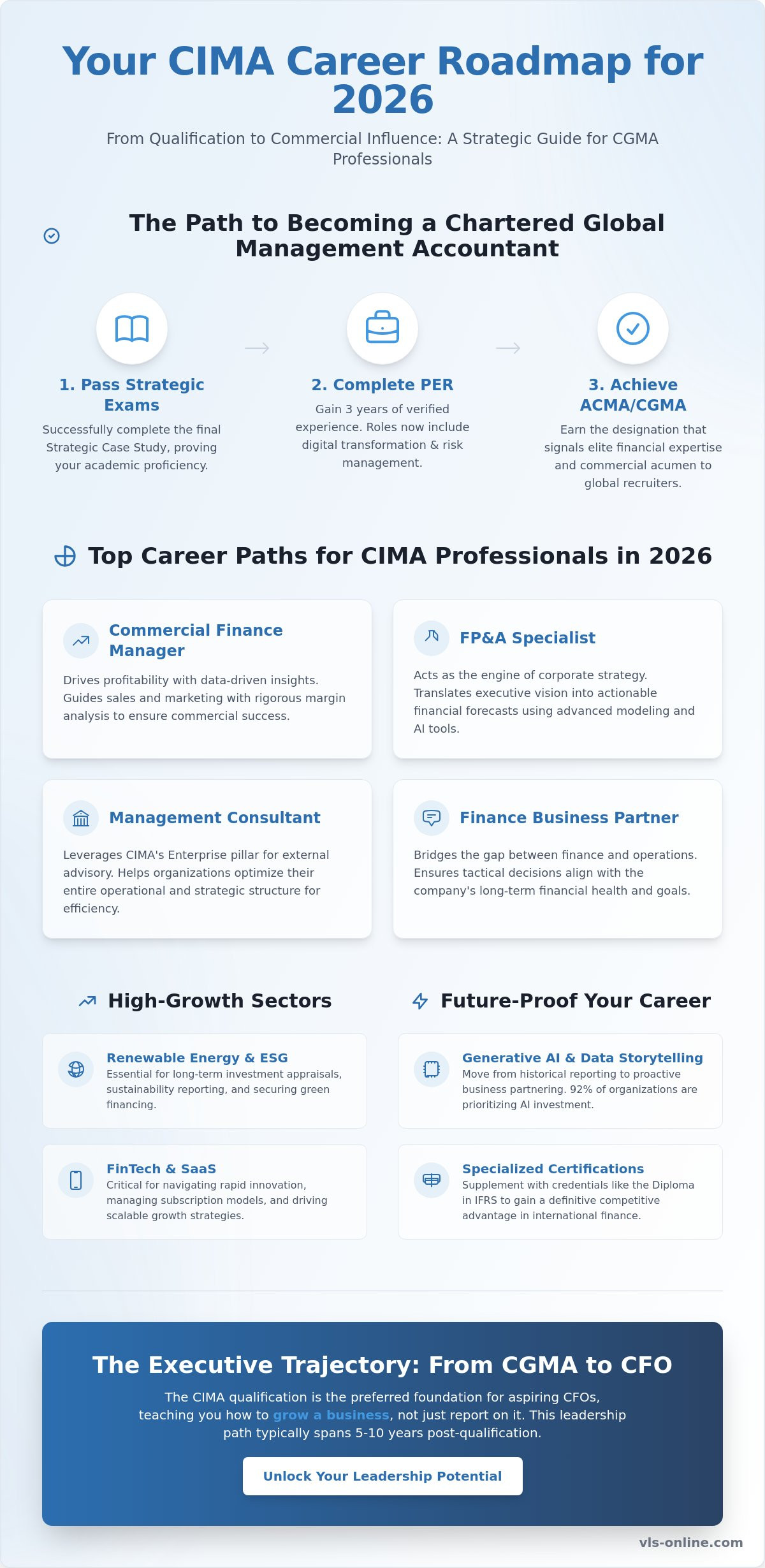
Passing the final Strategic Case Study is a significant milestone, but the formal designation of Associate Chartered Management Accountant (ACMA) and Chartered Global Management Accountant (CGMA) is what truly unlocks the most prestigious career opportunities after CIMA qualification. This transition represents a vital shift from academic proficiency to verified professional authority. While many candidates focus solely on the exams, the market in 2026 values the application of that knowledge in high-stakes environments.
The global business landscape has evolved to prioritize management accountants over traditional auditors. While audit focuses on historical accuracy and compliance, CIMA professionals provide the forward-looking analysis required for survival in volatile markets. This strategic expertise is recognized by the Chartered Institute of Management Accountants and is highly sought after across the UK, Europe, and the Middle East. In regions like the UAE, tax-free salaries for qualified experts can reach AED 35,000 monthly, reflecting the premium placed on strategic leadership.
Completing Your PER for Membership
Obtaining full membership requires three years of verified work-based experience. In 2026, 'relevant' experience has expanded beyond cost accounting to include roles in digital transformation, risk management, and strategic business reporting. You'll need to document how your work satisfies CIMA's core competencies through the Practical Experience Requirement (PER). A professional mentor is essential during this stage. They don't just validate your application; they provide the professional guidance needed to demonstrate your readiness for senior leadership roles.
The Power of the CGMA Letters
The CGMA designation is the result of a powerful joint venture between CIMA and the AICPA. These letters signal to global recruiters that you possess a unique blend of financial expertise and commercial acumen. It's a definitive badge of 'Business Partnering' capability. As AI continues to automate routine ledger work, the CGMA letters prove you can interpret complex datasets and influence executive decision-making, which is why career opportunities after CIMA qualification often lead directly to the boardroom.
Top Career Paths for CIMA Professionals in 2026
The versatility of the CGMA designation ensures that career opportunities after CIMA qualification extend far beyond the traditional finance department. In the 2026 corporate landscape, businesses prioritize professionals who act as strategic architects rather than historical record keepers. Commercial Finance Managers, for instance, are now essential for driving profitability. They use data-driven insights to guide sales and marketing teams, ensuring that every promotional campaign or product launch is backed by rigorous margin analysis.
FP&A Specialists function as the engine room of corporate strategy. They translate executive visions into actionable financial forecasts, often utilizing advanced AI tools to model complex scenarios. Research indicates that the most lucrative career paths for CIMA professionals often involve these forward-looking roles. Similarly, Management Consultants leverage the Enterprise pillar of the CIMA syllabus to provide external advisory services, helping organizations optimize their entire operational structure. Finance Business Partners bridge the gap between finance and operations, embedding themselves within departments to ensure tactical decisions align with the company's long term financial health.
From Management Accountant to CFO
The trajectory from a management accountant to a Chief Financial Officer typically spans five to ten years. CIMA is often the preferred qualification for aspiring CEOs and CFOs because it fosters a comprehensive understanding of business operations. Unlike qualifications focused solely on audit, CIMA teaches you how to grow a business, not just how to report on it. To solidify this executive path, many leaders refine their technical reporting through our Strategic Business Reporting (SBR) modules to master global compliance standards.
Specialized Roles in ESG and Sustainability
The 2026 regulatory environment has accelerated the rise of the Sustainability Accountant. These specialized career opportunities after CIMA qualification focus on ESG (Environmental, Social, and Governance) reporting. You'll manage the intersection of financial performance and ethical impact. Since the CIMA syllabus emphasizes long term value creation, you're uniquely equipped to handle strategic investment appraisals for green infrastructure projects and carbon footprint monetization.
High-Growth Sectors for Management Accountants
The landscape of career opportunities after CIMA qualification has shifted significantly toward sectors that prioritize agility and long term strategic planning. While traditional manufacturing remains a staple, the 2026 market sees a surge in demand within the Technology and SaaS (Software as a Service) industries. In these environments, management accountants are vital for managing complex recurring revenue models. You won't just be looking at balance sheets; you'll be analyzing churn metrics and customer lifetime value to ensure the business model remains sustainable during rapid scaling phases.
Renewable Energy is another high-growth corridor where CIMA professionals are indispensable. Large scale infrastructure projects in wind, solar, and green hydrogen require sophisticated strategic investment appraisal. Because these projects often span decades, your ability to model long term financial viability and navigate green subsidies is a critical asset. Similarly, in the FMCG and Retail sectors, the focus has moved toward supply chain optimization. With global markets remaining volatile, CIMA graduates are hired to implement margin protection strategies that safeguard profitability against fluctuating logistics costs.
Banking and Financial Services
Within the banking sector, CIMA graduates often secure senior roles in risk management and treasury. It's essential to distinguish this path from the CFA. While the CFA focuses on external investment analysis and portfolio management, CIMA provides the internal structural expertise needed to optimize the bank's own operational efficiency and capital adequacy. This makes you a strategic partner in ensuring the institution's long term stability rather than just an analyst of market trends.
International Opportunities
The global reach of the CGMA designation allows for seamless relocation to financial hubs like London, Singapore, or Dubai. In the Middle East, the lack of personal income tax combined with a high demand for strategic finance experts makes it an attractive destination for ambitious professionals. To maximize your chances of success in these competitive markets, you should consider exploring specialist accounting qualifications that complement your CIMA background. If you're ready to start your journey toward these global roles, you can explore our comprehensive professional courses to build a diverse and powerful skill set.
Public Sector organizations and NGOs also offer rewarding paths. Here, the focus is on value-for-money auditing and strategic resource allocation. You'll ensure that every dollar or pound of funding is utilized effectively to meet social objectives, proving that management accounting is as much about impact as it is about profit.
Future-Proofing Your Career: Skills Beyond the Qualification
In the 2026 finance function, the ability to interpret data is far more valuable than the capacity to compile it. As AI and automation handle the routine aspects of ledger maintenance and basic reporting, your role must evolve. You're no longer just a data preparer; you're a data storyteller. This transition is essential to maximize the career opportunities after CIMA qualification. By using technology to uncover hidden trends, you provide the strategic narrative that boards of directors rely on for high-stakes decision-making.
Technical brilliance also requires a foundation in global standards. Many CIMA graduates find that adding the Diploma in IFRS to their toolkit provides a significant competitive edge. It bridges the gap between management accounting and the rigorous requirements of international financial reporting. Additionally, your success depends on soft skills like stakeholder management and the art of professional persuasion. You must be able to convince non-finance leaders to adopt your strategic recommendations. To maintain your status, remember that Continuous Professional Development (CPD) is a mandatory commitment that ensures your CGMA designation remains a mark of contemporary expertise.
Technical Upskilling for 2026
While new technologies emerge, the spreadsheet remains the primary tool for financial modeling. However, basic proficiency isn't enough for senior commercial roles. Mastering Advanced Excel for Accountants is a prerequisite for building the complex, flexible models used in modern business partnering. To truly future-proof your workflow, consider integrating Python or SQL. These languages allow you to manipulate the massive datasets that define the current digital economy, moving you beyond the limitations of traditional software.
Strategic Continuous Learning
Broadening your expertise can also involve exploring adjacent professional frameworks. Learning from ACCA Strategic Professional modules can deepen your understanding of advanced financial reporting and corporate governance, further expanding the career opportunities after CIMA qualification in the international market. At Vertex Learning Solutions, we offer a distinct advantage through our post-qualification support and tutor-led masterclasses. These resources provide the professional protective net you need to navigate a complex and ever-changing regulatory environment with absolute confidence.
Commanding Your Future in the Global Finance Landscape
The 2026 corporate market doesn't just reward those who pass exams; it elevates professionals who can translate complex data into strategic, board-level narratives. You've seen how the CGMA designation serves as a hallmark of business partnering, opening doors in high-growth sectors ranging from SaaS to renewable energy. By mastering advanced tools and specialized frameworks, you transition from a traditional accountant to a vital commercial architect who steers organizational growth. The vast range of career opportunities after CIMA qualification ensures that your professional trajectory remains stable, profitable, and globally mobile.
To navigate this transition with absolute confidence, advance your career with Vertex CIMA Professional Courses. Our platform provides a professional protective net through expert tutor support via WhatsApp, weekly live sessions with industry professionals, and exam-focused study materials specifically updated for 2026. Your journey from student to strategic leader is a significant undertaking, but with the right partnership, it's a path toward lasting security and elite financial rewards. We're here to ensure your expertise remains at the forefront of the industry.
Frequently Asked Questions
What is the average salary for a CIMA-qualified accountant in 2026?
A qualified professional in the UK can command a salary between £50,000 and £80,000, while finance director roles frequently reach six figures. In the UAE, tax-free monthly compensation typically ranges from AED 20,000 to AED 35,000. These figures reflect the high demand for strategic experts who can navigate complex career opportunities after CIMA qualification in volatile global markets.
Can I work in investment banking with a CIMA qualification?
You can certainly secure high-level roles in investment banking, particularly within risk management, treasury, and internal corporate finance. While the CFA is often associated with front-office portfolio management, CIMA provides the operational framework needed to manage the bank's own capital adequacy and strategic efficiency. Many financial institutions value this internal structural expertise over pure market analysis.
How long does it take to get the CGMA designation after passing all exams?
Obtaining the CGMA designation requires a minimum of three years of verified work-based practical experience. This experience can be gained before, during, or after you complete the professional exams. Once you submit your Practical Experience Requirements (PER) and pay the £199 application fee, the review process typically confirms your status as a strategic leader within a few weeks.
Is CIMA better than ACCA for a career in industry?
CIMA is generally considered the premier qualification for careers in corporate industry and strategic leadership. While ACCA provides an excellent foundation in audit, taxation, and compliance, CIMA focuses on forward-looking analysis and business partnering. This makes it particularly effective for those aiming for CEO or CFO positions where the focus is on driving profitability rather than historical reporting.
Does CIMA help in starting my own business or consultancy?
The CIMA syllabus is uniquely designed to support entrepreneurial ventures and external advisory roles through its Enterprise pillar. You'll gain mastery over change management, digital strategy, and organizational structure. This training allows you to offer high-value consultancy services that go beyond simple bookkeeping, providing the strategic protective net that many small and medium-sized enterprises require to scale safely.