

Why did 54% of candidates fail the December 2025 sitting when the pass rate reached only 46%? This statistic highlights a sobering reality: traditional study methods often collapse under the weight of complex group accounting and the rigorous application of international standards. Success in your ACCA Dip-IFR Exam Preparation requires more than just reading through textbooks; it demands a structured, strategic framework that transforms theoretical knowledge into professional precision. You likely feel the pressure of navigating these intricate standards while balancing a demanding career, and the sense of isolation in self-study often creates unnecessary risk.
We provide the professional protection and expert-led guidance you need to secure your qualification in 2026. This guide outlines a clear path for the June 4th and 5th exam sessions, ensuring you meet the March 31 registration deadline with absolute confidence. We'll break down the £236 total examination cost, analyze the stable syllabus valid through June 2026, and provide a roadmap to master the case-study driven format of the computer-based exam. You'll gain a comprehensive overview of how to simplify complexity and achieve long-term professional stability through this globally recognized qualification.
Key Takeaways
- Understand the 2026 eligibility criteria and registration milestones to align your professional development with global accounting benchmarks.
- Master the "Big Five" high-yield IFRS standards through a structured focus on group accounting, financial instruments, and revenue recognition.
- Optimize your ACCA Dip-IFR Exam Preparation by following a 12-week roadmap that transitions from knowledge acquisition to intensive exam practice.
- Evaluate training partners based on their expert-led support and the quality of exam-focused study notes rather than the volume of generic content.
Understanding the 2026 ACCA Dip-IFR Exam Requirements
The Diploma in International Financial Reporting (Dip-IFR) represents the definitive global benchmark for high-level financial reporting expertise. As over 140 jurisdictions now mandate or permit International Financial Reporting Standards (IFRS), this qualification provides the professional protection necessary to operate within a complex regulatory environment. For the 2026 exam sessions, eligibility remains strictly defined. Candidates must be qualified accountants under national standards or possess a relevant university degree combined with two years of professional experience. Those without a degree may still qualify by demonstrating three years of verified accounting practice. It's a rigorous standard that ensures only those with a solid foundation enter the assessment phase.
Effective ACCA Dip-IFR Exam Preparation begins with a fundamental mindset shift. Unlike many local GAAP systems that rely on rigid, rule-based checklists, IFRS is a principle-based framework that demands professional judgment and a deep understanding of substance over form. This requires candidates to move beyond memorization and embrace the IASB's Conceptual Framework as their primary decision-making tool. The Diploma in International Financial Reporting acts as a strategic asset for accountants aiming for senior roles in multinational corporations.
Why IFRS Certification Matters in the 2026 Global Economy
The ongoing harmonization of global accounting standards has removed traditional barriers to career mobility. Professionals who master these standards find themselves equipped for leadership roles across international borders. This certification is a cornerstone among specialist accounting qualifications, offering a clear advantage in a job market that increasingly values cross-border compliance expertise. It doesn't just improve your CV; it builds a professional protective layer around your career path.
Key Differences Between Dip-IFR and the ACCA SBR Paper
While both assessments test high-level reporting, the Dip-IFR is a standalone diploma designed specifically for experienced professionals seeking IFRS mastery without completing the full ACCA suite. In contrast, the Strategic Business Reporting (SBR) paper is a mandatory component of the professional qualification path. If your goal is the full designation, you might explore our ACCA SBR course to understand how these requirements differ. Your ACCA Dip-IFR Exam Preparation will focus more intensely on the practical application of standards to complex group scenarios, providing a specialized edge that the broader SBR paper distributes across other business reporting topics.
Core Syllabus Mastery: Navigating High-Yield IFRS Topics
Achieving success in the 2026 exam sessions requires a disciplined prioritization of the syllabus. While the full range of standards is examinable, five "high-yield" areas consistently form the backbone of the assessment. These Big Five include Group Accounting, Financial Instruments (IFRS 9), Leases (IFRS 16), Revenue Recognition (IFRS 15), and Impairment of Assets (IAS 36). Your ACCA Dip-IFR Exam Preparation must treat these topics as non-negotiable pillars of your study plan. Precision is your shield.
The IASB’s Conceptual Framework serves as the logical foundation for every answer you provide. When you face a complex scenario where a specific standard seems ambiguous, the Framework's principles on recognition and measurement offer the professional protection you need to justify your treatment. In 2026, this conceptual depth becomes even more critical as the exam begins to incorporate the context of sustainability-related financial disclosures (IFRS S1 and S2). While these are not yet tested in technical depth, understanding their interaction with traditional reporting is essential for a complete professional perspective.
The exam itself is a 3-hour and 15-minute computer-based challenge. It consists of four questions worth 25 marks each. With a 50% pass threshold, your strategy should focus on securing marks through clear structure and precise application. If you're looking for a structured way to master these topics, our specialized Dip-IFR course provides the expert mentorship needed to simplify these complexities.
Mastering Group Financial Statements
Question 1 typically centers on consolidated financial statements, often involving a mix of subsidiaries, associates, and joint arrangements. You must be proficient in calculating goodwill, non-controlling interests, and consolidated retained earnings under pressure. Although group cash flow statements are generally excluded from the practical calculation requirements of the current syllabus, the disclosure requirements and the conceptual treatment of group transactions remain vital for securing full marks.
Applying Disclosure Requirements and Professional Judgment
The examiner consistently emphasizes that the Dip-IFR is a test of application, not just calculation. To satisfy these requirements, you should adopt a "debrief-style" approach to your written answers. State the relevant standard, explain its requirements, and apply those rules specifically to the case study provided. This transition from "calculating" to "interpreting" is what separates successful candidates from those who struggle to reach the 50% mark.
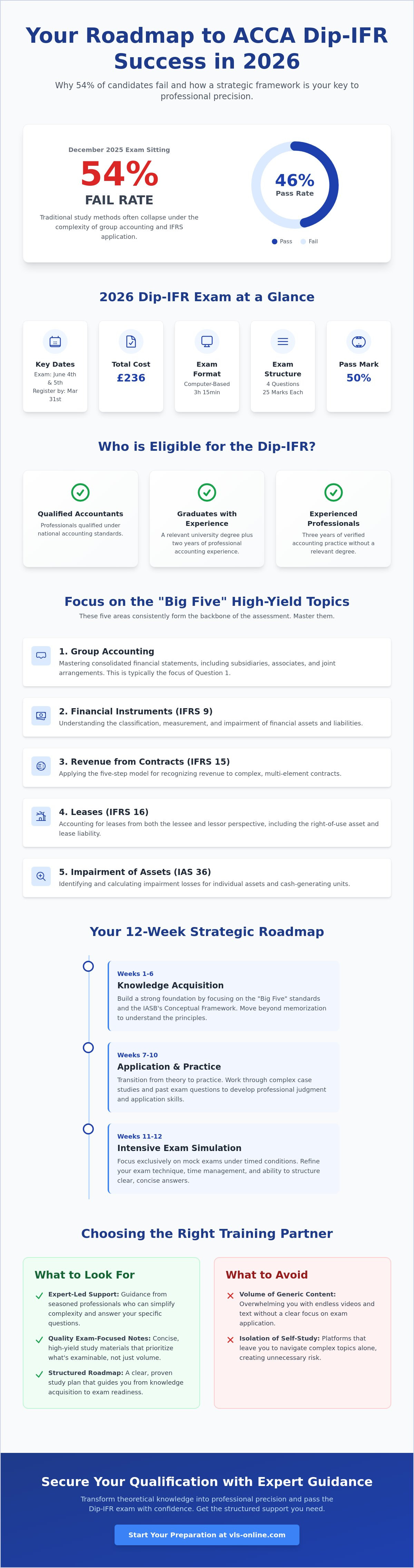
A Strategic Roadmap for Effective ACCA Dip-IFR Preparation
A methodical approach to ACCA Dip-IFR Exam Preparation ensures that technical complexity doesn't lead to professional confusion. For the 2026 sessions, we recommend a 14-week roadmap designed to build both confidence and competence. This timeline isn't arbitrary; it's a calculated structure that respects the depth of the syllabus while acknowledging the time constraints of a working professional.
Phase 1 (Weeks 1 to 8) centers on Knowledge Acquisition. During this period, your priority is mastering individual IAS and IFRS standards through high-quality recorded lectures. Phase 2 (Weeks 9 to 12) marks the transition to Intensive Practice. You'll shift your focus to past paper questions and rigorous group accounting drills to build the "muscle memory" required for the computer-based exam. Finally, Phase 3 (Weeks 13 and 14) is the Final Sprint. This stage involves completing full mock exams under timed conditions and conducting targeted revision of your weakest areas. Integrating these accounting exam study tips into your daily routine will enhance retention and prevent the burnout often associated with professional certifications.
The Role of Mock Exams and Debriefs
Completing a mock exam without a professional debrief is a wasted opportunity. A debrief allows you to analyze your logic against the examiner's expectations, helping you understand not just what the answer is, but why a specific treatment is required. You should use official examiner reports to identify personal knowledge gaps. These reports provide a protective insight into the common errors that frequently prevent candidates from reaching the 50% pass mark. They're essential for refining your exam technique.
Leveraging Active Tutor Support
Isolation is a significant risk in self-study environments. Proactive tutor support via dedicated WhatsApp groups provides instant clarification for those moments when a standard feels impenetrable. Weekly live sessions further simulate a professional classroom environment, which significantly reduces exam-day nerves by normalizing the process of deconstructing complex scenarios. If you're ready to secure your success with expert mentorship, enroll in our Dip-IFR preparation program to gain direct access to our senior advisors.
Choosing the Right Partner for Your IFRS Certification
Selecting a training provider is a strategic investment that requires a careful evaluation of the support-to-content ratio. While many institutions offer massive, 1,000-page textbooks, these generic materials often obscure the path to success with unnecessary complexity. Your ACCA Dip-IFR Exam Preparation should instead focus on concise, exam-oriented study notes that prioritize the application of standards over rote memorization. True professional protection comes from having direct access to experts who can deconstruct intricate group accounting scenarios in real-time. Partnering with Vertex Learning Solutions, a London-based institution, provides a unique advantage, combining a global financial perspective with the rigorous standards of the world’s leading accounting hub. It ensures your training remains relevant to the high expectations of multinational employers.
Vertex Learning Solutions: Tailored Learning for Global Professionals
We offer a structured environment where professional growth is supported by a robust digital infrastructure. Our platform features high-definition recorded videos and interactive questions designed to reinforce technical knowledge at your own pace. The defining feature of our approach at Vertex Learning Solutions is the WhatsApp "safety net," which ensures you're never isolated during your studies. This proactive support system allows for instant clarification of complex IFRS treatments, providing the expert proximity needed to master the syllabus. The Diploma in IFRS modules are specifically engineered as a flexible path for busy accountants who need to balance rigorous study with demanding corporate responsibilities.
Investing in Your Future: Beyond the Certificate
The return on investment for IFRS expertise in the 2026 job market remains exceptionally high. As multinational corporations seek specialists capable of navigating an increasingly unified reporting environment, your certification serves as a long-term professional shield. This diploma is often the first step toward a broader leadership role within the global financial community. You can explore our full range of ACCA courses to continue your career advancement beyond this single qualification. Success is a choice made through disciplined preparation and the selection of a partner who understands the high stakes of your professional journey.
Take the final step toward your 2026 goals. Enroll in our comprehensive ACCA Dip-IFR course today and secure the expert mentorship required for a first-time pass.
Securing Your Professional Future in 2026
Navigating the complexities of international reporting requires a blend of technical mastery and strategic discipline. By mastering the "Big Five" standards and following a structured 14-week roadmap, you transform a daunting syllabus into a manageable professional milestone. Success in your ACCA Dip-IFR Exam Preparation isn't merely about passing a test; it's about adopting a principle-based mindset that provides a career-long protective layer in the global economy.
The London-based expert faculty at Vertex Learning Solutions brings global experience directly to your screen, ensuring you're never left to decipher complex group accounting alone. Through active tutor support via WhatsApp and weekly live interactive sessions, we provide the professional safety net necessary to simplify the most intricate standards. This structured approach ensures you're prepared for the upcoming 2026 sessions with absolute confidence.
Secure your first-time pass with Vertex Learning Solutions' ACCA Dip-IFR Preparation Course and elevate your career to a new global standard. Your journey toward becoming a recognized IFRS specialist starts with the right strategic partner.
Frequently Asked Questions
Is the ACCA Dip-IFR exam difficult for those only familiar with local GAAP?
The transition from local GAAP to IFRS represents a significant shift from rule-based compliance to a principle-based framework. Candidates often find the conceptual judgment required for ACCA Dip-IFR Exam Preparation demanding if they're accustomed to rigid national checklists. Success requires moving beyond simple memorization to understand the economic substance of transactions as defined by international standards.
How many hours of study are required to pass the Dip-IFR in 2026?
Professionals should allocate approximately 150 to 200 hours of disciplined study to ensure a comprehensive understanding of the syllabus. This commitment typically spans 12 to 14 weeks, allowing for 10 to 15 hours of weekly engagement. A structured roadmap ensures that technical standards are mastered well before the final mock exam phase, providing the professional protection needed for a first-time pass.
What is the passing score for the Diploma in International Financial Reporting?
The passing score for the Diploma in International Financial Reporting is 50%. The examination consists of four questions, each worth 25 marks, totaling 100 marks. Candidates must demonstrate a balanced proficiency across all sections to reach this threshold. The examiner rewards precise application and professional explanation over simple mathematical calculation, making structured answers essential for success.
Can I take the Dip-IFR exam online or must I visit a center?
The Dip-IFR is a computer-based exam (CBE) typically administered at designated professional testing centers. While the ACCA utilizes remote invigilation in specific regions where center access is restricted, most candidates will visit a secure facility to complete the assessment. You should verify your specific location's availability during the exam booking window, which closes on October 27 for the December 2026 session.
What are the key differences between IFRS and US GAAP mentioned in the 2026 syllabus?
The 2026 syllabus primarily emphasizes the application of IFRS, though it addresses conceptual differences with US GAAP in areas like revenue recognition and financial instrument classification. While the two frameworks achieved significant convergence through joint projects, understanding the remaining distinctions is essential for providing accurate professional advice. Your ACCA Dip-IFR Exam Preparation will focus on these nuances to ensure compliance in a multinational reporting context.