

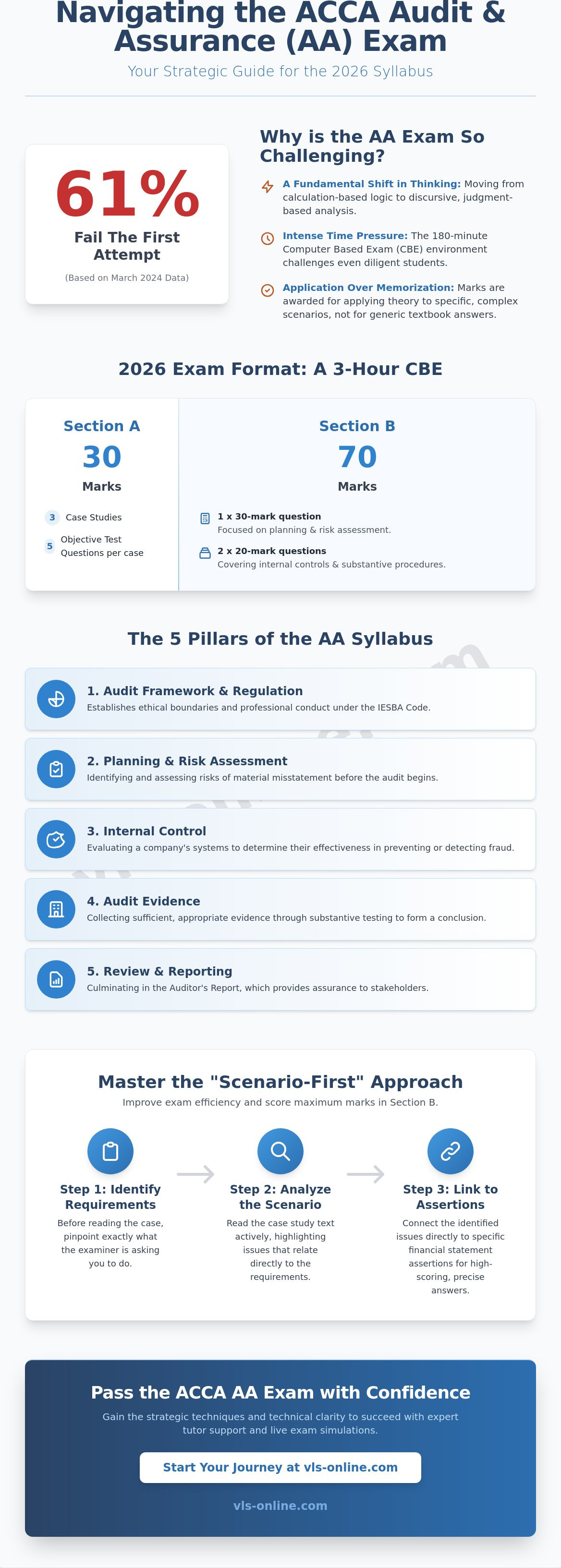
Why do 61% of candidates fail to secure a passing mark in their first attempt at the ACCA Audit and Assurance (AA) exam? According to the March 2024 pass rate data, the shift from the predictable logic of calculation-heavy papers to the discursive, judgment-based requirements of auditing represents a significant hurdle for many professionals. It’s understandable to feel overwhelmed when you’re asked to distinguish between an audit risk and a response under intense pressure. You’ve likely mastered the numbers, yet find the 180-minute Computer Based Exam (CBE) environment creates a unique set of time management challenges that can undermine even the most diligent preparation.
This guide serves as your professional protective shield, providing the strategic exam techniques and technical clarity required to navigate the 2026 syllabus with absolute confidence. We’ll provide a structured study plan and demonstrate exactly how to capture every available mark in Section B by refining your professional skepticism. You’ll gain a clear understanding of the examiners' expectations, ensuring your path to qualification remains stable and secure.
Key Takeaways
- Understand the strategic role of the ACCA Audit and Assurance (AA) exam within the Applied Skills framework and how it prepares you for the complexities of the Strategic Professional level.
- Master the five pillars of the audit syllabus, focusing on the legal and ethical requirements of the IESBA Code and the critical process of audit planning and risk assessment.
- Learn to implement the "Scenario-First" approach to improve exam efficiency by identifying specific requirements before analyzing complex case study texts.
- Develop the technical precision required to identify scenario-based issues and link them directly to audit assertions for maximum scoring potential.
- Discover how real-time tutor support and live exam simulations can refine your professional writing style and help you navigate the 2026 exam environment with confidence.
Navigating the ACCA Audit and Assurance (AA) Landscape in 2026
The 2026 examination cycle for the Association of Chartered Certified Accountants (ACCA) marks a period where professional skepticism is no longer just a buzzword; it's a survival mechanism. Within the ACCA Applied Skills framework, the AA paper acts as a strategic gateway. It's the point where technical accounting knowledge evolves into the high-level oversight required for the Strategic Professional level. Mastering ACCA Audit and Assurance (AA) isn't about memorizing standards; it's about developing a protective, analytical mindset that ensures financial integrity in complex environments.
Success requires a fundamental psychological pivot. In ACCA Financial Reporting (FR), your role is the "preparer" focused on the mechanics of calculations and statement construction. AA reverses this relationship. You're now the "reviewer" tasked with identifying where those preparations might fail. This shift is reflected in the marking scheme. While FR is calculation-heavy, AA is approximately 70% discursive. You won't find safety in numbers here; your marks are earned through the logical structure of your arguments and the precision of your written justifications.
The AA Exam Format: What to Expect in 2026
The 2026 exam structure remains a disciplined, three-hour computer-based assessment. Section A utilizes three distinct case studies, each containing five Objective Test Questions (OTQs) for a total of 30 marks. These test the breadth of the syllabus, from ethics to reporting. Section B represents the "constructive response" heart of the exam, featuring one 30-mark question and two 20-mark questions. These focus on three core pillars: internal control evaluation, audit risk assessment, and the design of substantive procedures. There's no room for generic answers; every response must be anchored to the specific scenario provided.
Pass Rates and 2026 Difficulty Projections
Analysis of pass rates from 2023 through 2025 shows ACCA Audit and Assurance (AA) consistently sitting between 39% and 45%. It remains one of the more rigorous modules because it demands professional judgment over rote learning. For 2026, the examiner's focus has intensified on "audit evidence" and "internal controls." Data suggests that candidates who fail often provide generic "textbook" risks rather than identifying the specific financial statement assertions at risk in the case study. To secure a pass, your preparation must prioritize the application of theory to practical, messy business realities.
Deconstructing the AA Syllabus: The 5 Pillars of Audit
The ACCA Audit and Assurance (AA) syllabus is structured to transform a student into a meticulous professional capable of navigating complex financial environments. It's not merely about memorizing rules; it's about applying a strategic mindset to five core pillars. These pillars begin with the Audit Framework and Regulation, which establishes the ethical boundaries defined by the IESBA Code. From there, the focus shifts to Planning and Risk Assessment, where the auditor identifies potential pitfalls before they manifest in the accounts.
Effective auditing requires a deep dive into Internal Controls to determine if a company's own systems can prevent or detect fraud. This leads to the collection of Audit Evidence through rigorous substantive procedures, which serves as the empirical basis for any conclusion. Finally, the Review and Reporting phase culminates in the Auditor’s Report, the document that provides stakeholders with much-needed security. To stay aligned with the latest standards for the 2026 sessions, students should consult the Official ACCA AA Syllabus and Resources for technical guidance.
Mastering Audit Risk vs. Business Risk
Distinguishing between these two concepts is the most frequent hurdle for candidates. Business risk involves factors that threaten a company’s survival, such as a 15% drop in market share or rising energy costs. Audit risk, however, focuses strictly on the integrity of the financial statements. Audit Risk is the risk that the auditor expresses an inappropriate audit opinion when the financial statements are materially misstated.
Audit risk consists of three components: Inherent Risk (the nature of the business), Control Risk (failure of internal systems), and Detection Risk (the auditor's failure to find an error). For example, a tech firm with complex revenue recognition policies has high inherent risk due to the subjectivity of the accounting. A common student mistake is describing why the company might lose money, rather than explaining why the revenue figure on the balance sheet might be overstated. Developing this level of precision is a core focus of our ACCA preparation modules, where we emphasize logical clarity over rote learning.
How to Master AA Exam Technique: A Step-by-Step Approach
Success in the ACCA Audit and Assurance (AA) exam isn't just about technical knowledge; it's about the precision of your application. Achieving a passing grade requires a methodical approach to the case study scenarios presented in the 2026 CBE environment.
Step 1: Adopt the "Scenario-First" approach. Read the specific requirements before diving into the case study text. This allows you to filter the narrative for relevant triggers immediately, saving precious minutes that are often wasted on irrelevant background information.
Step 2: Isolate the "Issue" within the scenario. You must link every identified risk or deficiency directly to a relevant assertion. For instance, if inventory is stored at multiple third-party locations, the assertion of existence becomes a focal point. This methodology aligns with the UK Auditing Standards (ISAs), which require a risk-based approach to evidence gathering and professional skepticism.
Step 3: Draft your "Audit Procedure" using active, specific verbs. You shouldn't simply "check" a document. You must "Inspect" a purchase invoice, "Observe" a physical count, "Recalculate" a depreciation charge, or "Inquire" of management regarding outstanding legal claims. Vague verbs lead to lost marks.
Step 4: Apply the "Explain" rule. When identifying a control deficiency, you must explicitly state why it's a problem for the client. If there's no sequence check on invoices, don't just state the fact; explain that this increases the risk of unrecorded liabilities or fraudulent entries.
The "Risk and Response" Formula for Section B
Organizing your thoughts in a two-column table is the most effective way to satisfy 2026 CBE markers. Use the left column for "Audit Risk" and the right for "Auditor’s Response." Structure your sentences with discipline. Start with "The risk is that..." to describe the financial statement impact, and "The auditor should..." to outline a precise substantive procedure. For those seeking structured guidance, our ACCA courses online provide detailed video walkthroughs of these Section B requirements.
CBE Software Mastery for Audit Documentation
The word processor tool is your professional report environment. Use headers and bullet points to ensure your documentation is clear and logical. Time management is critical. Professional data suggests that leaving Section B for the final 45 minutes often leads to incomplete answers. Aim to allocate 1.8 minutes per mark to ensure every requirement receives the depth it deserves.
Secure your professional future with a strategic study plan designed for 2026 exam success.
Choosing the Right Support: Why Vertex Leads ACCA AA Preparation
Success in the ACCA Audit and Assurance (AA) exam requires more than just reading a textbook; it demands a strategic partner who understands the nuances of International Standards on Auditing (ISAs). Vertex provides active tutor support through dedicated WhatsApp groups, allowing students to resolve queries about complex ISAs in real-time. This immediate feedback loop prevents the accumulation of misunderstandings that often derail revision schedules during the final weeks before an exam.
Our weekly live sessions go beyond theory by simulating the rigorous 2026 exam environment. These sessions focus specifically on the technical writing style necessary to secure marks in the constructive response sections. We provide exam-focused study notes that eliminate unnecessary academic fluff. Every page is designed to maximize your mark-earning potential by highlighting exactly what markers look for in audit risk, substantive procedures, and internal control questions.
The Vertex Learning Advantage
The transition from Applied Skills to the ACCA Strategic Professional level is a long-term journey that requires a stable foundation. Vertex supports this progression with interactive practice questions that precisely mirror the official ACCA CBE platform. This ensures students aren't just learning content but are mastering the digital interface they'll face on exam day, reducing technical anxiety.
For those looking to optimize their study timeline, our Professional Certification Packages provide a cohesive framework for taking ACCA Audit and Assurance (AA) alongside ACCA Performance Management (PM). This dual approach leverages the overlaps between performance metrics and audit evidence. Vertex provides recorded lectures that allow students to learn at their own pace while maintaining a classroom feel through live engagement. Our methodology ensures you're prepared for the 2026 sittings with the precision and confidence of a seasoned professional.
Securing Your Professional Future in the 2026 Audit Landscape
Success in this demanding module requires more than just memorizing standards. It demands a deep integration of the five pillars of audit with refined technical execution. As the 2026 exam cycle approaches, your ability to navigate complex risk assessments and internal control evaluations will determine your progression through the Applied Skills level. We've established that a structured approach to past papers and a clear understanding of auditor liability are non-negotiable for those seeking long-term professional stability.
VLS Online provides the strategic framework necessary to convert this complexity into a clear path toward qualification. Our London-based expert tutors offer a protective net of knowledge, delivering WhatsApp-based support that bridges the gap for global students. With our high pass rates across all Applied Skills modules, you're not just studying; you're investing in a proven methodology of success. Enroll in our ACCA Audit and Assurance (AA) course today for expert tutor support and 2026 exam success!
It's time to transform your technical potential into a definitive career milestone.
Frequently Asked Questions
Is ACCA Audit and Assurance (AA) hard to pass?
Success in this paper requires a shift from calculation to professional judgment. According to the June 2024 pass rates, the success rate for ACCA Audit and Assurance (AA) was 44%. It's often considered challenging because it demands a 100% application of theory to specific scenarios. You won't find success through rote memorization; instead, you must demonstrate how International Standards on Auditing apply to unique business risks.
What is the best way to study for ACCA AA in 2026?
The most effective strategy involves a 70/30 split between active question practice and technical reading. You should utilize the ACCA Practice Platform for at least 40 hours to master the digital exam environment. Focus on past papers from 2021 to 2025 to understand the recurring patterns in audit risk and internal control questions. This methodical approach builds the technical precision required for the 2026 regulatory environment.
Can I take AA and FR (Financial Reporting) together?
Pairing these exams is a strategic advantage because roughly 25% of the audit syllabus relies on financial reporting knowledge. You'll find that understanding IFRS standards makes identifying audit misstatements much more intuitive. Many candidates successfully sit both in one session, provided they can commit to a 250-hour total study plan. It's a logical combination that optimizes your learning curve across the Applied Skills module.
How much time do I need to prepare for the AA exam?
A disciplined candidate should plan for 120 to 150 hours of focused preparation. This timeframe allows for a full syllabus review and the completion of three timed mock exams. If you're balancing a career, a 10-week schedule with 15 hours of weekly study provides the necessary professional safety net. This structure ensures you've covered all five syllabus areas without rushing the critical revision phase.
What are the most common reasons students fail the AA paper?
Failure typically results from providing generic answers that don't reference the exam scenario. Recent examiner reports indicate that 60% of unsuccessful students lose marks by failing to link their audit procedures to the specific risks mentioned in the text. Poor time management also plays a role. Many candidates spend too much time on Section A, leaving insufficient space to provide the detailed responses required for the 30-mark Section B questions.