

What if the primary obstacle to your advancement in management accounting isn't the inherent complexity of the math, but the absence of a rigorous strategic framework? Many candidates entering the 2026 cycle feel a justified apprehension regarding the CIMA Certificate in Business Accounting, particularly when trying to reconcile the BA1 through BA4 requirements with a demanding professional schedule. It's a common challenge to seek professional growth while fearing that a lack of consistent study time will undermine your long term career goals.
This guide offers the structural clarity and expert insight necessary to transform that uncertainty into a disciplined path toward certification. We'll provide you with a comprehensive roadmap to master the updated syllabus, ensuring you possess the technical proficiency to pass all four exams on your first attempt. You'll explore a detailed analysis of each module, a method for optimizing your study hours, and the tactical preparation required to establish a firm foundation in management accounting.
Key Takeaways
-
Understand the core structure of the four foundational modules that serve as the essential gateway to the prestigious CGMA designation.
-
Gain a strategic advantage by mastering the logistics of on-demand objective tests, ensuring precision and effective time management during the assessment.
-
Develop a rigorous preparation framework for the CIMA Certificate in Business Accounting that utilizes active learning to guarantee professional competency.
-
Learn to demystify complex quantitative requirements in the syllabus, transforming perceived mathematical challenges into structured analytical strengths.
-
Identify the clear progression paths and high-value career opportunities accessible immediately upon completing this foundational qualification.
Table of Contents
What is the CIMA Certificate in Business Accounting in 2026?
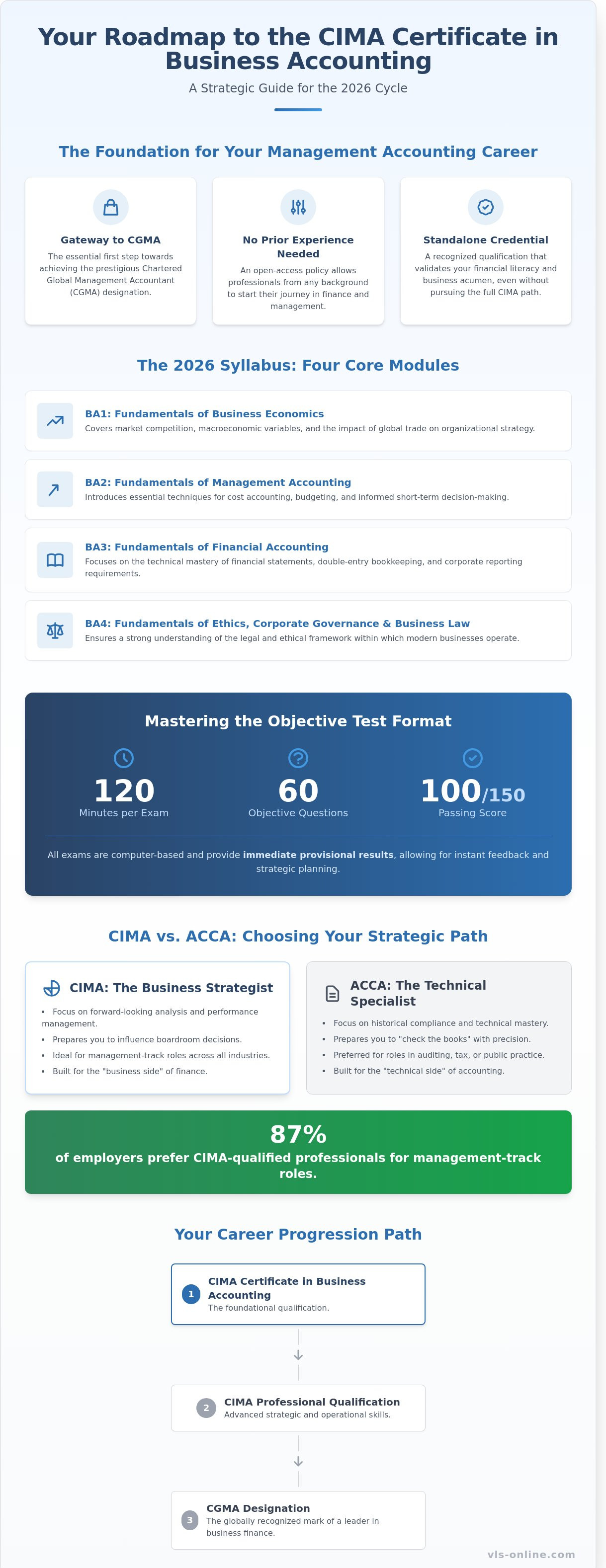
The CIMA Certificate in Business Accounting represents the formal entry point for professionals seeking the prestigious CGMA designation. Developed by the Chartered Institute of Management Accountants (CIMA), this qualification provides a robust framework for understanding how finance drives organizational success. It's a foundational step that bridges the gap between basic commerce and strategic management. One of its most significant advantages is accessibility; candidates don't need any prior accounting experience or specific academic degrees to begin their studies. This open-access policy ensures that professionals from diverse backgrounds can pivot into finance or enhance their management capabilities without delay.
In 2026, the certificate remains a powerful standalone credential. While it serves as a prerequisite for the CIMA Professional Qualification, it also functions as a recognized badge of expertise for business owners, project managers, and entrepreneurs. It validates your ability to interpret financial data and apply it to real-world business scenarios, providing a level of professional security in an increasingly data-driven market.
The 2026 Syllabus: BA1 to BA4 Breakdown
The curriculum is divided into four distinct modules, each assessed through a 120-minute computer-based objective test. These exams can be taken in any order, allowing for a flexible study schedule that fits your professional life.
-
BA1: Fundamentals of Business Economics covers the economic context of business, focusing on market competition, macroeconomic variables, and the impact of global trade on organizational stability.
-
BA2: Fundamentals of Management Accounting sits at the heart of the CIMA qualification. It introduces the essential techniques for cost accounting, budgeting, and short-term decision-making.
-
BA3: Fundamentals of Financial Accounting focuses on the technical mastery of financial statements. You'll learn the mechanics of double-entry bookkeeping and the regulatory requirements for corporate reporting.
-
BA4: Fundamentals of Ethics, Corporate Governance and Business Law ensures you understand the legal and ethical framework within which all modern businesses must operate.
Why Choose CIMA Over Other Entry-Level Qualifications?
Deciding between qualifications requires a clear understanding of your long-term career goals. When you compare the CIMA Certificate in Business Accounting to the ACCA Applied Knowledge route, the difference in focus becomes clear. ACCA is often the preferred choice for those aiming for technical roles in auditing or tax. In contrast, CIMA is built for the "business side" of finance.
The CIMA path prioritizes strategy, performance management, and forward-looking analysis rather than just historical compliance. It's designed for those who want to be in the boardroom, influencing decisions rather than just checking the books. This strategic focus is why 87% of employers in a recent industry survey indicated they prefer CIMA-qualified professionals for management-track roles. It provides a logical, structured approach to business that translates across all industries.
Exam Structure and What to Expect at the Testing Centre
The CIMA Certificate in Business Accounting utilizes a streamlined, computer-based assessment model designed for modern professionals. Each of the four modular exams consists of a 120-minute Objective Test. You must navigate 60 questions within this timeframe, which requires a blend of technical accuracy and rapid analytical skills. Pearson VUE manages the delivery of these exams through an extensive network of physical testing centres and a robust remote proctoring system, allowing you to choose the environment that best supports your performance.
Scoring is based on a scaled system ranging from 0 to 150. A score of 100 represents the passing threshold. This approach ensures that the difficulty level remains consistent across different versions of the exam. Perhaps the most reassuring feature is the immediate delivery of provisional results. You won't face the anxiety of a long waiting period; your performance is calculated the moment you submit your final answer, providing instant clarity on your progress and allowing for immediate strategic planning of your next steps.
Mastering the Objective Test Format
Success requires more than just memorizing facts. The exam format includes multiple-choice questions, drag-and-drop exercises, and "hot spot" questions where you identify specific areas on a graph or table. Time management is your most valuable asset. You'll have approximately two minutes per question. If a complex calculation takes longer, you must compensate by answering theoretical questions more quickly. Reviewing the CIMA Certificate in Business Accounting subjects in detail helps you identify which areas might require more time during the actual sitting.
Booking and Scheduling Your Exams
The flexibility of the 2026 schedule means you don't have to wait for specific exam windows. You can book your exam on-demand throughout the year. If you opt for remote proctoring, ensure your home office is a secluded space with a reliable internet connection and a clear desk policy. This level of control allows you to align your exam date with your peak readiness. For those who prefer a structured path to mastery, starting with comprehensive study resources can significantly reduce the pressure of the scheduling process and provide a secure professional foundation.
Strategic Preparation: How to Pass the CIMA Cert BA
Passing the CIMA Certificate in Business Accounting requires more than a passive review of study materials. Research into cognitive retention suggests that students lose nearly 70% of new information within 48 hours if they don't engage in active retrieval. Reading the textbook once is never enough. You must adopt an active learning approach by solving practice questions immediately after finishing a chapter. This methodology transforms abstract theory into functional knowledge, ensuring you're prepared for the 2026 exam standards.
Many candidates hesitate because they believe they aren't "good at maths." This is a common misconception that stalls progress in BA2 and BA3. These modules don't require advanced calculus; they demand logical consistency and basic arithmetic. Success comes from mastering the underlying structures of financial statements and cost accounting rather than complex equations. If you can follow a logical sequence, you can master these modules. The difficulty lies in the interpretation of data, not the calculation itself.
Time management is the final hurdle. The exam provides a strict 120-minute window to answer 60 questions, leaving you exactly two minutes per item. Mock exams are essential to simulate this high-pressure environment. Without practicing under timed conditions, even the most knowledgeable students can succumb to panic. Balancing these requirements with a 40-hour work week is challenging but manageable. You can implement these accounting exam study tips to optimize your limited study hours for maximum impact.
Self-Study vs. Online Tuition: Which is Right for You?
The solo route offers lower initial costs but carries a higher risk of stagnation. Without external structure, it's easy to lose momentum when encountering complex topics. In contrast, structured online courses provide a professional safety net. VLS Online offers direct tutor support via WhatsApp, allowing you to resolve technical queries instantly. This proactivity prevents small misunderstandings from turning into significant knowledge gaps.
Common Pitfalls in the Certificate Level
Students frequently fail BA4 (Ethics) because they underestimate its theoretical complexity, assuming it's merely "common sense." It's actually a rigorous framework that requires precise application. Additionally, the "BA2 Wall" remains the toughest obstacle. This module introduces fundamental management accounting concepts that are entirely new to most. Overcoming it requires a strategic focus on variance analysis and cost behavior patterns rather than rote memorization.
Secure your professional future by enrolling in our expert-led online courses today.
Your Career Path After the CIMA Certificate
Completing the CIMA Certificate in Business Accounting marks the transition from foundational knowledge to professional mastery. This qualification isn't an isolated achievement; it's the gateway to the CIMA Professional Qualification. The syllabus is designed so that the logic of the Cert BA flows naturally into higher-level strategic thinking. By the time you finish, you've already mastered the core principles that 92% of top-tier employers demand from entry-level finance professionals.
The certification immediately opens doors to several high-impact roles. You'll find yourself qualified for positions such as:
-
Junior Management Accountant: Assisting in the preparation of internal reports and cost analysis.
-
Accounts Assistant: Managing essential financial transactions with a focus on accuracy and compliance.
-
Business Analyst: Using data to drive organizational efficiency and identify growth opportunities.
The CIMA brand offers unparalleled global portability. In financial hubs like London, the Middle East, and Asia, the designation serves as a hallmark of quality. According to 2024 industry benchmarks, CIMA-qualified professionals are often prioritized in multinational recruitment due to their standardized expertise. Once you've secured the certificate, your next logical milestone is the CIMA Operational Level, where you'll begin applying management accounting to complex business scenarios.
Scaling Your Professional Success with VLS
Long-term career growth requires a stable educational partner who understands the complexities of the 2026 exam environment. VLS offers Full Access packages that provide a comprehensive safety net for your studies. Our structure includes weekly live sessions, which are essential for maintaining momentum. These sessions act as a professional anchor, ensuring you remain disciplined and focused on the long-term goal of CGMA status.
Conclusion: Starting Your Journey Today
The first step toward a new professional identity is often the most difficult, but the rewards of the CIMA Certificate in Business Accounting are lifelong. This isn't just about an exam; it's about building a foundation of professional integrity and strategic capability. We invite you to take control of your career trajectory. Browse our current CIMA course enrollments today and begin your journey with the backing of elite expert guidance.
Secure Your Professional Advancement in 2026
Achieving the CIMA Certificate in Business Accounting represents a decisive milestone for any aspiring finance professional in 2026. This foundational qualification serves as more than just a credential; it's a strategic entry point into a global network of elite management accountants. Success in the 2026 syllabus requires mastering four distinct modules through disciplined study and logical application. By understanding the rigorous exam structure and preparing for the digital-first testing environment, you mitigate risks and accelerate your career trajectory toward professional stability.
VLS Online provides the expert framework necessary to navigate these academic complexities with absolute confidence. Our methodology combines exam-focused study notes with high-definition recorded lectures to ensure your preparation remains precise and efficient. You'll benefit from weekly live interactive sessions and active tutor support via WhatsApp, providing a professional safety net that guarantees you're never studying in isolation. This structured approach simplifies the most challenging syllabus requirements into manageable, actionable goals.
Take the first step toward long-term career optimization today. Enroll in CIMA Certificate Courses with Expert Tutor Support and transform your professional potential into a tangible competitive advantage. Your journey toward financial leadership starts with the right partner.
Frequently Asked Questions
How long does it take to complete the CIMA Certificate in Business Accounting?
Most candidates complete the CIMA Certificate in Business Accounting within 6 to 12 months. This timeline assumes a consistent commitment of 10 to 15 study hours per week across the four mandatory modules. Each individual exam typically requires 120 to 150 hours of focused preparation. Your specific pace depends on your prior financial knowledge and professional background. Systematic planning ensures you maintain a steady progression through the curriculum.
Can I study for the CIMA Cert BA while working full-time?
You can successfully balance your studies with full-time employment by utilizing CIMA's flexible on-demand exam structure. Data from the professional body indicates that over 80% of active candidates manage their professional duties alongside their education. Exams are available year-round at Pearson VUE centers or via secure online proctoring. This structure allows you to schedule assessments during periods of lower professional intensity, ensuring your career development remains a stable priority.
Are there any exemptions available for the CIMA Certificate level?
Exemptions are granted to candidates who hold relevant degrees or professional certifications from accredited institutions. If you possess a degree in accounting or business from a recognized university, you'll likely qualify for credits that bypass specific modules. You must submit your official transcripts to CIMA for a formal assessment. This process typically takes 10 to 15 working days. Securing these exemptions optimizes your path to the professional level by removing redundant coursework.
What is the difference between CIMA Certificate and CIMA Professional levels?
The CIMA Certificate in Business Accounting serves as the entry-level foundation, while the Professional level encompasses three distinct tiers of strategic management. The Certificate level focuses on fundamental accounting principles and business ethics. In contrast, the Professional Qualification requires passing 9 objective tests and 3 case study exams. This progression ensures a comprehensive transition from technical proficiency to executive decision-making. It's a structured path designed to build long-term professional resilience.
How much do the CIMA Cert BA exams cost in 2026?
Exam fees are determined by your geographic region, categorized into three tiers by the institute. For Tier 1 markets, the standard exam fee is £115 per module, alongside a one-time registration fee of £99. These costs are subject to annual adjustments by the governing body. You should also account for the annual subscription fee, which maintains your active student status. Budgeting for these fixed expenses provides a clear financial framework for your qualification journey.