

What if the difference between a 25% salary increase and career stagnation in 2026 isn't how hard you study, but which four letters you choose to put after your name today? Deciding on ACCA vs CIMA often feels like a high-stakes strategic maneuver where a single misalignment leads to a job role that doesn't fit your long-term vision. You've likely felt the weight of this choice; it's natural to worry about committing years to a rigorous curriculum only to find it lacks the specific local utility or global recognition your future requires.
This analysis provides the definitive clarity you need to align your professional certification with the precise demands of the 2026 financial landscape. We'll examine the 13 papers of the ACCA framework against the 12 exams of the CIMA syllabus, evaluating their impact on salary benchmarks and mobility across 181 countries. You'll gain a clear decision on which path to take and a structured study plan designed to mitigate the risk of failure while securing your professional standing.
Key Takeaways
- Identify the fundamental distinctions between technical financial reporting and strategic management to align your certification with your specific professional aptitude.
- Analyze the 2026 exam structures and syllabus evolutions to determine which qualification offers the most efficient path for your career development.
- Explore the diverse career trajectories available, ranging from specialized audit and tax consultancy to high-level strategic leadership roles like Chief Operating Officer.
- Make an informed ACCA vs CIMA decision by evaluating how each credential functions as a long-term strategic asset in a digital-first global economy.
- Discover a proactive exam methodology designed to help you balance rigorous study requirements with the complex demands of a full-time professional career.
Understanding the Fundamentals: What are ACCA and CIMA?
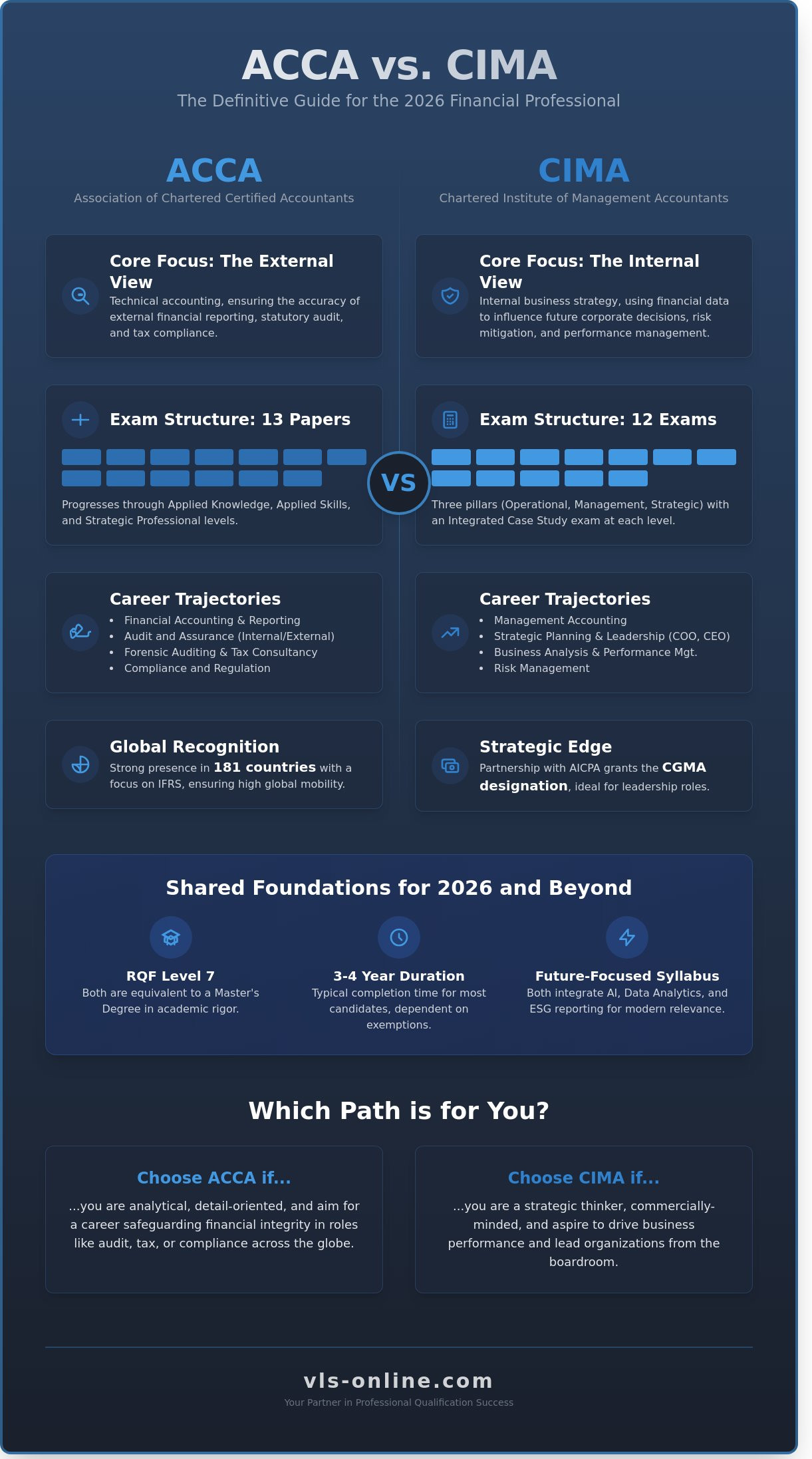
Determining the optimal career path in global finance requires a clear understanding of the professional landscape. The ACCA vs CIMA debate isn't about which qualification is superior, but rather which framework aligns with your long-term strategic objectives. Both qualifications are recognized as Level 7 equivalents under the Regulated Qualifications Framework (RQF) as of 2026, placing them on par with a Master’s degree in terms of academic and professional rigor.
The distinction lies in the "view" you take of an organization. ACCA, administered by the Association of Chartered Certified Accountants, provides a foundation in technical accounting, statutory audit, and tax compliance. It's designed for those who prioritize the accuracy of external financial reporting. Conversely, the Chartered Institute of Management Accountants (CIMA) focuses on internal business strategy and performance management. While ACCA looks at the integrity of past and present figures, CIMA uses financial data to influence future corporate decisions.
The Global Recognition of ACCA
ACCA maintains a presence in 181 countries, ensuring that its members possess a portable skill set rooted in International Financial Reporting Standards (IFRS). This reach allows professionals to navigate complex regulatory environments with precision and authority. ACCA’s core mission is to build ethical, technical financial leaders who safeguard the public interest through disciplined reporting.
The Strategic Edge of CIMA
CIMA offers a unique advantage through its partnership with the American Institute of Certified Public Accountants (AICPA), granting members the Chartered Global Management Accountant (CGMA) designation. This qualification transcends traditional bookkeeping. It prepares professionals for leadership roles in operations and organizational strategy. Data from 2024 indicates that 35% of CIMA members hold positions in general management or strategic planning rather than standard accounting functions.
When selecting your path, consider these core focus areas:
- ACCA: Financial accounting, forensic auditing, and international taxation.
- CIMA: Cost management, risk mitigation, and corporate strategy.
Ultimately, choosing between ACCA vs CIMA dictates whether you'll oversee the compliance of the books or the direction of the boardroom.
Core Differences: Syllabus, Structure, and 2026 Evolution
The choice between ACCA vs CIMA hinges on whether you aim for technical mastery or strategic management. ACCA follows a 13-exam structure. Students progress through Applied Knowledge, Applied Skills, and finally the Strategic Professional level. This path emphasizes financial accounting, audit, and tax. Conversely, CIMA requires 12 professional exams plus the initial Certificate level. It divides content into three pillars: Operational, Management, and Strategic. While ACCA tests specific technical competencies, CIMA utilizes Integrated Case Studies to simulate real-world business scenarios at the end of each level.
Exam Flexibility and Study Duration
Exam formats differ significantly between the two bodies. Early ACCA exams and CIMA Objective Tests are available on-demand, allowing for rapid initial progression. Professional levels typically follow quarterly cycles in March, June, September, and December. Most candidates spend 3 to 4 years completing either qualification. This timeline depends on exemptions, which can reduce the workload for university graduates by up to 9 exams for ACCA or the entire foundational level for CIMA. Consistency is vital, as the 10-year rule for ACCA professional papers requires disciplined planning.
The 2026 Syllabus: Tech and Sustainability
The 2026 syllabus updates reflect a shift toward digital finance and environmental responsibility. Both bodies have integrated AI, data analytics, and ESG (Environmental, Social, and Governance) reporting into their modules. For instance, the ACCA Strategic Business Reporting module now requires candidates to evaluate the financial implications of climate risk. CIMA has similarly updated its digital pillar to ensure management accountants can oversee automated financial systems. Modern professionals must be tech-fluent to remain relevant in a landscape where 85% of financial leaders prioritize data-driven decision-making.
Navigating these complex requirements requires a structured approach to risk management and career planning. Professionals often seek strategic tax and legal guidance to ensure their corporate structures align with their evolving professional status. This foresight prevents regulatory friction as you move into senior leadership roles. Success in the ACCA vs CIMA debate isn't just about passing; it's about mastering the 2026 digital landscape.
Career Trajectories: Where Will Your Choice Take You?
The decision between ACCA vs CIMA shapes your professional identity for decades. ACCA members often secure roles as Audit Partners, Tax Consultants, or Group Financial Controllers. Their expertise lies in the rigorous application of IFRS and tax legislation. In contrast, CIMA professionals thrive in dynamic sectors like FMCG, manufacturing, and high-growth technology. They frequently occupy roles such as Business Analyst or Finance Director. Financial rewards are substantial; 2023 market data shows post-qualified professionals in the UK earning between £52,000 and £65,000, depending on the specific sector and location.
Global Mobility and International Standards
ACCA's alignment with international reporting standards makes it a powerhouse in Europe and Asia. If you're starting your journey in these regions, this ACCA Applied Knowledge guide explains how to build a foundation for international markets. Conversely, CIMA’s partnership with the AICPA grants the CGMA designation. This credential provides significant leverage in the United States and Southeast Asian markets, where strategic management accounting is highly valued for driving corporate growth.
The CFO vs. CEO Pathway
The "top job" depends on the corporate structure. ACCA remains the gold standard for CFO roles in firms where financial integrity and statutory compliance are the primary risks. CIMA often leads to the CEO seat because it bridges the gap between finance and operations. Some critics claim CIMA isn't "real accounting," yet its curriculum includes rigorous financial pillars that ensure technical competence. It's a strategic choice. You're either protecting the value or creating it. Professional success requires a comprehensive career strategy to navigate these complex regulatory environments and reach the peak of your chosen path.
How to Ensure Exam Success: The Vertex Learning Approach
Balancing a 40-hour work week with the rigorous demands of professional certification remains the primary obstacle for 68% of candidates. Relying on passive reading is a recipe for failure in the 2026 digital-first exam environment; these assessments now require high-level application rather than simple recall. The transition from a student mindset to a professional one involves mastering strategic exam techniques that prioritize logic over rote memorization. Whether you're navigating the nuances of ACCA vs CIMA, the complexity of modules like Strategic Business Reporting (SBR) or the CIMA Case Studies requires a structured, expert-led framework to ensure a passing grade on the first attempt.
The Power of Interactive Support
Vertex Learning Solutions bridges the gap between theory and execution through a dual-layered support system. Students gain direct WhatsApp access to tutors, ensuring that technical queries don't stall their progress for more than 24 hours. Weekly live sessions provide a platform to deconstruct complex past papers in real-time, which is critical for success. Unlike generic textbooks that often exceed 600 pages of dense text, our exam-focused study notes distill the syllabus into actionable insights. This targeted approach reduces total study time by approximately 30% while significantly increasing retention for the high-stakes final papers.
Choosing Your Starting Point
Your journey begins with a clear assessment of your current standing. Many candidates qualify for up to nine exemptions based on their previous university degree or relevant professional experience, potentially accelerating their qualification by 18 months. Understanding where you fit in the ACCA vs CIMA landscape allows for a more efficient allocation of your resources and energy. We provide the professional scaffolding necessary to turn academic knowledge into a career-defining credential. To begin your journey with a structured roadmap and elite mentorship, explore our ACCA and CIMA preparation packages and secure your professional future today.
Securing Your Professional Future in 2026 and Beyond
Navigating the global financial landscape requires a strategic decision between two premier qualifications. By 2026, the distinction between ACCA vs CIMA remains clear. ACCA provides a robust foundation across 180 countries through 13 rigorous exams focused on international reporting standards. Conversely, CIMA equips you with the CGMA designation through its unique three-pillar structure designed for corporate leadership. Your choice dictates whether you'll lead in audit and tax or drive internal business strategy from the boardroom.
Success in these professional assessments demands more than just textbook knowledge; it requires a structured framework that mitigates the risk of failure. Vertex Learning simplifies this complexity by providing direct access to expert mentors. You'll benefit from dedicated WhatsApp tutor support for all students, participate in weekly live interactive sessions, and master the syllabus through exam-focused recorded lectures and comprehensive notes. Professional growth isn't a solitary pursuit. It's a managed progression toward long-term stability and career integrity.
Start your journey with expert ACCA and CIMA online tuition at Vertex Learning. Your path to becoming a qualified leader starts with the right partner today.
Frequently Asked Questions
Is ACCA harder than CIMA?
ACCA isn't objectively more difficult, but it requires passing 13 rigorous examinations compared to the 12 assessments required by CIMA. The curriculum focuses heavily on financial reporting and audit standards, which requires a deeper level of technical compliance and precision. According to 2023 pass rate data, professional level ACCA papers often see success rates between 30% and 50%, demanding a disciplined approach to complex regulatory environments.
Can I switch from ACCA to CIMA later in my career?
You can transition between these qualifications, and the CIMA gateway route allows ACCA members to bypass up to 11 exams. This strategic pivot enables professionals to move toward management accounting without repeating foundational coursework. If you've completed your ACCA qualification, you'll typically only sit the Management Case Study and the Strategic level exams, ensuring your professional protective net remains intact while you expand your expertise.
Which qualification pays more in 2026?
Salary projections for 2026 indicate that CIMA holders in senior management roles can expect an average annual compensation of £65,000. In comparison, professionals weighing the ACCA vs CIMA choice in audit or tax roles average approximately £62,000. The actual variance depends on your industry specialization; strategic wealth planning and long-term optimization skills often command higher premiums in the corporate sector than standard compliance roles.
Do I need a degree to start ACCA or CIMA?
You don't need a university degree to begin either path, as both organizations offer entry-level foundations for school leavers. The ACCA Foundations in Accountancy requires no prior qualifications, while CIMA’s Certificate in Business Accounting serves as a similar starting point for those without a degree. Starting early allows for proactive career structuring, and 25% of students now choose these alternative routes to gain a competitive edge.
How much does it cost to complete the full qualification?
Completing the full ACCA vs CIMA journey typically costs between £3,500 and £5,200 depending on your choice of tuition provider. These figures include registration fees, annual subscriptions, and individual exam costs, which currently range from £110 to £250 per paper. Investing in these qualifications provides a long-term solution for professional stability, acting as a safeguard against market volatility and ensuring your financial compliance remains beyond reproach.