

Mastering the legal framework of a global enterprise requires more than rote memorization; it demands a strategic perspective that transforms risk into a competitive advantage. You likely feel the weight of complex legal terminology and the pressure of choosing between English and Global variants while managing your professional obligations. It's a common challenge for candidates, yet recent data from the 2024 exam sittings indicates that over 80% of students succeed when they utilize a structured approach. This guide ensures you approach the ACCA Corporate and Business Law (LW) syllabus with the precision of a seasoned advisor. We'll show you how to secure a first-time pass in 2026 by selecting the right tuition provider and building a disciplined study plan. You'll move from confusion to clarity by understanding exactly how these legal principles apply to real-world corporate governance and risk management. Our analysis covers the latest syllabus updates and the most effective resources to guarantee your success. We provide the professional roadmap needed to integrate legal proficiency into your long-term career strategy without sacrificing your current work-life balance.
Key Takeaways
-
Understand the strategic importance of legal compliance and learn to identify the precise moments when specialist legal intervention is required within the ACCA Corporate and Business Law (LW) framework.
-
Master the 2026 ACCA Corporate and Business Law (LW) exam architecture by navigating the seven core syllabus areas through a 100-mark objective test format designed for professional precision.
-
Evaluate the critical investment between self-study and structured online tuition to secure a first-time pass in ACCA Corporate and Business Law (LW) while mitigating the risks of outdated resources.
-
Implement a high-performance study methodology for ACCA Corporate and Business Law (LW) using conceptual video lectures and active recall techniques to build a resilient foundation for complex legal scenarios.
-
Establish a structured roadmap for ACCA Corporate and Business Law (LW) that ensures long-term regulatory knowledge and provides a professional safety net for the evolving 2026 business landscape.
Table of Contents
What is ACCA Corporate and Business Law (LW)?
The Association of Chartered Certified Accountants (ACCA) structures the Corporate and Business Law (LW) module as a critical intersection between commercial operations and legal frameworks. It's not designed to transform accountants into practicing solicitors; instead, it provides the strategic foresight needed to identify legal risks before they escalate. The primary objective is to recognize specific scenarios where professional legal counsel becomes a necessity, ensuring the organization remains compliant and protected within an increasingly complex regulatory environment.
A unique feature of ACCA Corporate and Business Law (LW) is its status as an On-Demand Computer Based Exam (CBE). Unlike the higher-level Applied Skills papers that follow a fixed quarterly cycle, this exam can be sat at any point during the year. This flexibility allows candidates to progress through the fundamental stages of their qualification with greater speed and efficiency. To prepare effectively for this assessment, many students utilize structured ACCA LW course to master the broad syllabus within a condensed timeframe.
The syllabus is divided into two primary variants, allowing students to tailor their expertise to their intended professional jurisdiction:
-
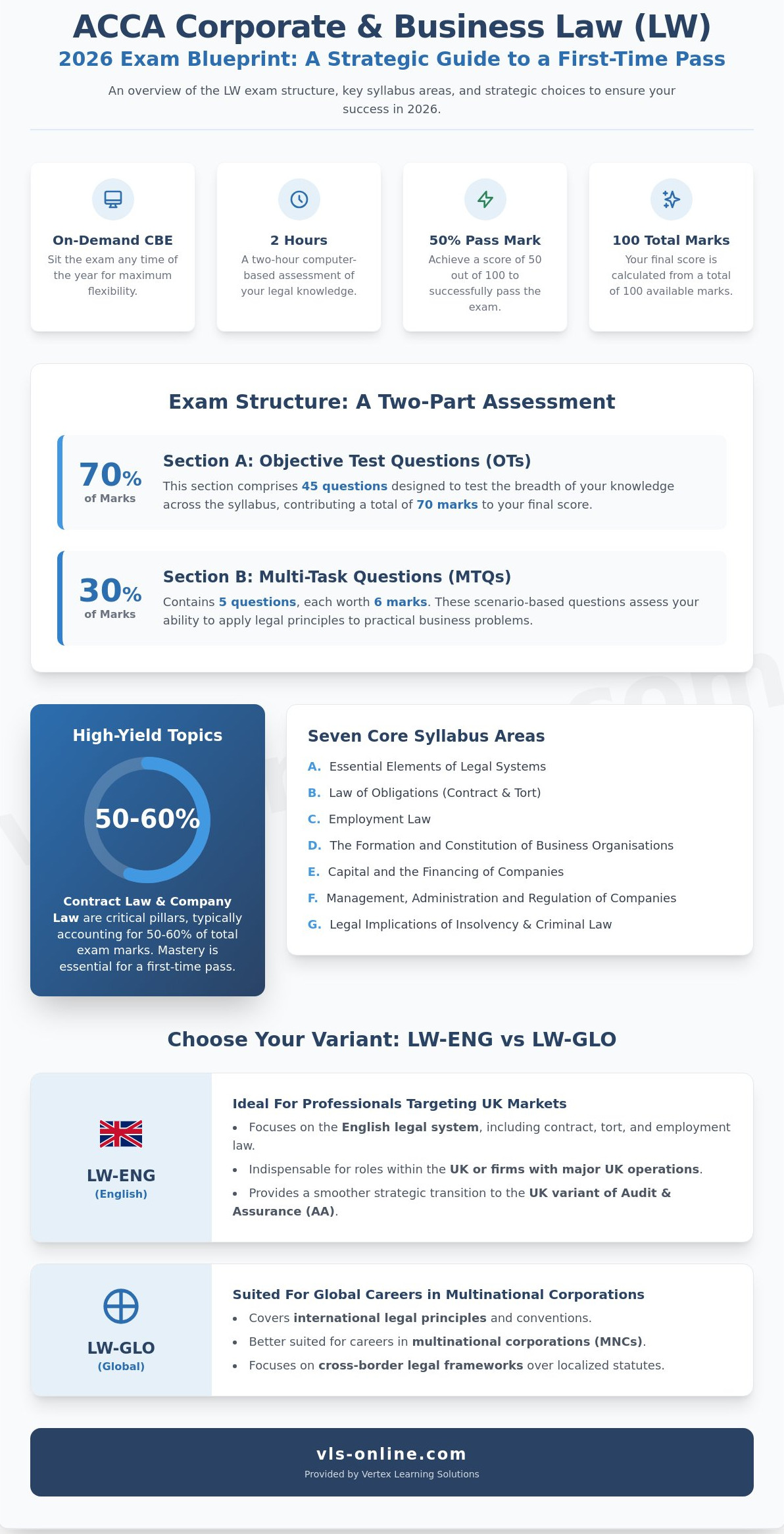
LW-ENG (English): Focuses on the English legal system, including contract law, tort, and employment legislation.
-
LW-GLO (Global): Covers international legal principles and the UN Convention on Contracts for the International Sale of Goods.
English vs. Global: Which Variant Should You Choose?
The choice between variants should align with your long-term career trajectory. The LW-ENG variant is indispensable for professionals intending to practice within the UK or work for firms with significant British operations. Strategically, selecting the English variant provides a smoother transition into future Audit and Assurance (AA) studies, particularly if you plan to take the UK-specific version of that exam. Conversely, the LW-GLO variant is better suited for those targeting careers in multinational corporations where cross-border legal frameworks take precedence over localized statutes.
The Role of Law in the Modern Accountant's Toolkit
Legal literacy is a fundamental component of modern risk management and professional ethics. Accountants must understand the legal implications of corporate governance, insolvency, and fraudulent behavior to protect stakeholder interests. In 2026, the accountant acts as a legal gatekeeper who proactively secures the organization's integrity through meticulous regulatory adherence. By connecting ACCA Corporate and Business Law (LW) concepts to real-world governance, professionals can build robust internal controls that prevent litigation and foster long-term institutional stability.
Syllabus Breakdown and Exam Structure for 2026
The 2026 exam for ACCA Corporate and Business Law (LW) remains a two-hour, on-demand computer-based assessment. It's designed to test your ability to identify legal issues within a commercial context through a 100-mark objective format. Section A contains 45 questions totaling 70 marks, while Section B utilizes five multi-task questions (MTQs) worth 6 marks each. You'll need a 50% score to pass. The ACCA Corporate and Business Law (LW) official page outlines a syllabus divided into seven key areas, spanning from the legal system's framework to insolvency and criminal law.
The 2026 cycle continues a deliberate shift toward scenario-based questions. You won't just recite statutes; you'll apply them to specific business dilemmas. High-yield topics like Contract Law and Company Law typically account for 50% to 60% of the total marks. Mastering these core pillars is essential for any student aiming for a first-time pass.
Mastering the Essential Elements of Legal Systems
This foundational area covers the sources of law and the court hierarchy. You must understand how judicial precedents function and how the hierarchy of the courts dictates which decisions are binding. Don't get bogged down in every minor detail of historic cases. Instead, focus on the "ratio decidendi," which is the legal principle behind the ruling. This structured understanding of legal definitions and obligations provides a vital framework that supports your success in ACCA Financial Reporting (FR), where the legal substance of transactions often dictates their accounting treatment.
Focusing on Obligations: Contract and Tort Law
Contract law is governed by the presence of an offer, acceptance, and consideration. Without these three elements, a binding agreement doesn't exist. In the 2026 exam, you'll likely face scenarios where you must distinguish between an "invitation to treat" and a formal offer. Tort law, specifically professional negligence, requires you to prove a duty of care, a breach of that duty, and a resulting loss. These concepts appear frequently in Section B's 6-mark scenarios. Precision is vital; misidentifying a breach can lead to the loss of critical marks. If you're looking to solidify your understanding of these complex legal structures, exploring specialized ACCA preparation courses can provide the professional protection and clarity you need to succeed.
ACCA LW Buying Guide: Choosing Your Study Path
Selecting the right preparation method for the ACCA Corporate and Business Law (LW) exam requires a balance between cost and efficacy. Self-study using only textbooks provides the raw data but lacks the strategic framework needed for professional application. Static materials cannot adapt to the nuances of legal interpretation; they often leave students struggling to apply theory to complex scenarios. Professional tuition bridges this gap by providing a structured environment where concepts are explained, not just stated.
Free online resources often carry a high price in the form of outdated content. Relying on a 2022 syllabus for a 2026 exam session is a significant risk that leads to unnecessary failure. While the ACCA Corporate and Business Law (LW) Resources page offers essential official guidance, translating these standards into a cohesive study plan requires professional oversight. Interactive practice questions outperform static mock exams because they force active engagement with the material. This method improves retention rates by up to 40% compared to passive reading alone.
Tuition Provider Checklist: What to Look For
A high-quality tuition provider must offer more than just a video library. You should look for specific features that guarantee a return on your investment:
-
Weekly live sessions: These sessions ensure classroom-style engagement and provide a rhythm to your study schedule.
-
On-demand recorded lectures: These allow for flexible revision and the ability to revisit complex topics at your own pace.
-
Updated question banks: Ensure the materials reflect the latest legislative changes in company law.
Explore our ACCA Courses for a full feature comparison of these delivery methods.
The Value of Expert Tutor Support in 2026
Legal jargon often acts as a barrier to understanding for many students. WhatsApp support provides a direct line to experts who can clarify complex terms like 'vicarious liability' or 'stare decisis' instantly. This immediate feedback loop prevents the cementation of incorrect concepts. Direct tutor feedback on practice questions accelerates the learning curve by identifying specific knowledge gaps that automated systems might miss. Consider the Full Access Package for long-term savings and comprehensive professional support throughout your ACCA journey.
Secure your professional future by choosing a structured path. View our course options here.
Strategic Exam Techniques for First-Time Success
Securing a pass in the ACCA Corporate and Business Law (LW) exam requires a shift from passive reading to active, strategic engagement. The syllabus is broad, covering everything from the English legal system to insolvency. Start your journey by building a solid conceptual foundation through recorded video lectures. These sessions allow you to break down complex legal frameworks at your own pace, ensuring you don't miss the subtle nuances of case law. Once the theory is clear, move immediately to active recall. Use interactive quizzes and flashcards to test your memory. Research suggests that students who use active testing methods improve their retention rates by 50% compared to those who simply highlight textbooks.
Mastering the 120-minute Computer Based Exam (CBE) window is your next priority. With 100 marks available, you have exactly 1.2 minutes per mark. You can't afford to linger on a single difficult question. To build the necessary stamina, you must conduct a minimum of three full-length mock exams. This practice helps you manage the 50 objective test questions in Section A while leaving enough mental energy for the more complex tasks in Section B.
Tackling Section B Scenario Questions
Section B demands that you act as a legal advisor. Your first task is identifying the specific legal issue within the business story. Is it a matter of professional negligence or a breach of a director’s statutory duties? Once identified, apply the relevant legal rules to the specific facts provided. Don't just quote the law; explain why it applies to the characters in the scenario. To see how these application techniques work in other technical papers, see our guide on ACCA Taxation (TX).
Final Week Revision Strategy
In the final seven days, your focus should shift to the examiner’s reports. These documents are vital because they highlight common student pitfalls, such as confusing the "veil of incorporation" with "limited liability." Use these insights to refine your answers. Focus exclusively on the weak areas you identified during your three mock exams. On the day, maintain a calm, professional mindset. Approaching the ACCA Corporate and Business Law (LW) paper with the discipline of a legal professional ensures you remain precise and logical under pressure.
Secure Your Professional Success for the 2026 Exam Cycle
Navigating the intricate legal frameworks of the 2026 syllabus requires a disciplined, strategic approach. The 2-hour computer-based exam demands mastery over 50 objective test questions, where precision is the only path to the 50% pass mark. Success in ACCA Corporate and Business Law (LW) depends on moving beyond passive reading toward active application of legal principles. By utilizing recorded lectures and exam-focused study notes, you transform complex regulations into manageable, actionable knowledge. It's essential to have a professional safety net that clarifies the nuances of contract and employment law before you sit for the assessment. Our methodology provides the structured clarity needed to eliminate ambiguity and build long-term professional competence. You'll gain access to weekly live interactive sessions and the immediate reassurance of active WhatsApp tutor support to resolve every technical query. This comprehensive protection ensures your preparation remains on track for first-time success.
Enroll in the Vertex Learning Solutions ACCA LW Course with 24/7 Tutor Support and take the definitive step toward your qualification today. We're ready to help you master the legal landscape with total confidence.
Frequently Asked Questions
Is ACCA LW harder than the Knowledge level exams?
ACCA Corporate and Business Law (LW) represents a strategic transition from the Knowledge level because it requires applying legal principles to specific scenarios rather than just recalling facts. While the global pass rate for the LW exam reached 80% in the September 2023 session, the complexity of the 2-hour syllabus demands greater analytical precision. Candidates must move beyond basic comprehension to demonstrate a structured understanding of professional legal frameworks.
Can I take the ACCA LW exam at any time of the year?
You can sit the ACCA Corporate and Business Law (LW) exam at any time throughout the year as it's classified as an on-demand Computer Based Exam (CBE). This flexibility allows professionals to align their assessment with their specific career progression and personal schedules. Results are provided immediately upon completion of the 50-question paper, ensuring a streamlined path toward the remaining Applied Skills modules.
What is the pass mark for Corporate and Business Law?
The pass mark for this exam is 50%, requiring candidates to secure 50 marks out of a total 100. The assessment consists of Section A with 45 objective test questions and Section B containing 5 multi-task questions. Achieving this threshold confirms your fundamental competence in navigating the legal complexities of the business environment. It's a clear, non-negotiable benchmark for professional qualification.
How much study time is required to pass ACCA LW?
Most candidates require between 100 and 120 hours of focused study to master the syllabus effectively. This timeframe allows for a comprehensive review of the seven main syllabus areas, including contract law and corporate insolvency. Allocating 12 hours per week over a 10-week period provides a stable foundation for success. A structured approach ensures you don't overlook critical legislative details or compliance requirements.
Do I need to memorize specific case names for the exam?
You don't need to memorize specific case names to earn marks, as examiners focus on your ability to apply legal principles to facts. While citing a case like Donoghue v Stevenson demonstrates depth, the 2024 syllabus guidelines clarify that marks are awarded for the correct application of the law. Focus your energy on understanding the underlying legal logic and statutory requirements instead of rote memorization of titles.