

In 2026, viewing professional development as a mere employee benefit is a strategic oversight that leaves your finance function vulnerable to talent drain and operational stagnation. Securing a formal agreement requires more than just a request; it demands a robust business case for CIMA company sponsorship that reframes your education as a critical risk-mitigation tool for the organization.
You likely feel the pressure of rising registration and subscription fees, while your leadership team remains preoccupied with the perceived trade-off between study hours and daily output. It's a common friction point that often prevents talented professionals from reaching the Strategic Level. This guide provides the framework to bridge that gap by demonstrating how CIMA-trained staff drive tangible ROI and long-term stability.
We'll explore how to build a data-driven proposal that highlights the strategic value of management accounting, addresses managerial concerns about productivity, and secures company-funded tuition. By the end of this article, you'll have a clear roadmap to transform your qualification into a shared corporate asset that benefits both your career and your employer's bottom line.
Key Takeaways
- Understand the strategic transition from traditional accounting to the CGMA designation and why it serves as a mutual commitment to organizational excellence.
- Discover how to build a data-driven business case for CIMA company sponsorship by quantifying talent retention and the long-term cost savings of developing internal strategic experts.
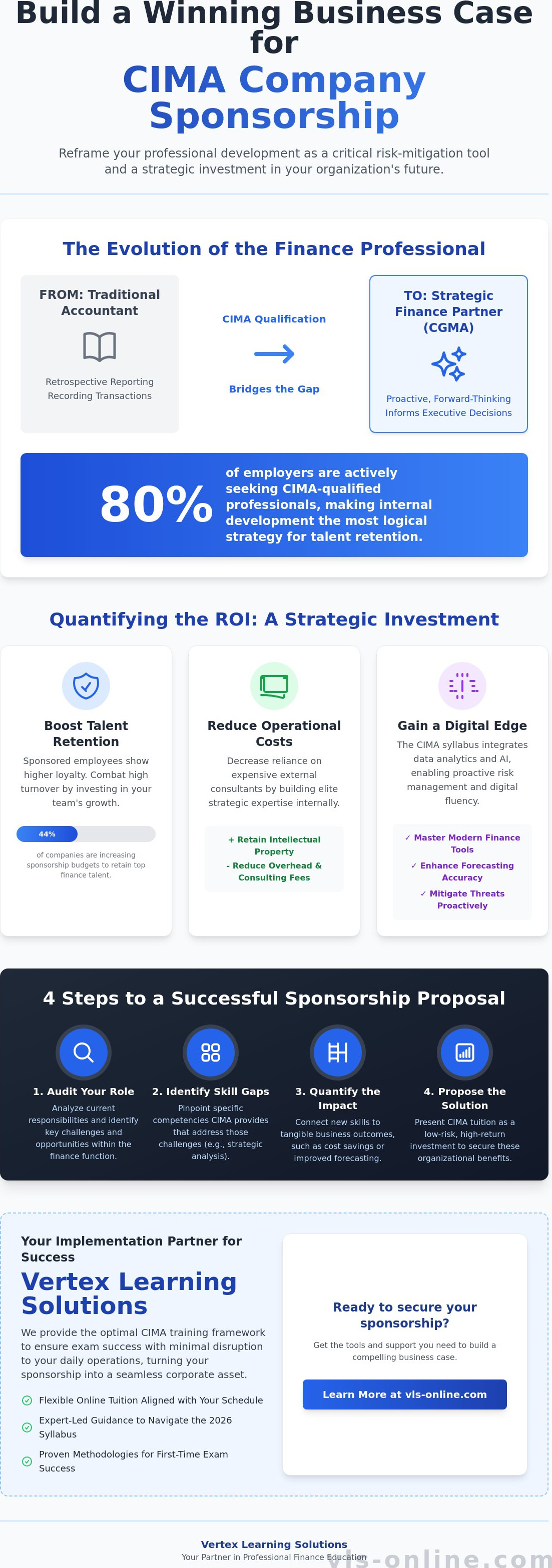
- Follow a structured, step-by-step framework to audit your current role and identify the specific skill gaps that a CIMA qualification will bridge for the finance function.
- Learn how to position online tuition through Vertex Learning Solutions as the optimal implementation partner to ensure exam success with minimal operational disruption.
The Strategic Value of CIMA Sponsorship for Modern Enterprises
CIMA sponsorship isn't a discretionary perk or a simple educational grant. It represents a formal, strategic alliance between an employer and an ambitious professional, designed to foster mutual growth and professional excellence. When you construct a business case for CIMA company sponsorship, you're proposing a structured investment in the organization's future resilience. This commitment ensures that the finance function remains agile and capable of addressing complex operational challenges with precision.
The global transition from traditional accounting roles toward the CGMA (Chartered Global Management Accountant) designation highlights a fundamental shift in the industry. Governed by the Chartered Institute of Management Accountants (CIMA), this designation signifies a mastery of both rigorous financial discipline and forward-thinking business leadership. By 2026, the mandate for finance teams has evolved. They must now integrate technical financial expertise with high-level digital proficiency and strategic foresight to maintain a competitive edge in a crowded market.
This evolution creates the "Strategic Finance Partner," a professional who moves beyond retrospective reporting to become a proactive thinker. These partners don't just record transactions; they analyze the underlying drivers of value to inform executive decisions. Sponsorship is the mechanism that secures this elite level of expertise internally, protecting the company from the volatility of the external talent market. It's reported that 80% of employers are actively seeking CIMA-qualified professionals, making internal development a logical choice for talent retention.
Bridging the Gap Between Data and Decision Making
The current economic environment is defined by extreme data saturation. CIMA-trained professionals provide the necessary filter, translating complex financial metrics into clear, actionable business insights that safeguard margins. This ability to interpret data is why a business case for CIMA company sponsorship is so compelling for leadership teams focused on stability. They utilize management accounting frameworks to navigate supply chain fluctuations and evolving consumer demands with confidence. To understand the specific competencies developed during this journey, you can review our CIMA Professional Qualification guide. This specialized training ensures that every strategic move is underpinned by sound financial logic, significantly reducing the risk of operational errors.
Quantifying the ROI: How CIMA Upskills Finance Teams for 2026
Building a robust business case for CIMA company sponsorship requires shifting the conversation from cost to value creation. In 2026, the demand for strategic finance professionals continues to exceed supply. This gap makes internal talent development a financial necessity. Organizations that invest in their staff see a direct impact on their bottom line, as CIMA-qualified experts bridge the gap between technical accounting and high-level business strategy.
Retention is a primary metric of success. Research indicates that approximately 44% of companies are increasing their annual corporate sponsorship budgets in 2026 to combat high turnover in the finance sector. Sponsored employees demonstrate higher loyalty, as the investment creates a professional protective net that benefits both parties. Additionally, developing internal expertise reduces reliance on expensive external strategic consultants. By empowering your team to handle complex forecasting and risk assessment, you retain intellectual property and reduce operational overhead.
The updated 2026 CIMA syllabus places a heavy emphasis on digital transformation. It integrates data analytics and AI into the core curriculum, ensuring that students aren't just managing books but are mastering the tools of the modern age. This digital proficiency allows for more accurate risk management. It enables the finance function to identify and mitigate potential financial threats before they impact the balance sheet. According to the Sponsorship Success Toolkit, structured professional development is the most effective way to align individual growth with organizational stability.
ESG and Sustainability Reporting
ESG metrics have become a non-negotiable component of corporate reporting in 2026. CIMA prepares staff to manage these new regulatory requirements with precision. By sponsoring a student, a company ensures it has the internal capacity to handle sustainability audits and corporate social responsibility disclosures. This proactive approach protects the brand's reputation and ensures compliance with evolving international standards.
Efficiency in the Finance Function
Efficiency is defined by the "time to insight." CIMA students learn advanced management accounting techniques that allow them to process data faster and more accurately. They apply these lessons in real-time to solve existing company problems, turning their study hours into immediate operational improvements. Professionals looking to accelerate this process often start with a comprehensive training solution that balances rigorous study with daily operational duties. This real-time application ensures that the company sees a return on investment long before the final exam is passed.
A Step-by-Step Guide to Crafting Your CIMA Sponsorship Proposal
Crafting a persuasive business case for CIMA company sponsorship requires a shift from personal ambition to organizational benefit. You aren't asking for a gift; you're proposing a professional partnership that addresses specific operational weaknesses. Follow this structured approach to ensure your proposal resonates with decision-makers who prioritize stability and measurable outcomes.
- Step 1: Audit your current role. Identify specific skill gaps in your department that CIMA's 2026 syllabus addresses. Whether it's a lack of digital strategy or inefficient performance management, pinpointing these areas makes your education a solution rather than a cost.
- Step 2: Research the 2026 costs. Be precise with the figures. For the 2026 calendar year, the CIMA registration fee is £99, while the annual student subscription is £150. Objective tests for the Operational Level in Tier 1 regions are £152 per exam. Presenting these exact numbers demonstrates professional diligence.
- Step 3: Align with 2026 strategic goals. Connect your studies to the firm's specific objectives, such as expanding into Global Capability Centers (GCCs) or improving ESG reporting accuracy.
- Step 4: Draft with a "Value to the Firm" lens. Use language that emphasizes how the company's risk profile will improve once you've mastered the Strategic Level competencies.
Addressing the "Flight Risk" Objection
Management often worries that sponsored employees will leave once they're qualified. To mitigate this risk, proactively propose a "training bond" or clawback clause. This agreement ensures that if you leave within a specified period, typically 12 to 24 months post-qualification, you'll reimburse a portion of the fees. This shows you're committed to a long-term career path within the current organization.
The Executive Summary: What to Include
Your proposal should open with a single, punchy sentence defining the business impact. For example: "This sponsorship will enable the finance team to internalize strategic forecasting, reducing our reliance on external consultants by the end of the 2026 fiscal year." Follow this with a clear table comparing the total investment against the projected value you'll deliver through improved efficiency and risk management.
If you're ready to quantify the exact investment required for your proposal, explore our CIMA full access study packages to include precise figures in your formal request.
Implementing Sponsorship: Cost-Effective Training with Vertex Learning Solutions
Once administrative approval is secured, the focus shifts to operational execution. In 2026, online tuition has become the preferred choice for modern enterprises because it eliminates travel time and ensures minimal work disruption. By selecting a digital-first provider, you strengthen the business case for CIMA company sponsorship by offering a solution that respects the company's operational capacity while maintaining high academic standards. It's a pragmatic approach that aligns professional growth with the daily demands of a high-pressure finance function.
Vertex Learning Solutions (VLS) acts as a strategic partner in this journey. Since 2007, over 75,000 professionals have utilized our platform to achieve their qualification goals. The VLS model combines the flexibility of recorded lectures with the accountability of weekly live sessions, creating a classroom feel without the logistical burden of physical attendance. Our dedicated WhatsApp tutor support provides a professional safety net, ensuring that students receive immediate clarification on complex technical points. This structure allows for flexible enrollment that aligns perfectly with corporate budget cycles, making it easier for finance directors to approve the expenditure without hesitating over cash flow timing.
Maximizing Pass Rates and Minimizing Resit Costs
The ultimate ROI for any employer is a first-time pass. VLS utilizes an exam-focused methodology that prioritizes the application of knowledge over rote memorization. This approach is vital for preventing study fatigue and reducing the financial impact of resit fees, which can otherwise erode the business case for CIMA company sponsorship. By providing pro-active tutor support, we ensure that students remain engaged throughout the syllabus. For organizations looking to optimize their training spend, our VLS Full Access courses offer comprehensive bundles that cover all levels of the qualification.
Scaling Professional Development
A robust finance function often requires upskilling multiple team members simultaneously across different CIMA levels. VLS is equipped to handle this complexity, providing a unified learning environment for junior staff at the Operational Level and senior managers at the Strategic Level. This scalability ensures a consistent standard of professional excellence across the entire department. To discuss tailored solutions for your team, we encourage you to contact VLS for corporate enrollment details and begin the process of securing your team's strategic future.
Securing Your Strategic Position in the 2026 Finance Landscape
Transitioning from an employee seeking a benefit to a strategic partner offering a solution is the key to obtaining corporate funding. By aligning your CIMA journey with the 2026 focus on digital proficiency and ESG reporting, you provide your employer with a clear path to operational stability. A well-structured business case for CIMA company sponsorship doesn't just request tuition; it promises a more resilient and data-driven finance function that is prepared for future regulatory shifts.
Selecting the right implementation partner is the final step in this professional roadmap. Vertex Learning Solutions provides the necessary infrastructure to ensure your success without compromising your daily responsibilities. Our platform offers a professional protective net through active WhatsApp tutor support, weekly live interactive sessions, and exam-focused study materials updated for 2026. These features are designed to maximize pass rates while minimizing the time away from your core duties.
Don't let financial barriers stall your professional evolution. Secure your future with Vertex Learning Solutions and explore our CIMA sponsorship-ready packages. Take the initiative today to transform your professional trajectory and lead your team toward a more secure, expert-led financial future.
Frequently Asked Questions
Is CIMA sponsorship tax-deductible for companies in 2026?
Professional training costs are generally treated as a tax-deductible business expense if the education is wholly and exclusively for the purpose of the trade. By 2026, most jurisdictions continue to allow firms to offset tuition and exam fees against their corporation tax liability. This reduces the net cost of the investment significantly. You should advise your finance department to verify specific local tax regulations to ensure full compliance and maximize the financial benefits of the agreement.
What is the typical ROI for a company sponsoring a CIMA student?
The return on investment manifests through a combination of increased retention and a reduction in external consultancy spend. Organizations that develop internal strategic experts save on the high costs associated with recruiting senior finance talent in a competitive market. Furthermore, the efficiency gains achieved through advanced management accounting techniques often lead to measurable improvements in margin protection. A strong business case for CIMA company sponsorship highlights these long-term fiscal advantages over short-term costs.
How much study leave should a company provide for CIMA exams?
Standard corporate policies typically provide one to two days of study leave per objective test, plus the day of the exam itself. For Case Study exams, three to five days are common to allow for deep analysis of the pre-seen material. Providing this dedicated time protects the company's investment by ensuring the student has the mental bandwidth to succeed. Clear boundaries around study leave prevent operational friction and ensure that exam preparation doesn't interfere with critical month-end deadlines.
What happens if an employee fails an exam under company sponsorship?
Most formal sponsorship agreements include a clause stating the company pays for the first attempt, while the employee covers any necessary resits. This structure maintains personal accountability and protects the corporate budget from repeated failure costs. If a student struggles, it's often a sign that their study method requires more structure. Moving to a supported online environment can provide the professional protective net needed to bridge knowledge gaps and secure a pass on the next attempt.
Can CIMA sponsorship be combined with the UK Apprenticeship Levy?
CIMA qualifications are frequently delivered through the UK Apprenticeship Levy via the Level 4 and Level 7 Professional Accountant standards. This allows levy-paying organizations to utilize their existing funds to cover the cost of training, making the business case for CIMA company sponsorship even more compelling for leadership. Even for smaller firms that don't pay the levy, government co-investment schemes can often cover up to 95% of the training costs. This provides a highly cost-effective route to developing elite-level finance expertise.