

Your ACCA qualification isn't just a personal milestone; it's a high-yield corporate asset that your firm should be eager to fund. While the financial burden of registration fees and the £140 annual subscription often falls on the individual, viewing this as a personal expense is a strategic error. You're likely concerned about the high personal cost or perhaps you're worried that management won't see the value in a qualification they don't fully understand. Learning how to convince my employer to pay for ACCA requires moving away from a "perk" mindset and toward a structured business proposal that emphasizes long-term organizational stability.
We recognize that the prospect of rejection is a significant barrier, particularly when the total cost of the qualification in 2026 is projected to reach £4,500. This article promises to provide the professional protection and strategic framework necessary to secure full corporate funding for your journey. We'll examine how to align your goals with the company's risk management and operational needs. You'll learn to present a case that covers everything from the £185 Strategic Business Reporting fee to specialized tuition, ensuring your career progression is both recognized and fully supported by a signed training agreement.
Key Takeaways
- Learn to reframe the ACCA qualification as a strategic solution to internal skill gaps rather than a personal expense, ensuring your request aligns with organizational capability.
- Discover the optimal timing for your pitch and how to convince my employer to pay for ACCA by presenting a formal Professional Development Proposal during critical budget cycles.
- Master the art of positioning online tuition as the most cost-effective and flexible option to minimize operational disruption and appeal to the CFO’s focus on ROI.
- Secure management's approval by proactively addressing retention concerns through structured training agreements and transparent clawback clauses that protect the firm's investment.
Building a Professional Business Case for ACCA Funding
Securing corporate sponsorship requires a fundamental shift in perspective. Instead of presenting the qualification as a personal career milestone, you must frame it as a critical upgrade to the firm's operational infrastructure. The Association of Chartered Certified Accountants (ACCA) provides a framework that transforms staff into strategic assets capable of navigating complex regulatory environments without the constant oversight of expensive external consultants. When you analyze how to convince my employer to pay for ACCA, focus on the specific technical gaps within your department that these modules bridge.
A team lacking advanced expertise in ACCA Taxation (TX) or Audit and Assurance (AA) often creates a bottleneck, forcing the organization to outsource high-level functions at a premium. By internalizing this expertise, the firm gains immediate access to specialized knowledge while fostering long-term stability and client trust through recognized professional standards. This approach positions the training as a preventive measure against operational risk rather than a discretionary expense.
Quantifying the ROI of a Chartered Accountant
Return on investment in professional accounting is the measurable increase in financial accuracy and strategic foresight that outweighs the initial expenditure on exam fees and tuition. By linking specific papers to workplace efficiencies, you demonstrate immediate value. For instance, an employee mastering Strategic Business Reporting (SBR) can streamline complex consolidation processes, saving dozens of billable hours. Retaining internal talent through professional development is also significantly more cost-effective than the recruitment and onboarding cycles required for external hiring.
Aligning ACCA with 2026 Corporate Goals
Modern corporate governance demands more than basic bookkeeping. The Strategic Business Leader (SBL) module equips candidates with the high-level decision-making skills necessary for board-level reporting. Additionally, the mandatory Ethics and Professional Skills Module (EPSM) ensures that the firm's reporting practices meet the rigorous transparency standards required for current ESG (Environmental, Social, and Governance) mandates. This alignment ensures the organization remains compliant and competitive in a highly scrutinized financial landscape.
Choosing the Right Moment and Delivery Strategy
Success in this negotiation depends on the intersection of corporate budget cycles and your personal performance trajectory. While an annual review is a traditional starting point, the most effective strategy involves a "soft launch" during regular 1-on-1 sessions. Mentioning your long-term ambitions early allows management to visualize your progression before you present a formal Professional Development Proposal. Mastering how to convince my employer to pay for ACCA requires demonstrating that your growth is synchronized with the firm's fiscal planning. It's often more effective to pitch just before the Q3 or Q4 budget finalization than after the annual training funds have already been allocated. Providing examples of successful ACCA funding within your industry can further validate your request as a standard professional practice.
The 5-Step Pitch Meeting Structure
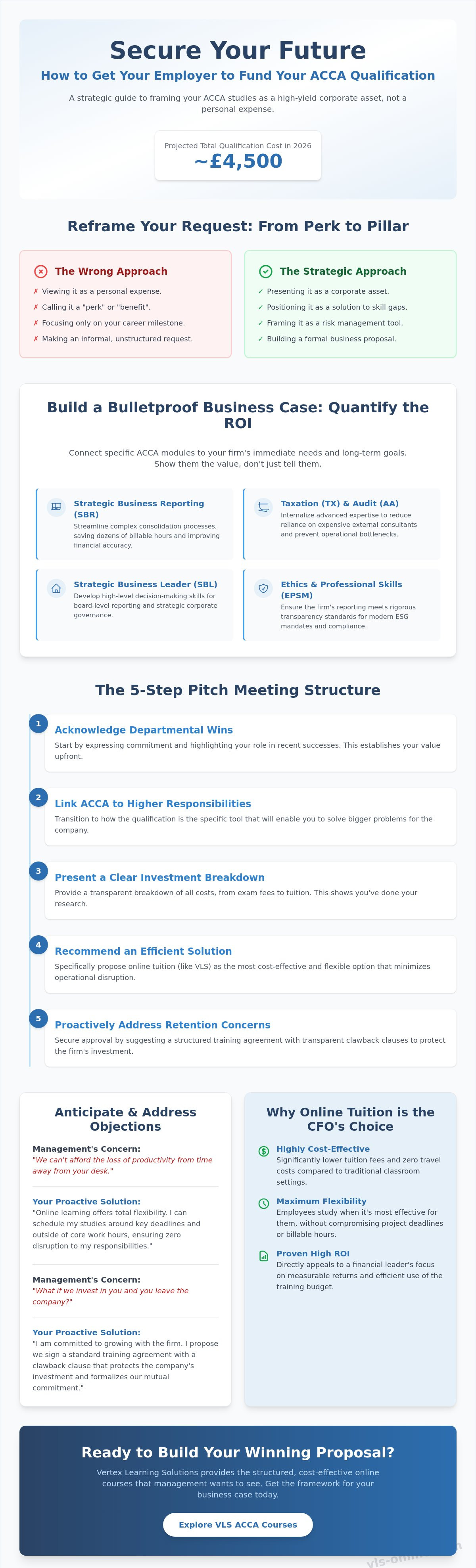
A structured meeting prevents the request from feeling like a personal favor. Start by acknowledging recent departmental wins and expressing your commitment to driving further results. Transition to the ACCA qualification as the specific instrument that will enable you to take on higher-level responsibilities, such as complex reporting or risk management. Finally, present a clear breakdown of the investment, specifically recommending VLS online courses as the preferred delivery method due to their structured efficiency and competitive pricing. This logical progression builds confidence in your professional maturity and shows you've researched how to ask your employer to pay for professional development with the firm's interests in mind.
Addressing the 'Time Away from Desk' Concern
The primary objection from management is often the perceived loss of billable hours or productivity. You can mitigate this risk by proposing a study schedule that leverages the flexibility of online learning. Unlike traditional classroom settings, online platforms allow you to integrate your studies into your existing routine without requiring full-day absences. By utilizing these accounting exam study tips, you can demonstrate a commitment to high-intensity, efficient learning. This proactive approach simplifies the process of how to convince my employer to pay for ACCA by showing you've already considered the firm's operational stability, making it significantly easier to secure a signed training agreement.
Positioning Online Tuition as the CFO’s Preferred Choice
Financial leadership prioritizes capital efficiency and measurable outcomes. When evaluating how to convince my employer to pay for ACCA, you must highlight the fiscal superiority of online tuition over traditional classroom models. Physical attendance often necessitates significant hidden costs, including travel, accommodation, and, most critically, lost billable time. By contrast, online platforms provide 24/7 access to high-quality materials, allowing you to study during off-peak hours without disrupting core operations. This flexibility transforms the qualification from a logistical challenge into a seamless professional integration. Choosing ACCA online tuition with tutor support ensures that the firm's investment is protected by expert guidance, which directly correlates with higher first-time pass rates.
Scalability is another decisive factor for global organizations. A single digital platform can standardize training across multiple jurisdictions, ensuring that remote teams in different time zones receive the same elite level of instruction. This uniformity simplifies the management of training budgets and maintains a consistent standard of excellence throughout the firm's global network.
Why VLS Online Learning Minimizes Corporate Risk
The primary risk for any employer is a failed exam attempt, which results in lost time and sunk costs. VLS mitigates this through a structured safety net of recorded lectures and weekly live sessions that provide real-time feedback. Our exam-focused study notes are specifically designed to condense complex regulations into actionable knowledge, significantly increasing pass rates. For a CFO, the Full Access model represents a predictable, fixed-cost investment that eliminates the uncertainty of variable tuition fees, making it a highly attractive proposition for long-term budget planning.
Leveraging Global Standards for Remote Teams
ACCA's global recognition is a vital asset for firms operating in an international scope. It ensures that every team member, regardless of location, adheres to the same rigorous ethical and technical standards. For junior staff, starting with the ACCA Applied Knowledge modules establishes a solid foundation early in their tenure. This proactive approach to upskilling demonstrates a commitment to organizational capability that resonates with strategic decision-makers.
Explore our comprehensive training solutions and secure your firm's future by enrolling in our structured ACCA online courses today.
Navigating Objections and Training Agreements
Addressing the "flight risk" is the final hurdle in understanding how to convince my employer to pay for ACCA. Management often hesitates, fearing that once you attain chartered status, you will seek opportunities with competitors. A robust Training Agreement mitigates this risk by formalizing the mutual commitment between you and the organization. Central to this legal framework is the "Clawback Clause," a standard industry mechanism that requires the employee to reimburse a sliding scale of tuition and exam fees if they resign within a specified period, typically 12 to 24 months after completing a module. This structure provides the firm with the security it needs to treat your education as a long-term capital investment rather than a sunk cost.
If the organization remains cautious, propose a lower-risk trial period. Suggest funding a single foundational module, such as ACCA Business and Technology (BT), to prove your dedication and the efficiency of the VLS platform. This approach allows the firm to evaluate the return on investment without a full-level commitment. Alternatively, discuss salary sacrifice schemes where the employer covers upfront costs, providing you with tax efficiencies while reducing the firm's direct financial exposure. These structured compromises often serve as the bridge to a full sponsorship agreement.
Drafting the Training Agreement
A professional agreement should be transparent and logically closed to avoid future ambiguity. It must clearly outline which fees are covered, including registration and annual subscriptions, alongside specific pass requirements. Transparency is vital for maintaining management's confidence. Ensure the agreement includes a provision for regular progress reporting, allowing the firm to see the tangible advancement of their internal talent pool. This disciplined approach reinforces your professional integrity and aligns your success with the company's operational stability.
What to Do If the Answer Is 'Not Now'
If the current budget cycle cannot accommodate your request, maintain a solution-oriented stance. Request a specific timeline for future reconsideration, perhaps linked to the next quarterly review. In the interim, seek non-monetary support such as mentorship from senior partners or dedicated study leave. This keeps the conversation active and demonstrates your persistent commitment to the firm's growth. Explore our ACCA Courses to find the most cost-effective entry point for your revised proposal and secure your professional future.
Securing Your Professional Mandate
Mastering the negotiation for corporate sponsorship is a definitive step toward professional autonomy and organizational influence. By shifting the narrative from personal gain to institutional capability, you position yourself as a strategic partner rather than a simple trainee. Understanding how to convince my employer to pay for ACCA requires a disciplined approach, integrating structured training agreements with the cost-efficiencies of digital learning. This methodology ensures that management views your qualification as a secure, high-yield investment in the firm's future stability.
Vertex Learning Solutions provides the elite framework necessary to support this transition. Our methodology combines London-based expertise with a global reach, offering exam-focused recorded lectures and direct expert tutor support via WhatsApp to ensure consistent results. This systematic support structure minimizes corporate risk while maximizing your professional trajectory. Secure your future with Vertex Learning Solutions’ ACCA packages and transform your career objectives into reality. It's a shared journey toward excellence, and with the right strategy, your organization will be proud to stand behind your success.
Frequently Asked Questions
Is it common for employers to pay for ACCA?
Employer sponsorship remains a standard practice within the global financial sector. Many organizations view professional qualifications as a necessary investment in their internal risk management and technical capability. While larger firms often have established training policies, smaller entities are increasingly open to funding as a retention tool. It's a mutually beneficial arrangement that secures high-level expertise for the firm while supporting your long-term professional growth.
How do I explain the cost of ACCA to my manager?
Transparency regarding the fee structure is essential when discussing how to convince my employer to pay for ACCA. Present a detailed breakdown that includes the £89 initial registration and the £140 annual subscription alongside specific exam costs. Contrast these figures with the potential expenses of hiring external consultants or the operational risks of technical errors. Framing these costs as a strategic investment in the firm's compliance and reporting efficiency makes the proposal significantly more persuasive.
What should be included in an ACCA training agreement?
A comprehensive training agreement must define the exact scope of financial support and the employee's subsequent obligations. It should specify that the employer covers exam fees and tuition while outlining a clawback clause to protect the investment if you leave the firm. Additionally, include clear expectations for exam results and a commitment to remaining with the company for a set duration, typically 12 to 24 months, following the completion of each module.
Can I ask for ACCA funding during a job interview?
Requesting professional development support during the interview process is a proactive way to signal your long-term commitment to the industry. It demonstrates that you prioritize high ethical and technical standards, which is a desirable trait for any strategic partner. You should frame the request as a desire to align your skills with the firm's growth objectives. This clarity ensures that both parties understand the professional roadmap and the organizational support required from the outset.
What happens to my ACCA funding if I leave the company?
If you choose to resign, the financial implications are governed by the specific terms of your training agreement. Most contracts include a repayment schedule where the employee must reimburse a portion of the tuition and exam fees paid within the last one or two years. These clauses are designed to protect the firm's investment in your skills. However, some new employers may offer to buy out these costs as part of your recruitment package, effectively transferring the professional protection to your new role.