

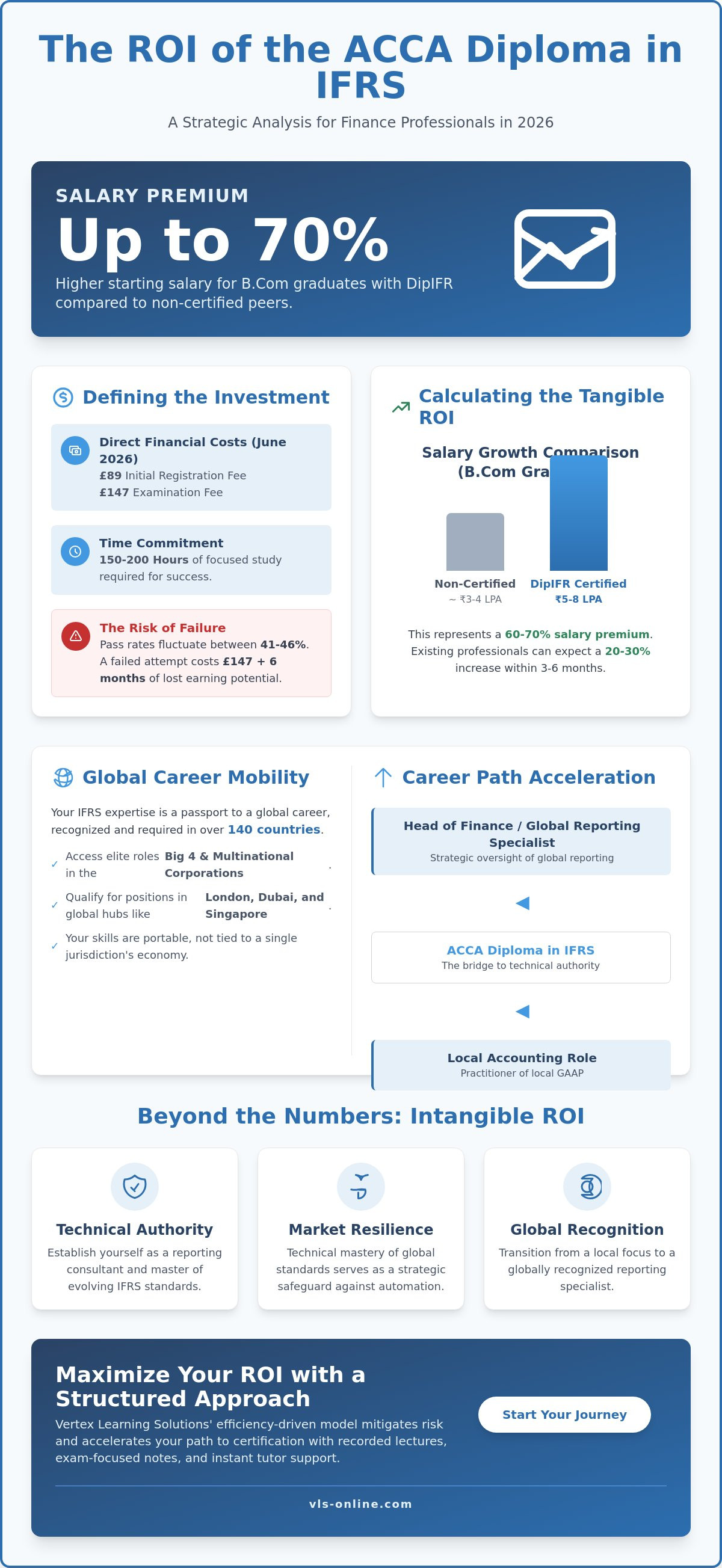
A B.Com graduate holding the ACCA Diploma in IFRS can command a starting salary premium of up to 70% compared to non-certified colleagues in the 2026 market. This statistic underscores a critical reality for finance professionals: technical mastery is no longer optional; it's the primary driver of market value. You likely recognize the frustration of stagnating in local accounting roles while the complexity of global standards continues to intensify. The initial financial outlay for professional exams can feel substantial when outcomes aren't guaranteed. This strategic analysis explores the comprehensive return on investment for DipIFR course, detailing how this credential functions as a professional safeguard.
We'll examine the path to significant salary increments, the eligibility for elite roles within the Big 4 or multinational corporations, and the global recognition of your technical expertise. Discover how to transform regulatory complexity into a distinct competitive advantage through a structured approach to the ACCA Diploma in IFRS. By investing in your technical authority now, you ensure your career remains mobile and resilient in an increasingly standardized global economy.
Key Takeaways
- Identify the precise financial and temporal requirements necessary to secure the ACCA Diploma in IFRS in the current 2026 regulatory environment.
- Analyze the "Multinational Premium" and the specific salary benchmarks that define the return on investment for DipIFR course across global markets.
- Understand how technical mastery of evolving IFRS standards serves as a strategic safeguard against automation while establishing your authority as a reporting consultant.
- Discover how an efficiency-driven delivery model utilizing recorded lectures and exam-focused notes can significantly mitigate pass risk.
- Evaluate the long-term career resilience gained by transitioning from a local accounting focus to a globally recognized reporting specialist.
Defining the Investment: Costs and Commitments of the DipIFR Course
Professional advancement requires a clear assessment of both capital and time. The return on investment for DipIFR course is technically defined as the ratio of projected career earnings growth to the aggregate cost of certification fees and the value of your study time. Unlike generic certifications, this diploma demands a specific financial and intellectual commitment that yields a high yield asset: global technical authority. You aren't just paying for a certificate; you're investing in a professional protective layer that ensures your relevance in a shifting regulatory environment.
Direct costs for the June 2026 session are structured around fixed ACCA requirements. These include an initial registration fee of £89 and an examination fee of £147. Beyond these administrative charges, tuition represents the primary variable. A successful attempt typically requires between 150 and 200 hours of focused engagement. Given that recent pass rates have fluctuated between 41% and 46%, a non-structured approach carries a significant "risk of failure" cost. A single failed attempt doesn't just result in a £147 re-sit fee; it delays your earning potential by a minimum of six months.
Direct vs. Indirect Costs
Strategic candidates distinguish between the price of a course and its total cost. Online platforms like Vertex offer a structured delivery model that utilizes recorded lectures, eliminating the logistical friction of physical attendance. These digital resources simplify the International Financial Reporting Standards (IFRS) into manageable, exam-focused modules. High-quality study notes reduce the time spent on independent research, effectively lowering the indirect cost of your education by accelerating the learning curve.
The Opportunity Cost of Professional Education
Balancing a full-time career with the rigors of IFRS mastery is a delicate equilibrium. The opportunity cost is the time taken away from your current billable hours or personal life. To mitigate this, targeted tutor support via WhatsApp provides a strategic safety net, allowing you to resolve complex technical queries instantly. This proactive support system ensures your study hours are efficient rather than exhaustive. By choosing a structured Diploma in IFRS program, you protect your most valuable asset while preparing for a significant transition into senior reporting roles.
Tangible Returns: Salary Growth and Global Mobility in 2026
The financial payout of this qualification is immediate and measurable. Professionals holding the ACCA Diploma in IFRS can expect a salary increase ranging from 20% to 30% within just three to six months of certification. This rapid appreciation makes the return on investment for DipIFR course one of the highest in the professional education sector. For a B.Com graduate, the impact is even more pronounced; entry-level salaries with this credential reach ₹5-8 LPA in 2026. This represents a 60-70% premium over non-certified peers, providing a clear path to financial stability.
Global firms don't just prefer this qualification; they require it for senior reporting roles. The "Multinational Premium" exists because these organizations need a unified financial language across borders. By demonstrating mastery of these standards, you reduce the firm's operational risk and audit friction. Industry leaders frequently highlight the value of IFRS certification as a prerequisite for leading cross-border transactions and complex consolidations. It's the difference between being a local practitioner and a global strategist.
Portability is a core component of your ROI. With over 140 countries requiring or permitting IFRS for listed companies, your expertise isn't tethered to a single jurisdiction. Whether you're targeting a role in London, Dubai, or Singapore, the technical framework remains consistent. This geographic flexibility ensures that your career isn't limited by local economic fluctuations.
Career Path Acceleration
Moving from local GAAP roles to international specialist positions is the most common trajectory for our candidates. The DipIFR provides the technical depth required for "Head of Finance" vacancies, where strategic oversight of global reporting is mandatory. It's a bridge to managerial authority, allowing you to bypass years of routine ledger work. You'll find that doors to the Big 4 firms open much wider once your technical proficiency is verified by the ACCA.
Global Recognition and Portability
The ACCA brand carries immense weight in global recruitment markets. This specialist qualification effectively complements other Specialist Accounting Qualifications, creating a multifaceted professional profile that's difficult to ignore. You're not just an accountant; you're a globally recognized reporting authority. If you're ready to secure these benchmarks, exploring a structured DipIFR preparation program is the next logical step in your professional journey.
Intangible ROI: Technical Authority and Market Resilience
While the financial metrics discussed previously are compelling, the return on investment for DipIFR course also manifests in ways that aren't immediately visible on a payroll statement. Technical authority is perhaps the most significant intangible asset you'll acquire. In an era where AI and automation are rapidly commoditizing basic bookkeeping, the ability to interpret and apply complex reporting frameworks remains a uniquely human, high-value skill. You'll stop being seen as a data processor and start being recognized as the definitive source of truth for your organization's financial narrative.
The psychological shift is equally profound. There's a specific kind of professional security that comes from mastering fair value measurements and complex group consolidations. You'll approach year-end audits with a calm confidence, knowing your reporting stands on a foundation of global best practices. This confidence isn't just internal; it's projected to stakeholders and auditors, significantly reducing friction during high-stakes reviews. Additionally, you join a global community of ACCA-certified professionals, gaining access to a network that provides lifelong professional support and insights.
Mastery Over Complexity
True expertise requires a deep understanding of the conceptual frameworks and international sources of authority. By mastering these, you minimize workplace errors that could lead to costly restatements. This knowledge acts as a professional safety net, ensuring that your financial statements are not only compliant but also robust under scrutiny. It's about developing a structured mindset that can navigate even the most ambiguous regulatory changes with precision.
Strategic Decision Support
DipIFR holders contribute at the "Strategic Professional" level, moving beyond entry-level tasks to offer insights that drive business management. You'll be equipped to explain how new standards, such as the upcoming IFRS 18 requirements, will impact the bottom line and influence investor perception. This shift from execution to advisory is what truly future-proofs your career. If you're ready to elevate your professional standing, you can enroll in the Diploma in IFRS to begin this transformation.
Maximizing ROI: Why the Vertex Delivery Model Ensures Success
To maximize the return on investment for DipIFR course, you've got to minimize the probability of a failed attempt. A fragmented study approach often leads to expensive re-sits and lost time. The Vertex delivery model's engineered to mitigate these risks by providing a structured, exam-focused framework. We prioritize technical precision over rote memorization, ensuring you understand the underlying logic of each standard. This strategic focus transforms a challenging syllabus into a manageable professional roadmap.
Our methodology combines the flexibility of recorded lectures with the discipline of weekly live sessions. You can master complex topics like revenue recognition or financial instruments at your own pace without sacrificing the depth of a traditional classroom. Unlike platforms that provide only static materials, we offer direct tutor support via WhatsApp. This immediate feedback loop prevents learning plateaus and saves hours of independent research. It's about maintaining professional momentum while balancing a full-time career.
Exam-Centric Methodology
We focus your efforts on "Highly Tested Areas" to ensure the highest return on your study time. Our mock exams serve as a vital tool for financial risk mitigation. By simulating the 3-hour and 15-minute computer-based exam environment, we identify technical gaps before they become costly mistakes on exam day. This proactive approach is essential for navigating the challenging pass rates seen in recent sessions, which have fluctuated between 41% and 46%.
Structured Support for Global Students
Achieving certification in a single cycle is the most effective way to protect your capital. Leveraging the Vertex Diploma in IFRS course provides an all-inclusive online package that's far more cost-effective than piecing together fragmented resources. We provide the technical authority and professional safety net you need to succeed. Your journey toward global mobility and significant salary growth starts with a preparation strategy that values your time as much as your career goals.
Securing Your Strategic Advantage in Global Reporting
The transition from a local practitioner to a global reporting specialist requires a calculated investment in your technical foundation. We've analyzed how the ACCA Diploma in IFRS provides a definitive career protective layer; it facilitates significant salary growth and unparalleled geographic mobility across 140 nations. The true return on investment for DipIFR course lies in your ability to provide strategic insights that automation simply cannot replicate. By establishing technical authority today, you ensure your relevance in a professional environment that increasingly rewards specialized expertise over routine execution.
Success in this demanding qualification depends on a structured preparation strategy that prioritizes efficiency. Vertex provides a comprehensive professional safety net through active tutor support via WhatsApp and weekly live interactive sessions. Our exam-focused materials are specifically engineered to help you achieve a first-time pass, protecting both your capital and your time. You've seen the data; now it's time to act on your professional potential. Enroll in the Vertex DipIFR Course to Secure Your Career Growth and take the definitive step toward a resilient, global accounting career.
Frequently Asked Questions
Is the DipIFR course better than a full ACCA qualification for ROI?
The choice between DipIFR and the full ACCA qualification depends on your immediate professional trajectory and existing credentials. For established accountants or B.Com graduates, the return on investment for DipIFR course is often higher in the short term because it involves only a single examination cycle. While the full ACCA qualification offers a broader scope, the Diploma in IFRS provides the specific technical badge required for senior reporting roles with a significantly lower time and capital commitment.
How long does it take to see a return on investment after passing the DipIFR exam?
Tangible financial returns are typically observed within three to six months of successfully passing the examination. Many professionals secure a salary increment or transition into a multinational reporting role shortly after certification. Given the observed 20% to 30% salary growth for certified individuals, the initial expenditure on registration and tuition is often recovered within the first two quarters of post-qualification employment.
Can the DipIFR course fees be reimbursed by employers?
Employer reimbursement is common among global firms that prioritize technical compliance and reporting accuracy. As standards like IFRS 18 introduce new complexities, organizations often view this certification as a necessary investment in their human capital. It's advisable to present a formal business case to your management, highlighting how your mastery of these standards will reduce audit friction and improve the quality of consolidated financial statements.
What is the pass rate for the DipIFR exam in 2026, and how does it affect ROI?
Current data shows pass rates fluctuating between 41% and 46%, with the December 2025 session reaching 46%. While these figures reflect the exam's rigor, this selective success rate actually protects the return on investment for DipIFR course by maintaining the credential's scarcity. A higher barrier to entry ensures that certified professionals remain in high demand, allowing them to command the premium salary benchmarks currently seen in the 2026 market.
Are there any prerequisites that might increase the initial investment cost?
Direct prerequisites involve professional experience or academic standing, which don't require additional registration fees. Candidates generally need three years of relevant experience or a degree plus two years of practice. If you lack a foundational understanding of reporting, you might choose to review basic principles first; however, a structured prep course typically includes the necessary refreshes to ensure you don't need to purchase separate introductory materials.